

Check your status now
Most answers on this site depend on your status for the tax year. Move the slider to the number of days you expect to spend in India this tax year. The result updates as you go, and it tells you which test decided it.
Your status decides what India can tax.
Count the days you'll spend in India this tax year, 2026-27. Most other answers on this site depend on the result.
- NRIOnly Indian income is taxed in India.
- RNORMostly Indian income; most foreign income stays out.
- ResidentWorldwide income can be taxed in India.
India taxes only your Indian income: rent, interest, gains on Indian assets. Your salary and other income abroad aren't taxed here.
Your Indian income is ₹15,00,000 or less, so you can't be a deemed resident. You're a non-resident.
The quick check assumes you’re an Indian citizen living abroad, and it doesn’t ask about your past years. If you’re of Indian origin but not a citizen, leaving India this year, or coming back after years away, use the full checker: it asks about all of it and shows each step.
The rules in brief
Everything here applies to tax year 2026-27, which starts on 1 April 2026. The rules are in 2025 Act s. 6was s. 6 of the Income-tax Act, 2025, which kept the old Act’s section number for residence. Each part below is a summary; the linked guide has the detail, the edge cases and the examples.
Either one is enough. Either one is enough. Foreign income is taxed only if received in India, or from a business controlled or profession set up here.
India can tax your worldwide income, with credit for tax paid abroad.
Most people who return after years abroad are RNOR for their first years back.
India taxes only income that arises or is received in India.
A citizen with Indian income above ₹15 lakh who isn't liable to tax elsewhere.
Fewer days can still make you resident: 60 days (120 days for a visitor with Indian income above ₹15 lakh) plus 365 days over the previous 4 years.
It's decided for each tax year on its own, not carried over.
Where your family lives and your visa don't decide it.
That follows FEMA. Your return needs the status the day tests give you.
You state your status, and as a non-resident your days in India.
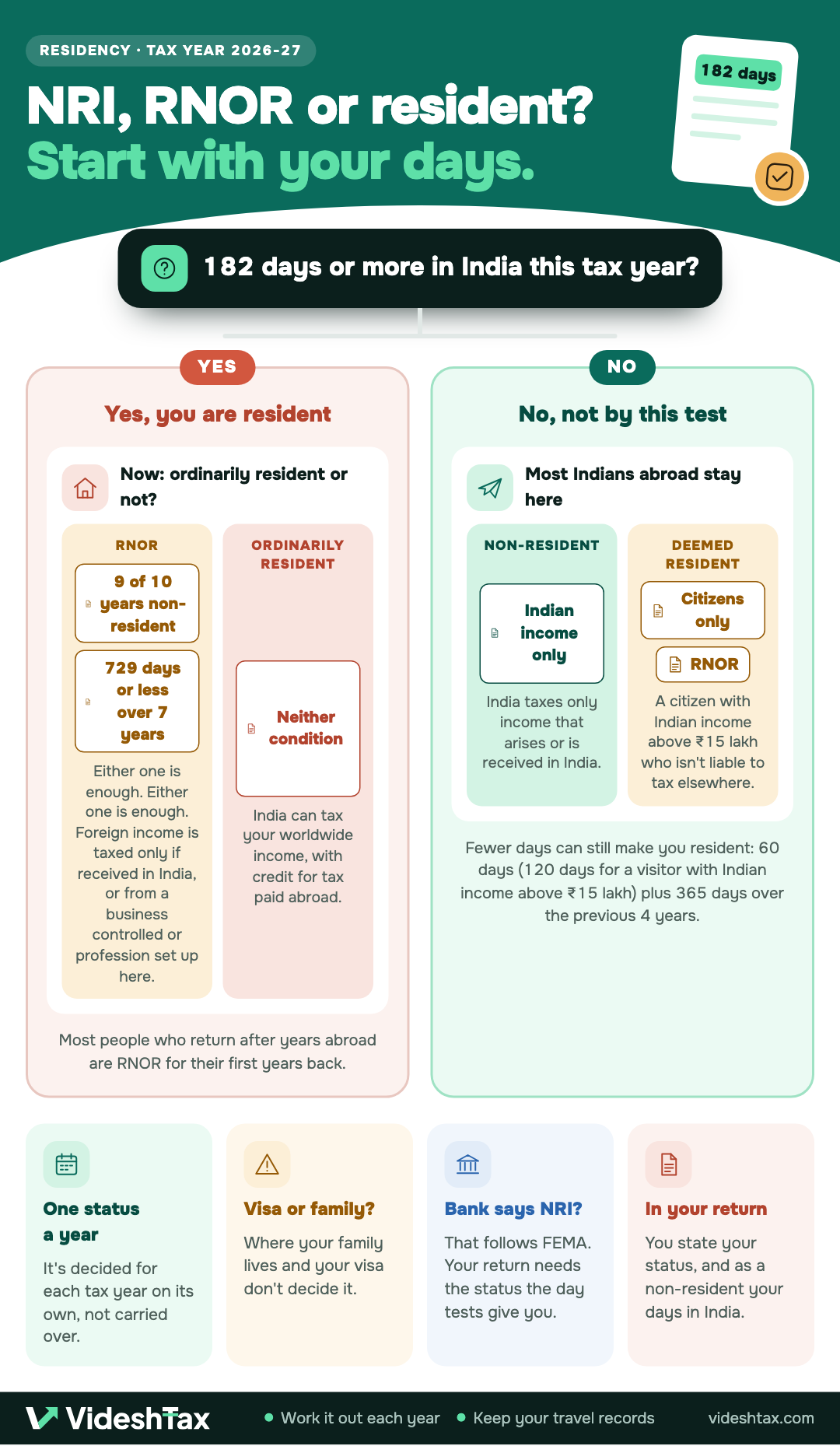
What your status decides
India has three residency statuses for an individual, and each one sets how much of your income India can tax 2025 Act s. 5was s. 5.
As a non-resident, India taxes only income that arises in India or that you receive in India: rent from a flat in Pune, interest on an NRO deposit, a gain on Indian shares or property, a salary for work done here. Your salary abroad, your foreign bank interest and gains on foreign shares are outside Indian tax, even if you later bring the money home. You file an Indian return only if your Indian income calls for one. That’s the position most of this site’s guides assume.
As a resident and ordinarily resident, India can tax your worldwide income. Your salary abroad, foreign rent, foreign dividends and gains are all in the return. You claim credit for tax you paid abroad, usually under the tax treaty, and you report your foreign bank accounts, shares, property and retirement accounts in the foreign-assets schedule, even if they earned nothing.
Resident but not ordinarily resident, or RNOR, sits in between. You’re resident for the year, but India taxes your foreign income only if you receive it in India, or it comes from a business controlled in India or a profession set up here. For most people that means India taxes the same income it taxed while you were an NRI. The status exists for people who have been away for years and for a few special cases described below.
Your status is decided for each tax year on its own. Being an NRI last year doesn’t make you one this year, and one busy year of visits doesn’t lock you in. Your visa and where your family lives don’t decide it, and citizenship matters only for the exceptions below. The days you spend in India do most of the work.
The day tests
There are two tests, and meeting either makes you resident 2025 Act s. 6(2)-(5)was s. 6(1).
The first is the one most people know. Spend 182 days or more in India in the tax year and you’re resident. It doesn’t matter why you were here, whether you worked, or whether you’re a citizen. A long family visit, an illness, a project that overran: the count is the count.
The second test catches people who come often. You’re also resident if you spend 60 days or more in India this year and 365 days or more over the previous 4 tax years. That’s the test that can surprise a foreign national on a long assignment.
For most readers of this site, though, the second test doesn’t apply. It’s switched off for two groups:
- an Indian citizen who leaves India this year for a job abroad, or as a member of the crew of an Indian ship; and
- an Indian citizen or person of Indian origin who lives abroad and comes to India on a visit, unless their Indian income for the year is above ₹15 lakh.
For both groups, only the first test counts: under 182 days and you’re not resident by days.
The visiting exception is for people who live abroad and come to India on a visit. We treat coming back to live in India as not a visit, so the second test applies to you in full that year, whatever your income. The Act doesn’t spell out how the year you move is treated, especially if you visited earlier in it, and there’s no CBDT guidance, so ask a CA if your days fall between the two tests. On that reading, someone who moves home in October, having spent plenty of time here in earlier years, can be resident with well under 182 days. They’ll usually be RNOR, as described below.
A “person of Indian origin” means you, a parent or a grandparent was born in undivided India, which covers most OCI cardholders.
Counting the days is where people slip. Count the day you land and the day you fly out as days in India. That’s the reading of an advance ruling and the safe one, but it isn’t settled: the Act doesn’t define a day, and at least one Tribunal has left out the arrival day. Either way, two trips can use up more days than the calendar suggests. Indian citizens working as crew on foreign-bound ships count days under their own rule, based on the dates in their Continuous Discharge Certificate. Read our guide to counting your days for the edge cases and the records to keep.
Visiting with higher Indian income
The exception for visitors has its own exception. If you’re a citizen or a person of Indian origin visiting from abroad and your Indian income for the year is above ₹15 lakh, the second test does apply to you, but with 120 days in place of 60 days. You’d still need 365 days or more over the previous 4 tax years.
“Indian income” here means your total income for the year without income from foreign sources: rent, NRO and FD interest, dividends from Indian companies, capital gains on Indian shares, mutual funds and property, and pay for work done in India. Your salary abroad doesn’t count towards it.
The income test is where a one-off event matters. Sell a flat in India and the gain alone can take you over the threshold for that year. If you also spent 120 days or more in India, sorting out the sale and seeing family, you could be resident that year when you’d expect to be an NRI.
The rule has a soft landing. Anyone who becomes resident only this way is treated as RNOR, not as ordinarily resident, so your foreign income stays outside Indian tax. What changes is mostly paperwork and a few Indian-income rules that differ for residents. See how the higher-income visitor rule works, with examples.
Deemed resident
The day tests aren’t the last word for Indian citizens. An Indian citizen is treated as resident, however few days they spend here, if two things are true in the tax year 2025 Act s. 6(7)-(8)was s. 6(1A):
- their total income, not counting income from foreign sources, is above ₹15 lakh; and
- they aren’t liable to tax in any other country or territory because of their domicile, residence or a similar test.
It applies only if you’re not already resident by days, and it doesn’t apply to people of Indian origin who aren’t citizens.
The rule is aimed at people who have arranged to be taxed nowhere, but it can catch ordinary readers too: someone working in a country without personal income tax, or someone between countries for a year, with a large Indian gain in that year. “Liable to tax” is a defined term: the other country’s income-tax law has to reach you, even if you end up paying nothing or are later exempted. A tax residency certificate shows where you live, not that you’re liable to tax there, so one from a country with no personal income tax doesn’t take you out of the rule.
Like the higher-income visitor rule, deemed residence comes with a soft landing: a deemed resident is always RNOR. Your salary abroad stays outside Indian tax as long as it’s paid to you abroad; the change is that you’re resident for the rest of the Act. Read the deemed-resident guide for who it catches and what “liable to tax” means.
RNOR: the in-between years
Once you’re resident, the next question is whether you’re “ordinarily” resident. You’re not ordinarily resident for the year if any one of these is true 2025 Act s. 6(13)was s. 6(6):
- you were a non-resident in 9 of the previous 10 tax years; or
- you spent 729 days or less in India over the previous 7 tax years; or
- you’re a citizen or person of Indian origin with Indian income above ₹15 lakh who spent at least 120 days but fewer than 182 days in India this year. That clearly covers a visitor caught by the higher-income rule; whether it also covers someone who moved back to live here isn’t settled, so ask a CA; or
- you’re a deemed resident.
The first two are what matter when you move back after years abroad. Because they look back over several years, most people who return after a long spell away are RNOR for their first two or three tax years back, depending on when in the year they arrive. That window is valuable: foreign salary, interest, rent and gains earned while you’re RNOR generally stay outside Indian tax, which gives you time to sell foreign investments, close accounts or draw down a foreign pension.
The window closes on its own once your past years stop qualifying, and you become resident and ordinarily resident. From then, your worldwide income is taxable in India and you report foreign assets every year. Plan the timing of large foreign gains around it. Read RNOR status after you return for what stays tax-free and for how long.
What changes with your status
Your status doesn’t only decide which income is taxed. It changes how tax is collected from you in India, and what you have to report.
Tax deducted at source. Banks, tenants and buyers deduct tax at non-resident rates when they pay an NRI, and the rates are higher than for residents. Interest on an NRO account, for example, has TDS of 30% before surcharge and cess, whatever your real tax rate. Tell your bank when your status changes, in either direction, so it deducts at the right rate from then on. If too much was deducted, the only way to get it back is a refund in your return. TDS on NRO interest explains the rates and the refund.
Selling property. When you sell a flat as a non-resident, the buyer usually deducts tax at the capital-gains rate on the whole price, unless you get a lower-deduction certificate first, rather than the small flat-rate deduction that applies when the seller is resident. The deduction follows your status for the year of the sale, so a sale in the year you come back can be treated very differently from one a year earlier. The full steps are in selling property as a non-resident.
What you report. A non-resident’s return covers Indian income only, and asks how many days you were in India. A resident and ordinarily resident taxpayer reports worldwide income, claims credit for foreign tax, and lists foreign assets: bank accounts, shares, retirement accounts and property abroad, even if they earned nothing. RNOR sits with the non-residents on foreign income, but you still declare your status and your Indian income in full.
Deductions and rebates. Some reliefs in the Act are only for residents, and some rules, such as the option to pay the older property rate with indexation, apply only to resident individuals. When a guide on this site says a rule is for residents, it means your status for that tax year.
Because so much depends on it, work out your status early in the year you move, and again before you file. It’s the first line of your return and the first question a CA will ask.
The year you leave India
The year you move abroad is decided by the same tests as any other year, but the days you spend in India before you leave count in full. If you leave for a job abroad before the midpoint of the tax year, you’ll often be under 182 days and a non-resident for the whole year. As a citizen leaving for employment, the second day test doesn’t apply to you.
Leave later in the year and you’re probably resident for the year of departure, and since you’ve lived in India, ordinarily resident. That means your first months of foreign salary can be taxable in India too, with credit for the foreign tax. It’s the most common surprise in this cluster, and it’s worth checking before you choose a start date.
Your bank accounts are a separate matter: under FEMA they should be switched to NRO from when you leave to take up a job abroad, not from the end of the tax year. Read your status in the year you leave for the timing, the salary split and what to tell your employer.
The year you come back
Coming home works the other way. Return early in the tax year and you’ll likely pass 182 days. Return later and you can still be resident. We treat coming back to live here as not a visit, so the second test applies: 60 days or more this year plus 365 days or more over the previous 4 years is enough. That’s our reading; the Act doesn’t spell out the year you move, so ask a CA if your days fall between the two tests. Only a late return with few earlier visits leaves you a non-resident for the year. Either way, you’ll usually be RNOR, as described above.
In your first return as a resident, the status you tick decides which schedules you complete, and whether your foreign income belongs in the return at all. Keep a clear record of your days abroad in the previous years, because the RNOR tests depend on them. Read your status in the year you come back for the timeline and what to do in the first months.
Working out your status is only the first step. Moving back to India covers the rest of the first-three-years plan: your NRE, NRO and FCNR accounts, foreign retirement accounts, and when you have to start reporting foreign assets.
Tax residency and FEMA residency
The word “NRI” means two different things in India. For income tax, it follows the tests on this page. For FEMA, the foreign-exchange law that decides which bank accounts and investments you can hold, you’re a person resident outside India once you’ve gone abroad for a job, business or with the intention of staying for an uncertain period.
So you can be a non-resident for FEMA and resident for tax in the same year, which is common in the year you leave. The reverse happens in the year you return. Your NRE, NRO and FCNR accounts follow FEMA; your return follows the Income-tax Act. Read FEMA residency versus tax residency for how the two interact.
Resident in two countries
Your country of residence has its own rules, and you can easily be resident in both countries in the year you move. When that happens, the tax treaty between India and that country usually decides where you’re resident for treaty purposes, using a tie-breaker: where you have a permanent home, then where your personal and economic ties are strongest, then where you usually live, then nationality. If you’ve moved to the US for work, our guide to the H-1B dual-residency year works through the overlap day by day.
The treaty doesn’t change your status under Indian law, but it can stop India taxing income the treaty gives to the other country. To claim it, keep the other country’s tax residency certificate as evidence. Once you’re non-resident under Indian law, the Act makes that certificate and Form 41 (was Form 10F) a condition of any treaty relief. See our guides on double taxation and treaty relief for your country.
Keep the evidence together each year: the certificate, your travel record, your lease or home ownership abroad, and where your family and job are. If the tie-breaker is ever questioned, those papers are what decide it, and they’re hard to rebuild years later.
Key numbers for tax year 2026-27
| Figure | Value | Source |
|---|---|---|
| Days in India in the tax year that make you resident | 182 days | Income-tax Act, 2025, s. 6(2)(a) |
| Days in the tax year for the second test (with 365 days in prior 4 years) | 60 days | Income-tax Act, 2025, s. 6(2)(b) |
| Days in India over the preceding four tax years for the second residency test | 365 days | Income-tax Act, 2025, s. 6(2)(b) |
| Number of preceding tax years counted for the 365-day part of the second residency test | 4 | Income-tax Act, 2025, s. 6(2)(b) ("in the four years preceding such tax year") |
| Replaces 60 days for visiting citizens/PIOs with Indian income above Rs 15 lakh | 120 days | Income-tax Act, 2025, s. 6(5) |
| Indian income (excl. foreign sources) above which 120-day test and deemed residency apply | ₹15,00,000 | Income-tax Act, 2025, s. 6(5), 6(7), 6(13)(b) |
| Preceding tax years as a non-resident (out of the lookback window) that make a resident RNOR | 9 | Income-tax Act, 2025, s. 6(13)(a)(i) ("a non-resident in India in nine out of the ten tax years preceding that year") |
| Preceding tax years looked at for the non-resident-years RNOR test | 10 | Income-tax Act, 2025, s. 6(13)(a)(i) ("nine out of the ten tax years preceding that year") |
| Days in India over the preceding seven tax years at or below which a resident is RNOR | 729 days | Income-tax Act, 2025, s. 6(13)(a)(ii) ("seven hundred and twenty-nine days or less in seven tax years preceding that year") |
| Preceding tax years counted for the days-in-India RNOR test | 7 | Income-tax Act, 2025, s. 6(13)(a)(ii) ("in seven tax years preceding that year") |
Figures for tax year 2026-27, checked 11 October 2026.
Forms and deadlines
Residency has no form of its own. It shows up in your return and in the papers you use to claim a treaty. These are the dates and documents that matter in a year your status is in question.
| What | Why it matters for residency | Who | When |
|---|---|---|---|
| Tax year 2026-27 | The period your days are counted over, starting on 1 April 2026 | You | Keep a running count all year |
| ITR-2 | Your return: you state your status, and as a non-resident your days in India | You | 31 July 2027 |
| Form 41 (was Form 10F) | Treaty details, with the other country’s tax residency certificate, to claim treaty relief | You | Before you file, and before tax is deducted where possible |
| Form 168 (was Form 26AS) | Shows the TDS deducted from you, and whether it was deducted at non-resident rates | You check it | Before you file |
Worked example: two common cases
The first case is the one most readers are in: an Indian citizen living abroad, visiting often.
Meera lives in London and is an Indian citizen. She spends 150 days in India this tax year looking after her parents, after only 280 days in India in all over the earlier years the second test looks at. Her Indian income is ₹9,00,000 of rent and interest, and she's taxed in the UK as a resident.
| Test | What the checker found | Met? |
|---|---|---|
| Days in India this year | You were in India for 150 days this tax year, short of the 182 days that would make you resident. | No |
| Visiting from abroad | The second test can't make you resident: you had 280 days in India over the previous 4 tax years, under the 365 days needed. (With Indian income of ₹15,00,000 or less, a visiting citizen or person of Indian origin is outside it anyway.) | No |
| Deemed resident | Your Indian income is ₹15,00,000 or less, so you can't be a deemed resident. You're a non-resident. | No |
India taxes only your Indian income: rent, interest, gains on Indian assets. Your salary and other income abroad aren't taxed here.
Meera spent far more time in India than usual, and she still isn’t resident. She’s under the first day test, and the second can’t catch her because she hasn’t spent enough days here in the previous years. Had she spent more, the visitor exception would still protect her, because her Indian income isn’t above the threshold.
The second case is someone coming home after a long time abroad.
Arjun moves back to Bengaluru after twelve years in Singapore and spends 250 days in India this tax year. He was a non-resident in every year he lived abroad, and his visits home added up to 150 days over the longer lookback the RNOR test uses.
| Test | What the checker found | Met? |
|---|---|---|
| Days in India this year | You were in India for 250 days this tax year, which meets the test of 182 days or more. You're resident. | Yes |
| Years as a non-resident | You were a non-resident in 10 of the previous 10 tax years, which meets the test of 9. You're not ordinarily resident. | Yes |
| Days over the longer lookback | You spent 150 days in India over the previous 7 tax years: 729 days or less. You're not ordinarily resident. | Yes |
| Resident only through higher income | You weren't resident through the higher-income test, so that route to RNOR doesn't apply. | No |
India taxes your Indian income and anything received in India. Most foreign income earned and received abroad stays outside Indian tax, unless it comes from a business controlled in, or a profession set up in, India.
Arjun is resident because of his days. What decides how much India taxes is whether he’s ordinarily resident, and his years abroad answer that. His Singapore bank interest and the gain on shares he still holds there are outside Indian tax while he’s RNOR, so it’s worth planning any sale around those years.
Common mistakes
- Using your bank’s status for your return. Your NRO account says NRI because of FEMA. Your return needs the status the day tests give you, which can differ in the year you move.
- Counting nights, not days. Count both the day you arrive and the day you leave, the safe reading of a point that isn’t settled, so two long trips can add up to more days than you think.
- Treating the year you move back as a visit. On our reading, once you’ve come back to live here the second day test applies in full, so you can be resident with far fewer days than you expect. The Act doesn’t spell this out, so check a close year with a CA.
- Forgetting the previous years. The second day test and the RNOR tests look back over several years. Rebuild those counts from your passport before you rely on a result.
- Assuming no tax abroad means no issue in India. A citizen with Indian income above ₹15 lakh who isn’t liable to tax anywhere is a deemed resident, and has to file on that basis.
- Moving back and declaring foreign income straight away. If you’re RNOR, most foreign income stays out. Over-declaring costs tax you don’t owe.
When to get professional help
Get a chartered accountant’s view in the year you leave India or come back, because your status for that year changes what goes in the return and the timing of your move can change the answer. Get one too if your days are within a couple of weeks of a threshold, if you work at sea, if you live in a country without personal income tax and your Indian income is near ₹15 lakh, or if you’ve had a notice asking about your status. If you’re resident in two countries, a CA who knows the treaty with your country can tell you which one it favours and what evidence to keep.
Residency is one of eight areas covered on VideshTax. Once you know your status, the guides to filing your return from abroad cover what to do with it.