

An Indian citizen too rarely in India to be resident under the ordinary day tests can still be deemed resident for 2026-27 if their Indian income, other than from foreign sources, is above ₹15,00,000 and they're not liable to tax elsewhere. It mainly catches citizens based in the UAE and similar no-tax countries. A deemed resident is automatically RNOR, so most foreign income stays outside Indian tax.
Is this you? This page is for an Indian citizen who spends little time in India but earns well from it — especially from the UAE or another no-tax country. Working out your status by days spent in India instead? Use the residency status checker.
This guide is part of our guide to residency status, and it covers the one route into Indian residence that has nothing to do with how many days you spent in India. Most of that pillar is about counting days; this page is about the citizens the day count never catches.
Foreign salary and gains paid to you abroad stay outside Indian tax. Paid into an Indian account, they're taxable.
It applies only if no day test already makes you resident.
You're liable to tax elsewhere, or under the threshold, or a person of Indian origin who isn't a citizen.
With few days in India you're simply non-resident.
It shows where you're resident, not that a tax law charges you.
A PIO or OCI holder can never be a deemed resident.
The other country's law can charge you tax, even if you pay nothing.
Get a CA's view, or if you need to show you aren't liable to tax anywhere.
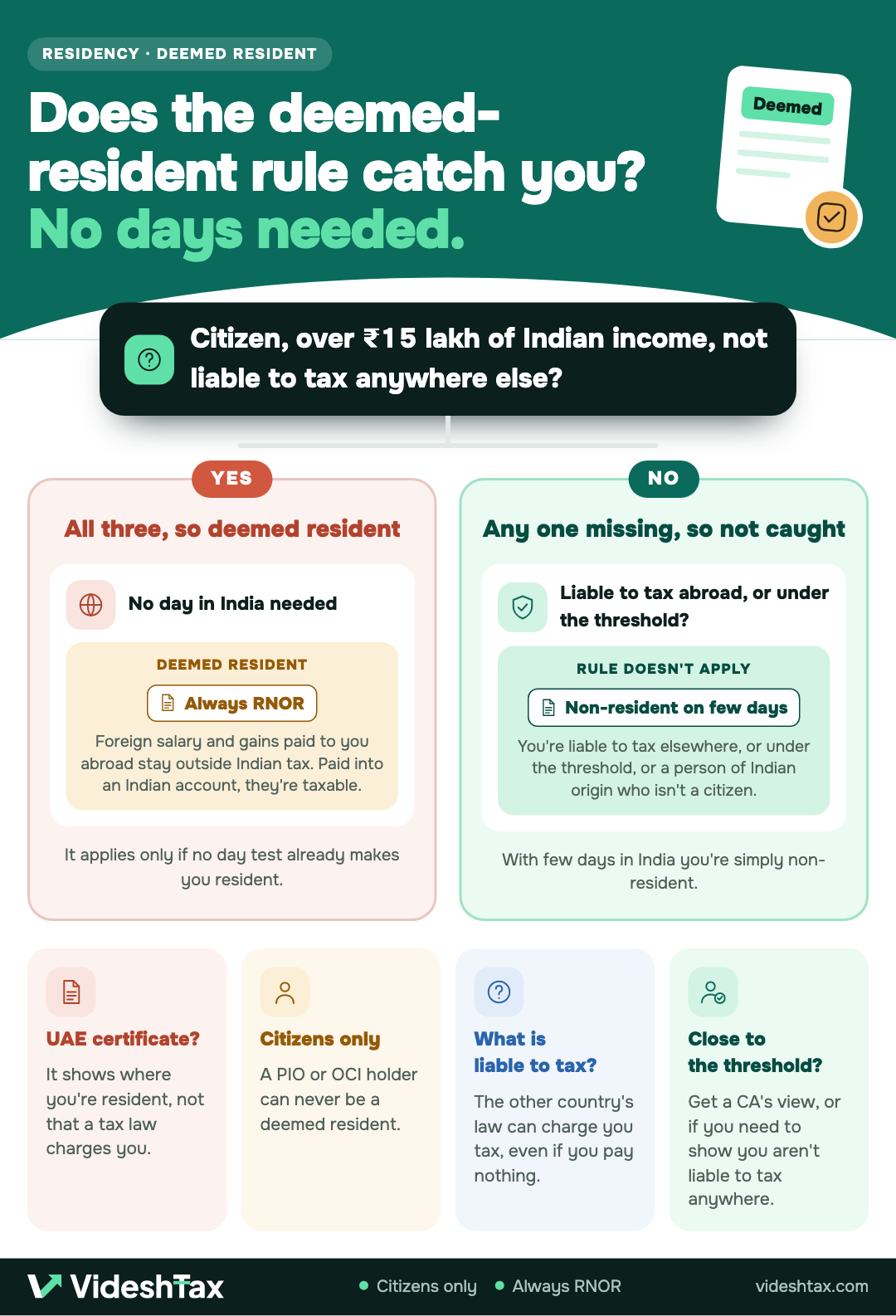
The rule in plain English
An Indian citizen can be deemed resident for a tax year — taxed as resident, without a single day in India — if: 2025 Act s. 6(7)-(8)was s. 6(1A)
- they’re a citizen of India, not just a person of Indian origin;
- their total income other than from foreign sources is above ₹15 lakh for the year; and
- they aren’t “liable to tax” in any other country or territory because of their domicile, residence or similar criteria there.
It also switches off for anyone already resident under the day tests that year — a backstop for people who’d otherwise be non-resident, not an extra route to “more resident.” Check your own day count with the residency status checker first.
What “liable to tax” means, and why a residence certificate isn’t the same thing
“Liable to tax” is its own defined term, not an everyday phrase 2025 Act s. 2(66)was s. 2(29A): it means the other country’s law can charge you income tax at all — and it still counts you if that country later exempts you. The test is whether the law reaches you, not whether you end up paying anything.
That’s the sharpest edge of the rule where there’s no personal income tax. The UAE doesn’t tax individuals on wages, personal investment income or real-estate investment income, so on a plain reading a UAE resident earning only those isn’t “liable to tax” there. The department’s own words lean the same way: its press release on this rule spoke of Indian workers in the Middle East “who are not liable to tax in these countries”. But no circular or ruling applies the definition to a no-tax country in so many words, so treat this as the likely reading, not a settled one. It’s less clear still if you run a business in the UAE big enough for UAE Corporate Tax to reach you as an individual: you then have a UAE tax liability, and whether that counts as being liable “due to domicile, residence, or similar criteria” hasn’t been tested.
A UAE tax residency certificate doesn’t close that gap. The UAE issues one mainly on days of presence, as few as 90 days with a job, business or permanent home there. So it shows where you’re resident, not that a UAE tax law charges you. It still helps for a tax residency certificate for treaty relief once you’re genuinely non-resident.
Who it catches
This mainly catches citizens based in the UAE or a similar no-tax country with substantial Indian income, plus frequent movers who never settle their tax residence anywhere — not ordinary NRIs who simply pay tax somewhere else. Get your day count right first: see how days in India are counted, since this rule only reaches someone already non-resident on the ordinary tests.
Three examples
Salim lives in Dubai. He spent 40 days in India this tax year, well under every day test. Back in India he earns ₹10,00,000 of interest on NRO fixed deposits and ₹8,00,000 of dividends from Indian shares, ₹18,00,000 in all, with no deductions against it. He's salaried in Dubai, and the UAE doesn't tax salaries, so on the plain reading nothing taxes him there.
| Test | What the checker found | Met? |
|---|---|---|
| Days in India this year | You were in India for 40 days this tax year, short of the 182 days that would make you resident. | No |
| Higher Indian income | Your Indian income is above ₹15,00,000, so the second test uses the higher day count instead of 60 days, but you had 160 days in India over the previous 4 tax years, under the 365 days needed. It isn't met. | No |
| Deemed resident | You're an Indian citizen with Indian income above ₹15,00,000, and not liable to tax in any other country. You're deemed resident. | Yes |
| Deemed resident is RNOR | A deemed resident is treated as not ordinarily resident, so most of your foreign income stays outside Indian tax. | Yes |
You're treated as resident because you're not liable to tax in any other country, but as RNOR. India taxes your Indian income; most foreign income stays outside Indian tax.
Salim fails every ordinary day test, but his Indian income clears the threshold and nothing taxes him abroad. He becomes deemed resident, and lands in RNOR status straight away.
Neha is “liable to tax” in the UK by residence, so the rule never opens for her 2025 Act s. 2(66)was s. 2(29A). With only 40 days in India, she’s simply non-resident — exactly as without this rule.
Cut Salim’s Indian income to ₹12,00,000, below the threshold, and the deemed-resident rule can’t apply to him, whatever the UAE’s tax rules. With his 40 days in India he’s simply non-resident.
Deemed resident means RNOR: what India taxes
Every deemed resident is automatically not ordinarily resident 2025 Act s. 6(13)was s. 6(6) — never fully resident.
That decides what India can tax. An RNOR is taxed on income received in India and income arising in India, like any resident. Income arising outside India counts only when it comes from a business controlled in, or a profession set up in, India 2025 Act s. 5was s. 5. Foreign salary, dividends and investment gains that are earned and paid to you abroad stay outside Indian tax; paid straight into an Indian account, they’re income received in India and taxable. CBDT said much the same in a press release of 2 February 2020, while the rule was still a Finance Bill proposal. The rule wasn’t meant to catch Indian citizens who are “bonafide workers in other countries”, and a citizen who became deemed resident wouldn’t be taxed in India on income earned outside India “unless it is derived from an Indian business or profession.” The Act now gets that result through RNOR status, and its wording, not the press release’s, is the test. Salim’s interest and dividends are taxed as they would be for any other resident.
How it fits with the other residency rules
Deemed residency is the only route into Indian residence with no day test.
| Route | Test | Automatically RNOR? |
|---|---|---|
| Ordinary residence | 182 days 2025 Act s. 6(2)-(5)was s. 6(1) | No, only if your past years qualify |
| Ordinary residence (second test) | 60 days plus 365 days over the prior four years (not for citizens or PIOs visiting India) | No, only if your past years qualify |
| Visiting citizen or PIO, high income | 120 days plus 365 days over the prior four years, once income clears ₹15 lakh | Yes, while under 182 days |
| Deemed resident | No days: citizen, income above the threshold, not liable to tax abroad | Yes |
The 120-day rule for high-income visitors shares the threshold and RNOR outcome through a different gate: days in India. Salim fails it and is still caught here.
Common mistakes
- Treating a UAE tax residency certificate as proof of “not liable to tax” there. It proves residence, not liability.
- Assuming any Gulf-based citizen with high Indian income is automatically caught. The threshold is necessary but not enough — someone already resident under the day tests is never pushed into this rule on top.
- Applying the rule to a PIO or OCI holder. It names citizens only.
- Assuming a territorial tax system abroad makes you “not liable to tax” there. If the country where you live taxes its residents, even only on local income, you’re generally liable to tax there by residence. It’s less clear where a country taxes income only by source, whoever earns it: the Act asks for liability “due to domicile, residence, or similar criteria”, so get a CA’s view.
When to get a CA
Get one if your Indian income sits close to the threshold, if you split your time across more than one low-tax country in a year, if you’re unsure whether where you live counts as taxing you “due to domicile, residence, or similar criteria,” or if you need to show the department evidence for a negative — that you aren’t liable to tax anywhere — since no certificate proves that directly.
Next steps
Questions people ask
Does a UAE tax residency certificate protect me from being a deemed resident?
Probably not, on its own. The certificate shows the UAE treats you as resident there. The deemed-resident test asks something else: whether you're "liable to tax" there, which the Act defines as an income-tax liability under that country's law. The UAE doesn't tax individuals' wages or personal investment income, so the plain reading is that a UAE resident earning only those isn't liable to tax there, certificate or not. No circular or ruling settles this, so if you plan to rely on the certificate, get a CA's view.
Does deemed residency apply to a Person of Indian Origin (PIO) or an OCI holder?
No. The rule names only citizens of India. A PIO or OCI holder can never become a deemed resident under this route, whatever their income or where they live — though they can still become resident and RNOR through the separate 120-day rule for high-income visitors.
If I'm a deemed resident, does India tax my foreign salary or investments?
Rarely. A deemed resident is always RNOR. India taxes an RNOR on income received in India and income arising in India, but on income arising outside India only when it comes from a business controlled in, or a profession set up in, India. Foreign salary, dividends or investment gains paid to you abroad stay outside Indian tax. If they're paid straight into an Indian account, they count as income received in India and are taxable here.
I already meet one of the ordinary day tests this year. Does the deemed-resident rule stack on top?
No. The rule only ever applies to someone who would otherwise be non-resident that year. If you're already resident under the day tests, you're taxed under those rules, and whether you're RNOR depends on your history under those rules, not on this one.
Sources
- Income-tax Act, 2025: s. 2(66) ("liable to tax", was s. 2(29A)), s. 5(1)(c) (scope of total income, RNOR foreign-income carve-out), s. 6(7)-(8) (deemed resident, was s. 6(1A)) and s. 6(13)(c) (not ordinarily resident, was s. 6(6))egazette.gov.in
- Finance Act, 2021 (No. 13 of 2021): s. 2(iv), inserting the "liable to tax" definition as old s. 2(29A)egazette.gov.in
- CBDT press release: "CBDT issues clarification on the new provision pertaining to residence in India", 2 February 2020incometaxindia.gov.in
- UAE Federal Tax Authority: "Issuance of Tax Certificates for Tax Residency"tax.gov.ae
Update log
- First published.