

The plan in brief
Everything here applies to tax year 2026-27. Each section is a summary; the linked guide has the steps, the exact wording and the documents.
Coming home doesn't flip a switch. Most returning NRIs are RNOR first.
NRI: India taxes only income that arises or is received here
RNOR: most foreign income received abroad stays outside Indian tax
Ordinarily resident: worldwide income taxed, with credit for foreign tax
Pick your move date with the day tests in mind
List every foreign account, plan, policy and shareholding
Check a big sale or vesting against your likely RNOR window
Tell every Indian bank. Re-designate NRE and NRO accounts; let FCNR deposits run to maturity or move them to RFC
Update PAN and KYC from non-resident to resident
Tell tenants TDS on rent should be at resident rates
Your window comes from your last 10 years, not your intentions.
NRE interest turns taxable the day you're resident under FEMA. FCNR stays tax-free while you're RNOR.
Once ordinarily resident, everything foreign is reportable, even an account that earned nothing.
Work out your own window with the checker and planner
Decide on the election for any foreign retirement account
Plan large foreign sales against the window
Start your Schedule FA list before it's compulsory
Reconfirm your status each year. The window sends no reminder
Bring foreign income and assets into your return, and claim foreign tax credit
Either one is enough. A rule of thumb isn't a guarantee, so check your own years.
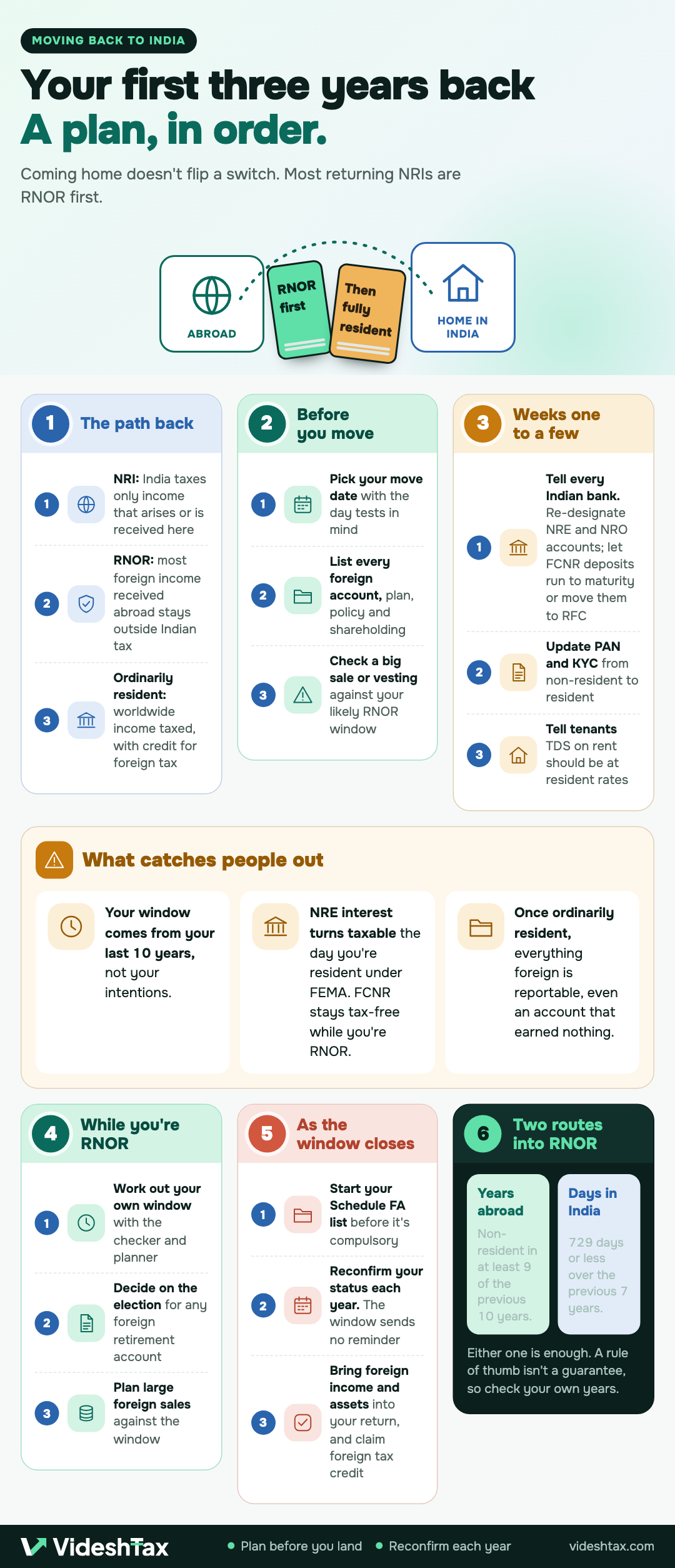
The path back: NRI, then RNOR, then ordinarily resident
Coming home doesn’t flip a switch. The same day tests that decided you were an NRI now decide whether you’re resident, and if you are, whether you’re resident but not ordinarily resident (RNOR) or fully resident and ordinarily resident (often shortened to ROR). Each status taxes you differently.
As an NRI, only income that arises or is received in India is taxed here. As RNOR, you’re resident, but India still leaves most of your foreign income alone: salary, interest, rent, dividends and gains that arise outside India, and are received outside India, stay outside Indian tax, with one carve-out — income from a business controlled from India or a profession set up here is taxed even while you’re RNOR 2025 Act s. 5was s. 5. Once you’re ordinarily resident, your worldwide income is taxed in India, wherever it’s earned, with credit for tax you’ve already paid abroad.
Most people who’ve lived abroad for several years land as RNOR for their first two or three years back before becoming ordinarily resident. “Two or three years” is a rule of thumb, not a guarantee: it comes from how the RNOR tests happen to work out for someone who left for good and rarely visited, and it can be shorter, or not apply at all, for someone who travelled home often while abroad. That window is the point of this pillar: it’s the time you have to sell, transfer or draw down foreign money before India taxes it in full.
The status also changes practical things well before you file a return. Banks and tenants deduct tax at non-resident rates for an NRI and at resident rates once you’re resident, RNOR or not, so a sale or a rent payment that lands right around your move date can be deducted at the wrong rate if nobody’s told the payer your status has changed. Our guide to residency status covers the day tests themselves.
RNOR status after you return covers exactly how the window is worked out, what stays tax-free while it lasts, and how long it typically runs.
Timing your return date
Because your status runs for the whole tax year, when in the year you move can decide whether you’re resident at all this year, and if so, from when. Move back early in the tax year and you’re very likely to pass 182 days in India and be resident for the whole year. Move back later and you can still be resident. We treat coming home to live as not a visit, so the 60 days test (with 365 days over the previous 4 years) applies to you, as well as the 182 days test 2025 Act s. 6(2)-(5)was s. 6(1). That’s our reading of the visitor rule, which the Act doesn’t spell out for the year you move; if your days that year fall between the two tests, ask a CA.
The date also matters for FEMA, separately from tax. Your accounts and your RNOR clock don’t necessarily start on the same day: FEMA treats you as resident from the day you come back to live in India, while your RNOR years are counted from the tax year as a whole. If you can choose your move date, a later one usually helps. Fewer days in India in the year you move keep your two-year total under 729 days for longer, which can add an RNOR year. Arrive late enough to stay under 182 days, without meeting the 60 days test, and that year can count as non-resident. The RNOR window planner shows the dates for your own figures.
The year you move is also the first year counted against you in later RNOR tests: its days go into the seven-year total. That’s why a move in, say, October rather than April can leave you RNOR a year longer. Weigh it against your job, school terms and visas, not tax alone.
Your NRE, NRO and FCNR accounts after you return
Your bank accounts follow FEMA, not your tax status, and FEMA moves first. As soon as you’re resident under FEMA — normally the day you come back to live in India — your NRE account should be re-designated as a resident account, and your NRO account simply becomes an ordinary resident account. If you’d rather keep money in foreign currency, you can move it into a Resident Foreign Currency (RFC) account instead of an ordinary rupee account. Anyone who was a non-resident and is now resident can open one, and move NRE and FCNR balances into it.
FCNR deposits are treated more gently: your bank can let an existing FCNR deposit run to maturity at its booked rate, and only then does it convert to a resident rupee deposit or an RFC account, at your choice. That matters for tax as well as banking, because FCNR interest stays exempt for as long as you’re RNOR, while NRE interest becomes taxable the moment you’re resident under FEMA, RNOR or not.
Your NRO account needs the least attention: it simply becomes an ordinary resident account, and the bank stops deducting tax at non-resident rates on interest paid after that point. If you share any account with a resident relative on a “former or survivor” basis, tell the bank which of you the money really belongs to once you’re both resident, since the reason for that arrangement often falls away. Do the accounts first, before anything else on this pillar: your PAN status, your broker and mutual-fund folios, and any lower-deduction certificate you’re holding all follow from what your bank has on record for you.
NRE, NRO and FCNR accounts covers how each one is taxed.
Foreign retirement accounts, shares and ESOPs
A US 401(k), an IRA, a UK workplace pension or a similar foreign retirement account doesn’t need to be closed or moved when you come home. What changes is how India taxes the money inside it, once you’re no longer NRI or RNOR on that income. Left as it is, growth inside the account would ordinarily be taxed in India as it accrues each year, out of step with the US or UK, which taxes it only on withdrawal. The Act has a specific relief for this: you can elect to have the account taxed India’s way only when you actually withdraw or redeem it, matching the country where the account sits, instead of year by year, provided you opened it while you were non-resident in India and resident in that country 2025 Act s. 158was s. 89A. You make the choice on Form 40 (was Form 10-EE) by your return’s due date, for all such accounts together, and it can’t be withdrawn later. If you become non-resident again, the choice is undone, and the growth it deferred is taxed in your last resident year.
Foreign shares and employer stock (including ESOPs from a foreign employer) work differently again. While you’re NRI or RNOR, a sale of shares you hold abroad is generally outside Indian tax, as long as the proceeds are received abroad; once you’re ordinarily resident, the gain is taxed in India too, worked out from what you originally paid, converted into rupees; the exact exchange-rate dates are a point to settle with your CA. There’s no reset of that cost just because your residency status changed, so keeping the purchase confirmations and vesting statements from your years abroad matters more than it felt like at the time. If you’re still holding unvested employer stock from a foreign job, get a CA’s view on when a later vesting or sale falls, relative to your RNOR window. An option exercise or RSU allotment after you’ve become ordinarily resident can bring the benefit into Indian tax even if the grant was years earlier. How much of it, when part was earned for work abroad, is a grey area: get a CA’s view before it lands.
The same logic reaches a foreign pension you haven’t started drawing yet, and a UK workplace pension or SIPP works much like a 401(k) for this purpose: while you’re RNOR its growth stays outside Indian tax, and the same election 2025 Act s. 158was s. 89A can apply to it if it meets the same conditions: an account in a notified country, taxed there on withdrawal, and opened while you lived there.
Reporting foreign assets: Schedule FA
NRIs and RNORs don’t complete Schedule FA, the foreign-assets part of the Indian return. Once you’re resident and ordinarily resident for a tax year, you do, for that year and every year after while you stay ordinarily resident. It asks for every foreign bank account, retirement account, shareholding, insurance policy and property you hold or have a beneficial interest in, even one that earned nothing and even one you opened years before you ever came to India. Holding any foreign asset also means you must file a return as an ordinarily resident person, even if your income is below the exemption limit. Schedule FA covers assets you held at any time in the calendar year (January to December) ending during the tax year, not India’s April–March year, which catches people out at the edges. Missing an asset off Schedule FA carries its own penalty under the Black Money Act, separate from any tax on the income itself.
“Every foreign asset” is wider than most people expect on their first pass: current and savings bank accounts, brokerage and custodial accounts, retirement accounts like a 401(k) or IRA, life insurance or annuity contracts with a cash value, a beneficial interest in a foreign trust, foreign property, and any other capital asset held abroad all have their own rows. A dormant account from a first job abroad, or a joint account you keep mostly for a parent-in-law’s convenience, still goes on the list if you have a beneficial interest in it. Gathering statements from every account you’ve ever opened abroad is the single most time-consuming part of a first ordinarily-resident return, so starting the list while you’re still RNOR, well before it’s compulsory, saves a scramble later.
Selling foreign assets: before or after you become ordinarily resident
Timing matters most where a single sale carries a large gain: a foreign house, a concentrated shareholding, employer stock that’s finally vested. Sold while you’re NRI or RNOR, the gain generally stays outside Indian tax, as long as the proceeds are received abroad. Sold after you’ve become ordinarily resident, the same gain is taxed in India in full, though usually with credit for tax you pay where the asset is, under the relevant treaty.
That makes your RNOR window valuable planning time, not just a compliance grace period. If you know a large disposal is coming, working out roughly when your window closes, ideally with the RNOR window planner, lets you decide whether to sell inside it or plan around a later date instead. There’s no universal right answer: a rushed sale to beat the window can cost more in a falling market than the tax saved, and a sale timed purely for an Indian tax reason can still trigger tax where the asset actually sits — a US brokerage account doesn’t stop being a US tax event just because the gain is clean in India that year.
Don’t forget the other side of the same coin: your country of residence may still tax the same sale, whether or not you’ve become ordinarily resident in India, and its own rules on residence, not India’s, decide that. Work out both sides before a large sale, not just the Indian one.
The other country’s side: a pointer
Everything above is what India does. Your old country of residence has its own rules for someone who’s left, and they don’t disappear just because you’ve moved. If you’re a US citizen or green-card holder giving up that status as part of moving back for good, the US has a separate “exit tax” regime, worked out from your net worth and past US tax and reported on its own IRS form, quite apart from anything in this pillar; simply moving back while keeping your citizenship or green card doesn’t trigger it on its own. A Canadian resident who becomes non-resident of Canada is treated as having sold most of their property at market value the day residency ends, with its own reporting form and payment deadline. A UK resident who returns to the UK within five years of leaving can have gains from the years abroad taxed in the year they come back, under the UK’s temporary non-residence rule — not relevant to most readers who’ve been away a decade, but worth checking if your stint abroad was short.
None of that is India’s business, but it’s usually cheaper to sort out before you file your first Indian return than after, since Indian and foreign advisers rarely coordinate unless you ask them to. Get advice in that country before you act, and treat this pillar as what happens on the India side only.
Your first Indian return back
Everything above decides your status. The return itself is where you state it. On the current return forms you choose resident, resident but not ordinarily resident, or non-resident for the tax year, then tick the condition that puts you there. For most people coming home, the RNOR condition is one of the two this pillar has used throughout: a non-resident in at least 9 of the previous 10 years, or 729 days or less in India over the previous 7 years. The form also lists the two routes for higher-income visitors and deemed residents. Getting it right matters beyond the tick box, since your status decides which schedules the return asks you for. Which ITR form to use walks through picking the form once you know your income types; most returning NRIs without business income use ITR-2, and business or professional income usually means ITR-3 instead.
What you report follows the same split as the rest of this pillar. As an NRI, you report income that arises or is received in India. As RNOR, you report the same, plus foreign income from a business controlled in India or a profession set up here 2025 Act s. 5was s. 5. Once you’re ordinarily resident, everything foreign is in scope too: Schedule FA lists the foreign accounts, retirement accounts, shareholdings and property you hold, Schedule FSI lists the foreign income itself, and you claim credit for tax you’ve already paid abroad on Form 44 (was Form 67), rather than paying in full in both countries.
Tax already deducted at non-resident rates earlier in the year, on rent or bank interest before anyone had updated your status, isn’t lost. It’s credited against what you owe when you file, so check it actually landed correctly on your Form 168 (was Form 26AS) before you file, rather than after the portal flags a mismatch. A bank or tenant that was slow to re-designate your account can keep deducting at the old rate for longer than you’d expect, and a deduction booked under the wrong section is the kind of thing that’s far easier to sort out with the deductor before you file than to argue with a processing notice afterwards. File by 31 July 2027 if you have no business or professional income. With business or professional income whose accounts don’t need an audit, the date is 31 August 2027. Either way, the date is the same whether you were NRI, RNOR or ordinarily resident that year.
Your first three years: a checklist
Roughly in order, once you know you’re moving back for good.
Before you move
- Decide your move date with the day tests in mind, and note it down — it’s the anchor date for everything else.
- List every foreign account, retirement plan, insurance policy and shareholding you hold. You’ll need this list again for Schedule FA even if it’s not due yet.
- If a large sale or vesting is coming, work out roughly where it falls against your likely RNOR window before you move, not after.
Weeks one to a few
- Tell every Indian bank you’re back. Re-designate NRE and NRO accounts; decide FCNR-to-RFC or run to maturity for existing deposits.
- Update your PAN and KYC details from non-resident to resident.
- Tell your Indian tenants, if any, that TDS on rent should now be at resident rates, not the non-resident rate.
Your first two or three years, while you’re RNOR
- Work out your actual RNOR window with the residency checker and the RNOR window planner — don’t rely on the “two or three years” rule of thumb for your own figures.
- Decide on the election for any foreign retirement account, and file it with your first return that needs it.
- Plan any large foreign disposal against the window, weighing the tax saved against market timing and the other country’s own tax on the same sale.
As the window closes, and after
- Start building your first Schedule FA before it’s compulsory, using the list from step 2.
- Reconfirm your status each year — the window closes on its own, and doesn’t send a reminder.
- Once you’re ordinarily resident, bring your foreign income and assets fully into your Indian return, and start claiming credit for foreign tax where it applies.
Key numbers for tax year 2026-27
| Figure | Value | Source |
|---|---|---|
| Preceding tax years as a non-resident (out of the lookback window) that make a resident RNOR | 9 | Income-tax Act, 2025, s. 6(13)(a)(i) ("a non-resident in India in nine out of the ten tax years preceding that year") |
| Preceding tax years looked at for the non-resident-years RNOR test | 10 | Income-tax Act, 2025, s. 6(13)(a)(i) ("nine out of the ten tax years preceding that year") |
| Days in India over the preceding seven tax years at or below which a resident is RNOR | 729 days | Income-tax Act, 2025, s. 6(13)(a)(ii) ("seven hundred and twenty-nine days or less in seven tax years preceding that year") |
| Preceding tax years counted for the days-in-India RNOR test | 7 | Income-tax Act, 2025, s. 6(13)(a)(ii) ("in seven tax years preceding that year") |
| Indian income (excl. foreign sources) above which 120-day test and deemed residency apply | ₹15,00,000 | Income-tax Act, 2025, s. 6(5), 6(7), 6(13)(b) |
Figures for tax year 2026-27, checked 11 October 2026.
Forms and deadlines
| What | What it’s for | Who | When |
|---|---|---|---|
| Notice to each bank | Re-designate NRE/NRO accounts to resident, or move balances to an RFC account | You, in writing, to each bank | As soon as you’re back |
| Election for a foreign retirement account | Choose to be taxed on a 401(k)/IRA-type account only on withdrawal, not as it accrues | You, with your return | By the return’s due date |
| Schedule FA | Report foreign accounts, retirement accounts, shares and property, once you’re ordinarily resident | You, in your return | With your return (31 July 2027 for most) |
| PAN and bank KYC | Update your status from non-resident to resident | You | Early in the year you return |
Worked example: the most common case
Rohit moves back to Pune after eleven years in New Jersey, arriving early in the tax year. He was a non-resident for every one of those years. He keeps his 401(k) and a small US brokerage account, moves his NRE savings to an RFC account so they stay in dollars, and lets an FCNR deposit run to maturity.
| Test | What the checker found | Met? |
|---|---|---|
| Days in India this year | You were in India for 300 days this tax year, which meets the test of 182 days or more. You're resident. | Yes |
| Years as a non-resident | You were a non-resident in 10 of the previous 10 tax years, which meets the test of 9. You're not ordinarily resident. | Yes |
| Days over the longer lookback | You spent 90 days in India over the previous 7 tax years: 729 days or less. You're not ordinarily resident. | Yes |
| Resident only through higher income | You weren't resident through the higher-income test, so that route to RNOR doesn't apply. | No |
India taxes your Indian income and anything received in India. Most foreign income earned and received abroad stays outside Indian tax, unless it comes from a business controlled in, or a profession set up in, India.
Rohit is resident this year because he’s spent well over the day-count test in India, and he’s RNOR because he was a non-resident in enough of the previous years. While he’s RNOR, his 401(k)’s growth and any gain on his US brokerage account stay outside Indian tax, and his FCNR deposit’s interest stays exempt too. He doesn’t complete Schedule FA yet. Once his RNOR years run out, all of that starts counting, so he’s using the window to decide whether to trim the brokerage account and to file the retirement-account election before his first return is due.
Common mistakes
- Assuming RNOR is automatic just because you’ve come home. It depends on your last several years, not on the fact that you moved. Someone who visited India often while abroad can come back straight into full residency, with no window at all.
- Leaving NRE and FCNR accounts untouched. NRE interest becomes taxable from the day you’re resident under FEMA, whether or not you’ve told the bank.
- Selling a large foreign holding right at the edge of the window “just to be safe”. A rushed sale can cost more than the tax it avoids. Work out your actual window first.
- Skipping Schedule FA in your first ordinarily-resident year because an account earned nothing that year, or because it was opened long before you’d ever filed an Indian return.
- Treating a US exit tax question as an Indian tax question, or the other way round. They’re decided under completely different laws and need advice on each side separately.
When to get professional help
Get a chartered accountant’s view as you plan your return date, and again before any large foreign disposal near the edge of your RNOR window. Get one too if you hold a foreign retirement account and want the withdrawal election right the first time, if your years abroad are close to the RNOR thresholds, or if you’re not sure whether income is “from a business controlled in India”. If you’re also closing out US citizenship or a green card, get separate US advice on that before you file anything here.
Moving back is one of eight areas covered on VideshTax. Once you know your residency path, the guides to filing your return from abroad cover what actually goes in your first return home.