

Add up every day you're physically in India this tax year, across every trip, counting both the day you arrive and the day you leave — the cautious reading of a genuinely disputed point. Do the same for the lookback years the second and RNOR tests use; those windows decide close cases just as often. Keep passport stamps or an official travel-history record to back the total up.
Is this you? This guide turns your travel into a day count. It doesn't say which residency test applies to you or what your status then means — for that, run your total through the residency status checker. Already resident and wondering about RNOR? See RNOR status after returning.
This guide is part of our guide to residency status, which walks through every test that decides your status for a tax year. Here we cover just the one input every one of those tests needs: turning your travel into an actual day count, since a day or two either way can move you across the line.
Count the days you were in India between 1 April and 31 March, then check where you land.
Resident if you also spent 365 days in India over the previous 4 years. Doesn't apply to most NRIs who are only visiting.
Takes the place of 60 days for a visiting citizen or PIO with Indian income over ₹15 lakh, still with 365 days over the previous 4 years.
Resident, whoever you are. This is the line every NRI watches.
- You don't meet either day test
India taxes only your Indian income
- Non-resident in 9 of the previous 10 years, or
- 729 days or fewer in India over the previous 7 years
Common for the first years after moving back
- Resident, and no RNOR route applies (the 120 days route is always RNOR)
India taxes your worldwide income
An Indian citizen who isn't liable to tax in any other country, with Indian income above ₹15 lakh, is a deemed resident (treated as RNOR), even with zero days in India.
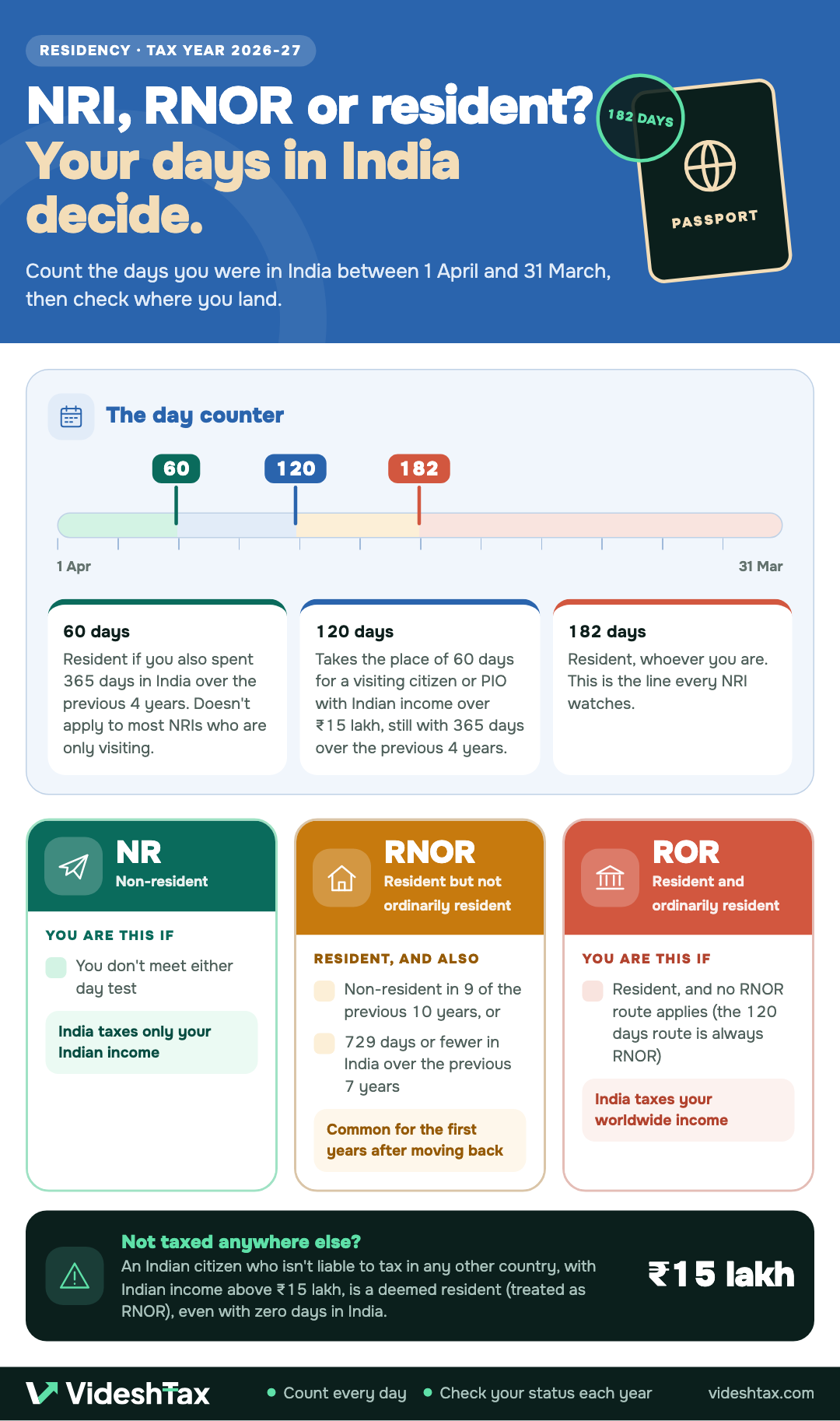
Why the day count decides almost everything
Nearly every route to Indian residency is, at bottom, a count of days. The plain 182 days test, the second test that combines 60 days this year with your travel over 4 years, the higher 120 days version for visitors with more Indian income, and both routes to RNOR built on the years you lived abroad — all of them turn on a number you build yourself from your own travel, not one the department hands you.
Get that number wrong and you can end up on the wrong side of whether India treats you as a non-resident (NRI), RNOR or a full resident, which decides whether India can tax only your Indian income or everything you earn worldwide.
This guide uses tax year 2026-27 throughout (what used to be called FY 2026-27, AY 2027-28 under the old Act) 2025 Act s. 3was s. 3. Every day test runs on days between 1 April and 31 March, so a trip that straddles the year-end gets split across two tax years, each with its own count.
Which days count
The Act’s own wording is “is in India for a total period of… days” and “in India cumulatively for… days” 2025 Act s. 6(2)-(5)was s. 6(1). It never says how a day itself is counted — whole calendar days, any part of a day, or something else — and that silence is exactly why the next point is a genuine grey area, not just something nobody’s researched yet.
Arrival and departure days
Whether the day you land and the day you leave both count as full days of stay is unsettled. A 2009 guide for overseas Indians published on the Ministry of External Affairs site, citing an Authority for Advance Rulings ruling (In re P. No. 7 of 1995, (1997) 225 ITR 462), says both the day of arrival and the day of departure count as days of stay in India, so a two-day trip counts as two days, not one. Against that, the Income Tax Appellate Tribunal in Bangalore (Manoj Kumar Reddy v. ITO, (2009) 34 SOT 180) left out the day of arrival, applying the General Clauses Act rule that the first day of a period isn’t counted. That reading turns the same two-day trip into a single day. An advance ruling binds only the person who asked for it, a Tribunal order doesn’t bind other benches, and no CBDT circular settles the point either way.
This guide counts both the arrival and departure day of every trip as a full day in India — the cautious reading, since it doesn’t risk under-counting if you’re close to a threshold. If your own count is within a day or two of a threshold either way, that’s exactly when this grey area can decide your status, and worth a CA’s opinion rather than picking whichever reading is convenient.
Passing through an airport without clearing immigration
No provision of the Act, rule or CBDT circular deals with airport transit. The day tests ask whether you were physically in India, and the Act’s definition of India covers its land and the airspace above it. It says nothing about immigration. An international transit area at an Indian airport is on Indian soil, so on a literal reading a transit stop is a day in India even if you never clear immigration. Some advisers treat a passenger who never clears immigration as not having entered India, but no ruling or circular backs that, so don’t rely on it if that day would take you over a threshold. Keep both boarding passes either way, since a passport that was never stamped won’t show the stop.
Territorial waters, and being on an Indian ship or aircraft
Territorial waters are settled. The Act defines “India” to include its territorial waters, the seabed and subsoil beneath them, the continental shelf, the exclusive economic zone and other maritime zones, and the airspace above its land and territorial waters. Being in India’s territorial waters counts as a day in India, the same as standing on land, and the advance ruling above says so too. Further out it’s less clear. The definition names the continental shelf and exclusive economic zone, but whether time aboard a vessel out there counts as a day in India for these tests hasn’t been settled, so get advice if it matters to you. What doesn’t count is simply being aboard a ship or aircraft registered in India once it’s outside India’s waters and airspace. The test is where you physically are, not what flag the vessel flies.
Adding up several trips in one tax year
Every day test counts your cumulative days in India across the whole tax year, not the length of any one trip. If you came back three times between April and March, you add the days from all three, including a short weekend trip you might be tempted to leave out. There’s no rule that only counts the “main” trip or ignores anything under a certain length — a single day on a stopover to see family counts exactly like a day in the middle of a six-week stay. Where this catches people out is a trip that straddles the tax year-end: a stay from, say, 25 March to 5 April splits into a handful of days in one tax year and the rest in the next, each counted separately toward that year’s own tests.
The lookback totals
The second test doesn’t stop at this year. It needs 60 days or more this tax year and 365 days or more in India cumulatively over the 4 tax years immediately before it 2025 Act s. 6(2)-(5)was s. 6(1). Both halves have to be true; falling short on either one means the second test isn’t met, whatever the other half looks like.
That test mostly doesn’t reach a citizen or person of Indian origin who’s simply visiting from abroad, rather than moving back: for them the 60 days test doesn’t apply at all, and only the 182 days test can make them resident, unless their Indian income is above ₹15 lakh, when 120 days replaces the 60 days. See the 120-day rule for higher-income visitors for how that substitution works and who it actually catches.
Once you’re resident, a separate pair of lookbacks decides whether you’re ordinarily resident or just not ordinarily resident (RNOR) 2025 Act s. 6(13)was s. 6(6): you qualify if you were a non-resident in 9 or more of the previous 10 tax years, or if you spent 729 days or fewer in India over the previous 7 tax years. Either one is enough on its own. These are genuinely separate windows from the second test’s four-year lookback above, and from each other — a common mistake is treating “the last few years” as one blurred figure instead of three distinct counts, each with its own length and its own threshold.
If your own numbers put you into RNOR, the RNOR window planner works out roughly how many years of it your travel history is likely to give you.
Once you know you’re RNOR rather than ordinarily resident, RNOR status after returning covers what that status actually shields and for how long.
One rule doesn’t use a day count at all: a citizen with Indian income above the same threshold who isn’t liable to tax in any other country by reason of domicile, residence or similar criteria can be a deemed resident whatever their days in India. It’s a separate gate from everything on this page, worth knowing about even though counting days won’t help you here.
Ship’s crew and the Continuous Discharge Certificate rule
Two different rules apply to crew, and it’s easy to mix them up. A citizen who’s a crew member of an Indian ship and leaves India in the tax year is simply taken out of the second test altogether — only the 182 days test can make them resident that year 2025 Act s. 6(2)-(5)was s. 6(1).
The other rule changes the day count itself, for a citizen crew member of any foreign-bound ship, not only an Indian one. Section 6(6) of the 2025 Act (was Explanation 2 to s.6(1) of the old Act) leaves the method to the Income-tax Rules. Rule 8 of the Income-tax Rules, 2026 (was rule 126 of the 1962 Rules) sets it: for an eligible voyage, the period from the joining date to the sign-off date entered in the seafarer’s Continuous Discharge Certificate doesn’t count as days in India. An eligible voyage is one by a ship carrying passengers or freight in international traffic that starts at an Indian port and ends at a foreign one, or starts at a foreign port and ends at an Indian one. A voyage between two Indian ports, or between two foreign ports, doesn’t qualify. The evidence is specific: the dates entered in the Continuous Discharge Certificate for that voyage, not a passport stamp or a general estimate of time at sea.
Records to keep, and rebuilding your count
Dates stamped in your passport are normally treated as proof of when you arrived and left, though that’s a matter of practice rather than something the Act itself sets out as the required evidence. Keep the passport itself, and don’t assume a lost or expired one is a dead end: airline boarding passes, e-visa or e-arrival confirmations, and an employer’s travel records can all help rebuild a trip that left no physical stamp.
For an official record of your own travel history, the Bureau of Immigration runs an e-FRRO service (indianfrro.gov.in) that lets you request your own entry-exit data directly. The request includes a document check at your local FRRO office, in person or through an authorised representative if you’re abroad, so start it well before you need the record. It’s the kind of record that settles a dispute over a specific day far more cleanly than a memory of when a trip happened. Whatever the source, reconcile your records twice: once for this tax year’s own count, and again for whichever lookback window above actually applies to your situation.
Worked example across three trips
Karthik lives in Doha, Qatar, and comes back to India three times in tax year 2026-27: once for his parents’ anniversary, once combining work with Diwali, and once at the end of the year to sort out some paperwork. Counting both the arrival and departure day of every trip — the cautious reading above — his three trips add up like this:
| Trip | Dates in India | Days counted |
|---|---|---|
| 1 — parents’ anniversary | 10 May – 2 Jun 2026 | 24 |
| 2 — work and Diwali | 20 Oct – 25 Nov 2026 | 37 |
| 3 — year-end paperwork | 15 Feb – 20 Mar 2027 | 34 |
| Total for the tax year | 95 | |
Karthik lives in Doha. His three trips this tax year add up to 95 days in India, and his Indian income of ₹4,00,000 is well under the threshold that would change which test applies to him.
| Test | What the checker found | Met? |
|---|---|---|
| Days in India this year | You were in India for 95 days this tax year, short of the 182 days that would make you resident. | No |
| Visiting from abroad | The second test can't make you resident: you had 180 days in India over the previous 4 tax years, under the 365 days needed. (With Indian income of ₹15,00,000 or less, a visiting citizen or person of Indian origin is outside it anyway.) | No |
| Deemed resident | Your Indian income is ₹15,00,000 or less, so you can't be a deemed resident. You're a non-resident. | No |
India taxes only your Indian income: rent, interest, gains on Indian assets. Your salary and other income abroad aren't taxed here.
Ninety-five days clears the 60 days figure on its own, but that’s beside the point for Karthik: because he’s a citizen simply visiting India rather than moving back, and his Indian income sits under ₹15 lakh, the second test doesn’t apply to him at all. Only the 182 days test could make him resident, and 95 days is well short of it. He stays an NRI this year, regardless of how many years he has behind him or how the arrival-day grey area is read.
The four-year lookback doesn’t matter to Karthik at his current numbers. Even if his Indian income crossed ₹15 lakh, the second test would then need 120 days this year instead of 60 days, and his 95 days fall short of that. The lookback decides the case for someone who has moved back to live in India during the year (the visitor exemption doesn’t cover them) with 60 days or more this year, or for a higher-income visitor with 120 days or more. To see how close that lookback can run, and how much the arrival-day grey area alone can move it, take someone like that who made one trip to India in each of the four tax years before the one in question:
| Tax year | Counting both days (this guide’s reading) | Excluding the arrival day (the Tribunal reading) |
|---|---|---|
| 2022-23 | 90 | 89 |
| 2023-24 | 91 | 90 |
| 2024-25 | 92 | 91 |
| 2025-26 | 92 | 91 |
| Total over four years | 365 | 361 |
Counting both ends of every trip, that traveller reaches exactly 365 days and meets the lookback. Leave out the arrival day of each year’s trip and the total falls to 361, under the line. With several trips a year the gap is wider, since the Tribunal reading drops a day for every trip. The trips themselves don’t change; only which grey-area reading you use does, and at a margin this tight it’s the difference between meeting the second test and missing it entirely.
Common mistakes
- Excluding one end of every trip and then wondering why the count comes up short. This guide’s reading, and the advance ruling a government-published guide cites, counts both the arrival and departure day.
- Mixing up the second test’s four-year lookback with the RNOR tests’ seven-year and ten-year lookbacks. All three are different windows with different thresholds, and none of them substitute for another.
- Treating being aboard an Indian-registered ship or aircraft as being “in India” wherever it happens to be. The test is physical presence within India’s territory, territorial waters or airspace, not the vessel’s flag.
- Forgetting a short trip because it feels too small to matter. Every day test counts cumulative days across the whole tax year, not the length of any one visit.
- Assuming the second test applies to a visiting citizen or person of Indian origin at all, without checking whether Indian income has crossed the threshold that changes which day figure applies.
When to get a CA
Get one if your count is within a few days of any threshold either way, since the arrival and departure grey area can decide it. Get one too if you’re a citizen crew member relying on the Continuous Discharge Certificate rule, if part of a trip fell in international transit and the days are contested, if your Indian income is close to the figure that changes which test applies to a visit, or if you’re missing passport evidence for a stretch of years and need to reconstruct it before you rely on the total.
Next steps
Questions people ask
Does the day I land in India count as a full day, or only the days after that?
This isn't settled. An Authority for Advance Rulings ruling, cited in a 2009 government- published guide for overseas Indians, counts both the day you arrive and the day you leave as full days in India. At least one Income Tax Appellate Tribunal bench has instead left out the arrival day, applying the General Clauses Act rule that the first day of a period isn't counted. Neither binds everyone, and no CBDT circular settles it. Count both ends as a day of stay. It's the safer reading if you're close to a threshold, since it won't make you under- count.
I only changed flights at a hub airport in India and never left the transit area. Does that count?
It isn't settled. No rule or circular deals with transit, and the Act's test is physical presence in India, which on a literal reading includes an airport's international transit area whether or not you clear immigration. Some advisers treat a transit without immigration clearance as not entering India, but nothing official backs that. If the day would take you over a threshold, count it. Keep your boarding passes for both legs, since a passport alone won't show a transit that left no stamp.
Does time in Indian territorial waters or airspace count, even if I never land?
Territorial waters, yes. The Act defines "India" to include its territorial waters and the airspace above its land and territorial waters, so being in those waters counts the same as being on land. The definition also names the continental shelf and exclusive economic zone, but whether time on a vessel that far out counts for the day tests isn't settled, and whether flying over India without landing counts has never been tested. What doesn't count is simply being aboard an Indian-flagged ship or aircraft once it's outside India's waters and airspace. The test is where you physically are, not the vessel's registration.
I made three short trips this year. Do I just add up the days from each one?
Yes. Every day test counts your cumulative days in India across the whole tax year (1 April to 31 March), not the length of any single trip. Add up every trip, including short ones you might be tempted to round down or forget, and the total is what goes into the day tests.
How far back do I need to count for the RNOR tests?
Three different windows apply to three different questions, and mixing them up is the most common mistake on this page. The second residency test looks at the four tax years right before this one. The two RNOR tests look further back and separately: how many of the previous ten tax years you were a non-resident, and how many days you spent in India over the previous seven tax years. The windows overlap in time (the previous four years sit inside the previous seven and ten), so the same trips feed more than one count, but each window has its own threshold and answers a different question.
What if I don't have physical stamps for some of my trips?
Passport stamps are what's normally treated as proof of your travel dates, but they're evidence, not the legal test itself — an e-visa or e-arrival record that left no physical stamp doesn't mean the days didn't happen. Rebuild the gaps from boarding passes, airline records or your employer's travel records, and request your own entry-exit history from the Bureau of Immigration's e-FRRO portal if you need an official record to fall back on.
Sources
- Income-tax Act, 2025: s. 2(52) (definition of "India"), s. 3(1) (tax year), s. 6(1)-(6) (day tests and the crew exception), s. 6(13) (not ordinarily resident), as gazettedegazette.gov.in
- Income-tax Rules, 2026 (G.S.R. 198(E), 20 March 2026): rule 8, computation of the period of stay for a citizen crew member of a foreign-bound ship (was rule 126 of the 1962 Rules)incometax.gov.in
- In re P. No. 7 of 1995, (1997) 225 ITR 462 (AAR), as cited in the Overseas Indian Facilitation Centre's Guide Book for Overseas Indians on Taxation (2009, on mea.gov.in), p. 13: day of arrival and departure both counted; territorial waters; passport stamps as evidencemea.gov.in
Update log
- First published.