

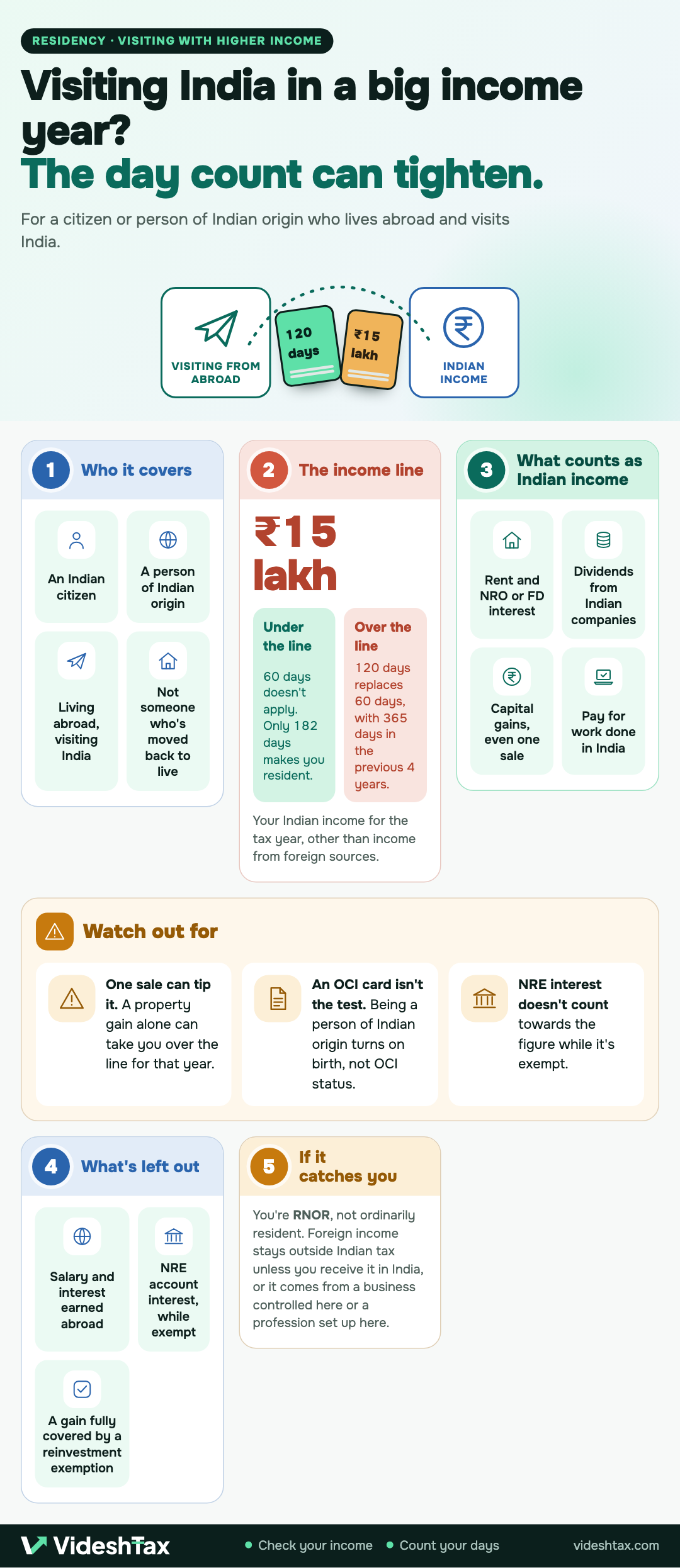
If you're a citizen or person of Indian origin visiting India, the ordinary test of 60 days doesn't apply to you at all — until your Indian income for the year passes ₹15 lakh. Cross that line and 120 days replaces 60 days, alongside 365 days in the previous 4 years. Get caught this way and you land as RNOR, not an ordinary resident.
Is this you? For a citizen or person of Indian origin abroad who visits India and wonders whether a good income year changes their day count. Moved back to live here rather than visiting? A different test applies — see how this fits with the other residency rules, below.
The rule in plain English
This guide is part of our guide to residency status for NRIs, and covers one exception in the day-count rules: a citizen or person of Indian origin (PIO — section 2(78) of the 2025 Act defines this as someone who, or whose parent or grandparent, was born in undivided India) visiting India in a high-income year.
The starting point is generous. Visiting India while living abroad, the ordinary test of 60 days doesn’t apply to you at all 2025 Act s. 6(2)-(5)was s. 6(1). Only 182 days can make you resident, so most visits, even long ones, leave you an NRI.
That relief has its own limit. Once your Indian income for tax year 2026-27 — other than income from foreign sources, defined below — exceeds ₹15 lakh, the day test returns, but with 120 days in place of 60 days, plus 365 days over the previous 4 years. Test your own numbers in the residency checker.
For a citizen or person of Indian origin who lives abroad and visits India.
Your Indian income for the tax year, other than income from foreign sources.
One sale can tip it. A property gain alone can take you over the line for that year.
An OCI card isn't the test. Being a person of Indian origin turns on birth, not OCI status.
NRE interest doesn't count towards the figure while it's exempt.
You're RNOR, not ordinarily resident. Foreign income stays outside Indian tax unless you receive it in India, or it comes from a business controlled here or a profession set up here.
What counts as Indian income (and what’s left out)
“Indian income” here is total income other than income from foreign sources — section 6(14) of the 2025 Act: income arising outside India, not deemed to arise here, except income from a business controlled in, or profession set up in, India. Foreign salary and interest are left out; almost everything arising in India goes in.
| Counts toward the figure | Left out |
|---|---|
| Rent, NRO or FD interest, dividends from Indian companies, pay for work done in India | Salary, dividends and interest earned abroad |
| Capital gains on Indian property, shares or funds — even a one-off sale | NRE account interest, while exempt |
| The above, after any deductions you’re allowed (few under the new regime, none against capital gains) | A gain fully covered by a reinvestment exemption |
Two catches: “total income” is net, after deductions (section 2(108)), not “gross total income” (section 122(10)) before them — though the default new regime allows few deductions, and none can be set against capital gains. And the NRE exclusion turns on your FEMA residency, not your tax residency: the exemption is for a “person resident outside India” under FEMA. A visit that makes you tax-resident under this rule doesn’t by itself change your FEMA status, so the interest normally stays exempt. It’s once you become resident under FEMA — typically when you come back to stay — that NRE accounts must be redesignated and the interest stops being exempt.
Three examples
His income doesn’t reach ₹15 lakh, so the test of 60 days never switches on for him — only reaching 182 days could, and five months falls well short. Karan stays an NRI.
Deepak lives in London. An Indian citizen and UK tax resident, he returns for four months to see his parents and manage his flat in Pune. Rent, NRO interest and dividends from Indian shares take his Indian income to ₹18 lakh this year.
| Test | What the checker found | Met? |
|---|---|---|
| Days in India this year | You were in India for 130 days this tax year, short of the 182 days that would make you resident. | No |
| Higher Indian income | Your Indian income is above ₹15,00,000, so 120 days replaces 60 days. You were in India 130 days and you had 400 days in India over the previous 4 tax years, which meets the condition of 365 days or more. You're resident. | Yes |
| Years as a non-resident | You were a non-resident in 6 of the previous 10 tax years, fewer than 9. | No |
| Days over the longer lookback | You spent 850 days in India over the previous 7 tax years, more than 729 days. | No |
| Resident only through higher income | You became resident only through the higher-income test, with under 182 days in India. That makes you not ordinarily resident. | Yes |
India taxes your Indian income and anything received in India. Most foreign income earned and received abroad stays outside Indian tax, unless it comes from a business controlled in, or a profession set up in, India.
Because his income is above ₹15 lakh, the checker swaps in 120 days for 60 days. His days and earlier years both clear the bar, so he’s resident — but only through this route, which is why the next section matters to him.
Together that’s ₹18 lakh for the year — over ₹15 lakh, though every other year sits well under it. Over the line, the test uses 120 days instead of 60 days, and her 140 days meet it. If her earlier years also clear 365 days, the sale alone made her resident that one year — a common way this rule catches people out.
Why you’re RNOR if this rule catches you
Becoming resident this way has a soft landing. Section 6(13)(b) of the 2025 Act treats anyone resident only through this 120-day rule as not ordinarily resident — RNOR 2025 Act s. 6(13)was s. 6(6) — not an ordinary resident. Foreign income mostly stays out of Indian tax: it’s taxed only if it’s first received in India, or comes from a business controlled in, or a profession set up in, India 2025 Act s. 5was s. 5. A few resident-only Indian-income rules do start applying to you.
That protection is written for the case this rule was built for: a visitor resident only through the 120-day route. Whether it also covers a citizen or PIO who’s moved back to live — not visiting — with income over the threshold and days at least 120 days but under 182 days, isn’t spelled out, and no CBDT clarification settles it. Read literally, section 6(13)(b) could cover that too, but it isn’t certain; don’t assume RNOR here without a CA’s sign-off.
How it fits with the other residency rules
Two other rules nearby in section 6 are easy to confuse with this one. A citizen leaving India that year for a job abroad, or as ship’s crew, gets a one-way exception 2025 Act s. 6(2)-(5)was s. 6(1): only the test of 182 days applies, and the 120-day rule never comes in, since they’re not “outside India, coming on a visit” — they’re leaving.
Deemed residency only applies once every day test here has ruled you out 2025 Act s. 6(7)-(8)was s. 6(1A). It catches only an Indian citizen, not a PIO, whose income is also above ₹15 lakh, and only if genuinely not liable to tax anywhere else by domicile or residence — not simply someone who pays less tax abroad. See the deemed-resident guide for who it actually catches.
Every test here runs on the same day count. Read counting your days in India for how travel and part-days are treated before you rely on your own tally.
If this rule has made you resident, the guide to RNOR status covers what actually changes in practice.
The glossary explains RNOR years in brief.
Common mistakes
- Treating the 120-day rule as universal. It only ever applies to a visiting citizen or PIO, once Indian income passes the threshold.
- Confusing an OCI card with being a “person of Indian origin”. The test is birth — yours, a parent’s or a grandparent’s, in undivided India — not OCI status.
- Assuming NRE interest and other exempt income count toward ₹15 lakh. It’s excluded from total income before this test even applies.
- Missing that a single capital gain, like a property sale, can tip a normally low-income visitor over the line for that year alone.
When to get a CA
Get one if your Indian income is close to ₹15 lakh and a single sale, bonus or dividend could tip it either way; if you’ve moved back to live in India rather than visiting, with income over the line and days at least 120 days but under 182 days, since the RNOR question above isn’t settled for that case; if your OCI status and your birth-test status as a PIO point in different directions; or if you’ve come back to stay and aren’t sure when your NRE accounts must be redesignated.
Next steps
Questions people ask
Does this rule apply to anyone with an OCI card?
Not automatically. The test for "person of Indian origin" is about birth — yours, a parent's or any grandparent's, in undivided India — not OCI cardholder status. Many OCI holders meet the birth test too, but OCI eligibility is broader (it also covers, for example, the foreign spouse of an Indian citizen), so an OCI card on its own doesn't decide this test either way — no circular covers the two pointing different ways, so check that case with a CA.
I moved back to India this year to live here, not to visit. Does the 120-day rule apply to me?
On our reading, no: the day-count change here is for a visit, and we treat coming back to live in India as not a visit, so the ordinary 60 days test applies regardless of your income. The Act doesn't spell out the year you move, so ask a CA if it's close. Where it gets less clear is the RNOR question: if that ordinary test makes you resident, your Indian income is above ₹15 lakh, and your days that year are at least 120 days but under 182 days, whether you're RNOR or an ordinary resident isn't settled — see the RNOR section above.
Does interest on my NRE account count toward the ₹15 lakh figure?
No, while it qualifies as exempt income, it's excluded from your total income before this test is even applied. The exemption itself depends on your FEMA residency status, which is tested separately from tax residency, so don't assume the two always move together.
Can deductions bring my Indian income back under the threshold?
Sometimes. This test looks at your total income, which is after deductions, not before them. But under the new tax regime, which applies unless you opt out, most of those deductions aren't allowed at all, and under either regime they can't be set against capital gains. So a deduction can pull rent or interest back under ₹15 lakh, but it won't offset a large gain.
Sources
- Income-tax Act, 2025: s. 2(78) (person of Indian origin), s. 2(108) (total income), s. 5 (scope of total income), s. 6(2)-(6) (day tests and the exceptions for visitors and employment departures), s. 6(7)-(8) (deemed resident), s. 6(13) (not ordinarily resident), s. 6(14) (income from foreign sources), s. 11 and Schedule IV Sl. 1 (exempt income, NRE account interest), s. 122(10) (gross total income)egazette.gov.in
- Finance Act, 2020 (No. 12 of 2020), as gazetted: s. 4 (amendment of section 6 of the Income-tax Act, 1961 — the enacted 120-day and deemed-resident rules carried into the 2025 Act)egazette.gov.in
Update log
- First published.