

The US tests residency by calendar year and India by April–March tax year, with unrelated day counts, so your H-1B move year can make you resident in both. A late arrival is usually a US nonresident that year but may choose residence. Spend under 182 days in India in the year you leave for the job and you're usually non-resident there.
Is this you? You moved to the US on an H-1B, or switched to it from F-1, and need your first US return or your Indian return for the year you left. H-4 spouses are tested the same way.
This assumes your residency status is changing: part-year in the US, and decided by your days in India. Moving back this year? Check your residency status first, because the answer can change.
This guide is part of our guide to US and India tax for Indians living in America. It works out, day by day, when each country treats you as resident in your H-1B move year, where the two overlap, and what to file so your salary isn’t taxed twice.
India has no split year. Resident means the whole April–March year.
India taxes your Indian pay up to the day you left. A late arrival is usually a US nonresident that year, taxed on US-source pay.
A late arrival may choose US residence, which brings Indian interest and rent into US tax.
The US tests the calendar year and India tests April to March.
Only for citizens, and only in the year you leave.
Savings accounts should become NRO when you leave.
A treaty position doesn't switch off the FBAR.
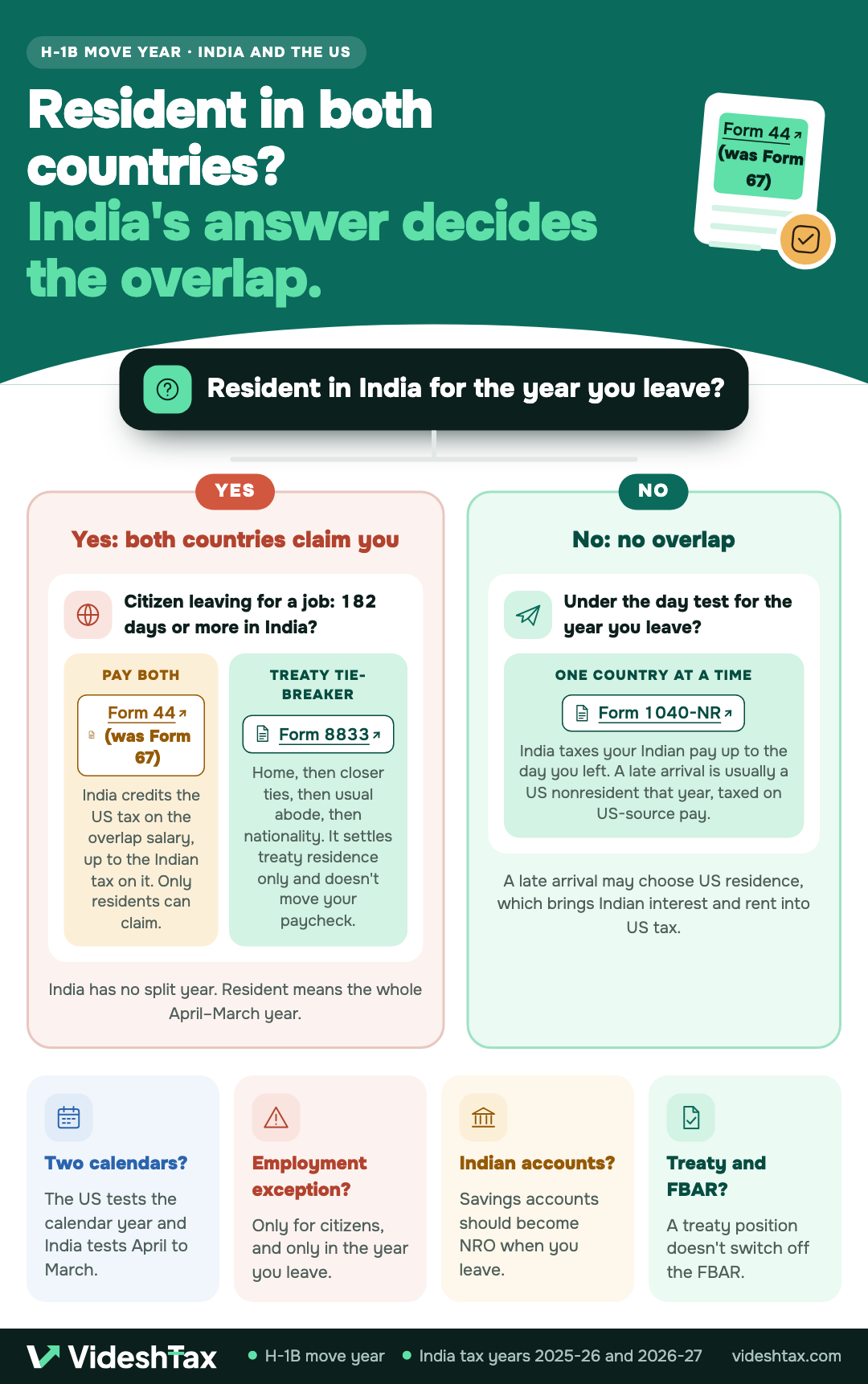
Two countries, two calendars
The US decides residency for each calendar year. India decides it for each tax year, 1 April to 31 March. A single flight in September or February therefore touches two US years and two Indian years, each judged on its own.
The tests are unrelated too. The US counts weighted days in the US over three calendar years; India counts days in India in its tax year, and sometimes the four before. Neither asks what the other decided. So you can be a US resident from your arrival day while India still treats you as resident for the whole year you left, which is the overlap this guide is about.
India’s new Income-tax Act, 2025 applies from tax year 2026-27. Tax year 2025-26 is still decided under the Income-tax Act, 1961, which the new Act keeps alive for earlier years (2025 Act, section 536). The tax department’s non-resident FAQ confirms that residence for tax years starting before April 1, 2026 is decided under the old section 6, on the same conditions. So for a 2025 move, the old Act decides the year you leave.
The US side: when an H-1B makes you a resident
The substantial presence test
Unless you hold a green card, you’re a US tax resident for a calendar year if you meet the substantial presence test. You need at least 31 days in the US that year, and a total of 183 days or more when you add this year’s days, a third of last year’s and a sixth of the year before’s. Fractions aren’t rounded, and any part of a day in the US counts as a day.
H-1B days always count. Students, teachers and trainees can be “exempt individuals” whose days are left out. H-1B is never exempt, and nor is H-4, so every day on either counts from the first.
F-1 and OPT years before the H-1B
If you came as a student, your F-1 days don’t count while you’re an exempt student. That lasts while you keep substantially to your visa’s terms (unauthorised work breaks it) and only for 5 years: any part of a calendar year uses up a whole one. After that, the days count unless you can show you don’t intend to live in the US permanently, and steps towards a green card count against you.
Time on OPT or STEM OPT is part of F-1 status, so those days are exempt too, as long as you kept to the OPT rules. If you’re not sure you stayed in status, for example after a long gap without work, check it with a CPA.
Exempt days still have to be reported. You file Form 8843 for each exempt year, with your nonresident return or on its own by that return’s due date. Without it, the IRS can count the days unless you show clear and convincing evidence that you tried to comply. Exemption ends on the day your H-1B status takes effect, and your days count from then.
Your residency starting date
Your residency doesn’t start on the day your count reaches 183 days. It starts on the first day you’re present in the US in the calendar year you meet it. If you were resident the year before, it starts on 1 January.
So a week of onboarding in January before moving in March can start your residency in January. A rule lets you disregard up to 10 days of earlier presence for the start date, if you can show your tax home and your closer ties were still abroad during those days. You must leave out a whole trip or none of it, the days still count towards the 183 days, and you need a signed statement with your return.
The first-year choice, for a late arrival
Arrive late in the year and you usually can’t reach 183 days by 31 December. You can instead choose to be a resident from your arrival if all of these are true:
- You weren’t a US resident in that year or the year beforeNot by green card and not by the day test.
- You were here for 31 days in a row in the arrival yearYour residency then starts on the first day of that run.
- You were here for 75% of the days from the start of that run to 31 DecemberUp to 5 days away count as days here, for this part only.
- You meet the substantial presence test for the following yearYou can’t make the choice until you’ve actually met it.
That last condition sets the timing. You make the choice in a statement attached to your Form 1040 for the arrival year, and you can’t file it before you pass the next year’s test, which for most people is around mid-year. So you extend: file Form 4868 by the regular due date (for 2025 returns, April 15, 2026) and pay with it the tax you’d owe as a nonresident for the whole year. The extended deadline for 2025 returns is October 15, 2026. Skip the procedure and you’re a nonresident for the arrival year, unless you can show clear and convincing evidence of reasonable steps to comply. Once made, the choice can’t be revoked without the IRS’s consent.
The choice isn’t free: from your starting date, Indian interest and rent you receive are US-taxable and your Indian accounts enter the foreign-account reports. Its main use is to open the joint-return election below.
What a dual-status return can’t do
A year that’s part nonresident, part resident is a dual-status year. If you’re resident on 31 December, you file Form 1040 marked “Dual-Status Return”, with a statement on Form 1040-NR for the nonresident part. Only the resident part reports worldwide income. You can’t take the standard deduction (you may itemize), can’t use head-of-household rates and can’t file jointly, and the IRS says dual-status returns for 2025 can’t be e-filed. Credits, including the foreign tax credit, generally follow the rules for residents.
Joint returns with an H-4 spouse
Two elections let a married couple file jointly as full-year residents instead. If you were both nonresidents on 1 January and both residents on 31 December, as an H-1B and H-4 arriving together early in the year usually are, you can both elect to be residents for the whole year; it’s a once-only election. If only one of you is resident at the year end, you can both elect to treat the other as resident, and that election carries into later years until ended.
Either way you get the standard deduction and joint rates back, but you’re both taxed on worldwide income for the whole year, including Indian salary from before you left (with credit for the Indian tax), and neither of you can use the treaty to claim you’re not a US resident. Whether a late arrival can combine the first-year choice with the first election isn’t addressed in the IRS’s guide; the law’s wording seems to allow it, but it’s untested.
The closer-connection exception on Form 8840 rarely helps an H-1B worker: it needs fewer than 183 days here in the current year, a tax home abroad all year, and no green card steps, such as an I-140 petition or labour certification filed for you.
The India side: the year you leave
The Indian rules are covered in full in our guide to residency status in India; here’s how they apply to an H-1B move.
You’re resident in India for a tax year if you spend 182 days or more there, or 60 days or more plus 365 days over the previous four years 2025 Act s. 6(2)-(5)was s. 6(1). Otherwise you’re a non-resident, an NRI in everyday terms. In the year an Indian citizen leaves India for employment abroad, the second test is switched off: only the 182 days test counts. An H-1B job is the clear case. It covers only citizens, and only the year you leave. After that, the visiting rule applies: 182 days, or 120 days with the four-year condition if your Indian income is above ₹15 lakh.
Count the day you fly out as a day in India: it’s the cautious reading of an unsettled point, explained in how to count your days. And India has no split year: if you’re resident, it’s for the whole April–March year, so your US salary for the rest of it is in your Indian return too.
If you’ve lived in India all along, a resident year is also an ordinarily resident one. The in-between RNOR status needs years abroad behind you, so it rarely helps a first-time leaver.
Deemed residence rarely catches an H-1B holder. An Indian citizen with Indian income above ₹15 lakh who isn’t liable to tax anywhere else because of residence or domicile is treated as resident 2025 Act s. 6(7)-(8)was s. 6(1A). As a US resident you’re liable to US tax by residence, so it shouldn’t reach you. The grey patch is a move year in which you’re a US nonresident, taxed only on US income, for most of the Indian year, and your Indian salary before leaving passes the threshold. The department hasn’t said whether source-only tax is enough; see our guide to deemed residence. Even then, a deemed resident is always not ordinarily resident, so US salary paid abroad stays outside Indian tax.
Three worked examples
Each example counts days at both ends and assumes no other trips.
Pranav, software engineer, left Bengaluru on 15 September 2025 for an H-1B job in Raleigh. A citizen who had always lived in India, he lands the same day and stays, apart from a 30-day trip home in December 2026. His wife comes on an H-4.
| Year | Day count | Result |
|---|---|---|
| US 2025 | 15 Sep–31 Dec = 108 days; no earlier years | Under the weighted total: nonresident by default |
| US 2026 | 335 days, plus 108 ÷ 3 = 36 | Resident from 1 January 2026 |
| India 2025-26 (1961 Act) | 1 Apr–15 Sep 2025 = 168 days (167 without the departure day) | Leaving for a job, so only the 182 days test: non-resident |
| India 2026-27 (2025 Act) | 30 days on a visit | Non-resident |
By default there’s no overlap at all. For 2025 the US taxes only his US salary, on Form 1040-NR. India taxes his salary to 15 September and his Indian interest, as a non-resident. Without the employment exception he’d have been resident on the second test, and a departure on 29 September or later would have reached 182 days and made him resident anyway.
He could make the first-year choice for 2025: 108 days in a row from 15 September, present on all of them (the test needs 81), and resident for 2026. With 36 carried-in days, he meets the 2026 test on his 147th day, 27 May 2026, so he needed to extend his 2025 return in April, paying as a nonresident, and file it with the statement by October 15, 2026. His residency would then start on 15 September 2025, NRO interest after that would be US-taxable, and he’d be a US person for the 2025 FBAR. The prize is a joint return with his wife, which also brings his Indian salary for January to September 2025 into US tax, with credit for the Indian tax. He should have it run both ways.
Shreya, data analyst, left Pune on 19 February 2026 and landed in Dallas on 20 February on an H-1B. First time in the US; no trips since.
| Year | Day count | Result |
|---|---|---|
| US 2026 | 20 Feb–31 Dec = 315 days; total reached on 21 Aug | Resident from 20 February 2026: dual-status year |
| India 2025-26 (1961 Act) | 1 Apr 2025–19 Feb 2026 = 325 days (324 without the departure day) | Resident and ordinarily resident for the whole year |
| India 2026-27 (2025 Act) | None so far | Non-resident |
Here the two countries overlap for 40 days, 20 February to 31 March 2026. The US taxes her pay for those days as a resident. India taxes the same pay, because she’s resident for the whole of 2025-26 and taxed on worldwide income. The employment exception can’t help; she was already well past 182 days. How she gets relief is in the double-tax section below.
Her 2026 US return is dual-status, due April 15, 2027: no standard deduction unless she and an H-4 husband who arrived the same day elect to be full-year residents, which would put her Indian salary for 1 January to 19 February into US tax as well. Had she spent five days at the US office in January, her residency would start then, unless she files the statement to disregard that trip.
Varun came to Pittsburgh on an F-1 in August 2021, worked on OPT, and moved to H-1B status on 1 October 2025. He left India in 2021 and has been a non-resident there ever since.
His F-1 years, 2021 to 2025, are his five exempt years, so 1 January to 30 September 2025 doesn’t count. From 1 October he has 92 counting days, far short of the total, so he’s a nonresident for 2025: Form 1040-NR with Form 8843. For 2026 he counts 365 days plus 92 ÷ 3, or 395.67, and he’s resident from 1 January. He could make the first-year choice for 2025 (92 days in a row; 69 needed for the presence test), but it only helps if he wants a joint return.
India doesn’t come into it: he’s been a non-resident for years. Variant: had he arrived in August 2020, 2025 would be a sixth student year. His days would count from 1 January unless he showed he didn’t intend to stay permanently, which an employer’s green card petition argues against. He’d be resident for all of 2025, with a 2025 FBAR due October 15, 2026.
When both countries treat you as resident
The India–US treaty settles which country you’re a resident of for the treaty, in order: where you have a permanent home; if both, where your personal and economic ties are closer; then where you usually live; then nationality; failing all of those, the two tax authorities agree it between them. It doesn’t change your status under either country’s own law, and in India you rely on the treaty only where it’s more beneficial than the Act 2025 Act s. 159was s. 90. This is the DTAA tie-breaker most NRIs hear about.
Three limits make it less useful than it sounds for an H-1B holder:
- It doesn’t move your paycheck. Pay for work done in the US can be taxed by the US whichever country you’re treaty-resident in. The tie-breaker mainly affects other income, and which country gives the credit.
- Its effect on part of a year is unsettled. The treaty doesn’t say whether you test the whole Indian year or only the overlap weeks. Shreya, with a family home in India until February and a Dallas lease after, could argue either way.
- On the US side, it changes your tax and little else. Claim Indian residence under the treaty and you file Form 1040-NR with Form 8833, taxed as a nonresident. For every other purpose you stay a US resident, on the same dates. The IRS’s FBAR guide says tax treaties don’t affect FBAR filing. Form 8938 is different: you can leave it out for the period the nonresident return covers, if you file that return and the disclosure on time.
For most people in Shreya’s position, the simpler route is the one the treaty itself provides: pay both and take the credit.
Avoiding double tax in the overlap
| Income | US | India | Who gives the credit |
|---|---|---|---|
| US salary after your US start date, while India-resident for the year | Taxed: US-source pay of a resident | Taxed: worldwide income of a resident | India, for the US tax on it |
| Indian salary for work in India, paid before your US start date | Not taxed (foreign income received while a nonresident) | Taxed | None needed |
| Indian salary, bonus or final settlement paid after your US start date | Taxed: received while a resident, even if earned earlier | Taxed: pay for work in India | The US, for the Indian tax on it |
| NRO interest or Indian rent after your US start date | Taxed | Taxed, with tax deducted at source | The US, for the Indian tax finally owed |
| US salary while India-non-resident | Taxed | Not taxed, unless received in India | None needed |
In India, a resident claims credit for the US tax on the overlap salary under the treaty. Tax withheld from your US pay counts, up to the Indian tax on that income. You file a statement of foreign income and tax, Form 44 (was Form 67). For 2025-26 that’s still the older form under the 1962 Rules; the newer one, under rule 76 of the 2026 Rules, starts with 2026-27. Only residents can claim the credit.
In the US, Indian tax on Indian-source income that the US also taxes goes on Form 1116, limited to the US tax on that foreign income. Pay for work done in the US is US-source, so it never creates US credit room. Our guide to claiming Indian tax as a US credit, line by line, is Coming soon.
If you missed the original Indian deadline for 2025-26, a late return is still possible until December 31, 2026. File the foreign tax credit statement before the return, and have a CA check a late claim: the department’s own FAQ still ties the statement to the original due date.
Your Indian bank accounts in the move year
Indian foreign-exchange law (FEMA) has its own residence test, and it isn’t the tax test. Under the RBI’s directions, when a resident becomes a person resident outside India, which on the usual reading of FEMA happens when you leave for a job abroad, the existing savings account should be redesignated as an NRO account. Banks usually do it once you tell them. So Shreya’s accounts should become NRO in February 2026 even though she files as a resident for 2025-26.
What to do with each account after that, and when an NRE or FCNR account suits better, is in our guide to Indian bank accounts from abroad.
From your US residency starting date, your Indian accounts are foreign accounts: above USD 10,000 combined at any time, you owe an FBAR. Whether a part-year resident tests the whole calendar year or only the resident months isn’t settled, and nor is the timing when you make the first-year choice after the FBAR date; our guide to the FBAR deadline on an H-1B gives the cautious course. The 2025 FBAR is due October 15, 2026, and the 2026 one October 15, 2027. Form 8938 covers only the part of the year from your starting date.
Which Indian accounts count, from NRE deposits to PPF, is set out in FBAR and FATCA reporting for Indian accounts.
A checklist for the move year
- Before you flyCount your days in India this tax year against 182 days; a few days can decide whether India taxes your first months of US pay. Keep your offer letter as proof you left for a job.
- The day you leaveTell your bank, and have savings accounts redesignated as NRO. If you can, get the final settlement paid before you go.
India - Your first US dayNote it, and any earlier US trips that year, or the day your H-1B status took effect if you were on F-1.
US - 31 DecemberCheck the substantial presence test. Record your highest and year-end Indian balances.
US - 31 MarchIndia’s year ends. Make your final day count and decide your Indian status for the year.
India - US return due dateFile, or extend on Form 4868. Extend if you plan the first-year choice, and pay as a nonresident with the extension.
April 15, 2027 for 2026 - Indian return due dateFile as a resident or non-resident. If resident, include the overlap salary and the foreign tax credit statement.
July 31, 2027 for 2026-27 - Extended US and FBAR dateFile the extended return and the FBAR.
October 15, 2027 for 2026
Common mistakes
- Treating the day you reach 183 days as your US start date. Residency runs from your first day in the US that year.
- Filing a plain resident return with the standard deduction in a dual-status year.
- Forgetting Form 8843 for F-1 years, which can bring student days into the count.
- Assuming India splits the year at your departure. Resident means resident for the whole April–March year.
- Carrying the employment exception into later years, or claiming it as a non-citizen.
- Expecting RNOR in the year you leave. It’s for people coming home after years abroad: see RNOR status after returning.
- Thinking a treaty position switches off the FBAR.
- Missing the Indian bonus or final settlement paid after your US residency starting date: it’s US-taxable when received, even though you earned it in India.
- Selling Indian mutual funds after your US start date without checking the PFIC rules for Indian funds.
When to get a CPA or EA, and a CA
Get a US CPA or Enrolled Agent for your first dual-status return; if you’re weighing the first-year choice or a joint election; if you had F-1 years, especially a sixth; if an earlier US trip predates your move; or for a treaty-based nonresident position. Get a chartered accountant if you were resident in India for the year you left, to claim the overlap salary and credit correctly; if you left within a couple of weeks of the 182 days line; if your Indian income topped ₹15 lakh that year; or if you missed the Indian deadline.
Next steps
Questions people ask
I arrived on an H-1B in October 2025. Am I a US tax resident for 2025?
Probably not. With no earlier US days, you need 183 days in 2025 alone, and October to December is at most 92 days. So you're a nonresident alien for 2025, taxed only on US-source income such as your US pay. If you were here 31 days in a row, were here on at least 75% of the days from the start of that run to 31 December, and meet the test for 2026, you can choose to be resident from the start of that run instead, on a return extended for the purpose.
When exactly does my US residency start?
On the first day you're in the US in the year you meet the substantial presence test, not the day you reach the total. Land on 20 February and pass in August, and you're resident from 20 February. An earlier short trip that year sets the start date at that trip, unless it was no more than 10 days, your tax home and closer ties were in India, and you file a signed statement to leave it out.
Do my F-1 and OPT days count towards the US day test?
Not while you're an exempt student: days on an F-1 that you kept to don't count, for up to 5 years (any part of a calendar year uses up a whole one). After that they count, unless you show you don't intend to live in the US permanently and have kept to your visa's terms. Time on OPT or STEM OPT is part of F-1 status, so those days are exempt too, as long as you kept to the OPT rules. Your days start counting on the day your H-1B status takes effect.
Can I file a joint return with my H-4 spouse in the year we arrive?
Not as an ordinary dual-status filer. But if you were both nonresidents on 1 January and both residents on 31 December, you can elect together to be treated as residents for the whole year and file jointly. You get the standard deduction back, but both of you are then taxed on worldwide income for the full year, including Indian salary from before you left. It's a one-time election.
I left India in September 2025 for my H-1B job. Am I an NRI for 2025-26?
Usually yes. Tax year 2025-26 is decided under the 1961 Act, whose tests match the new Act's. An Indian citizen leaving for a job abroad is resident that year only with 182 days or more in India, and leaving in mid-September gives about 168. Your Indian salary up to the day you left is still taxed in India; your US salary isn't.
Can I really be a tax resident of both countries for the same months?
Yes. India gives you one status for the whole April–March year, and the US starts your residency on your arrival day. If you're resident in India for the year you leave, the months after your US start date overlap. The India–US treaty's tie-breaker can settle residence for treaty purposes, but the usual fix for the overlap is a credit in India for the US tax on that salary.
Do I need to file an FBAR for the year I arrived?
Only if you were a US person that year and your foreign accounts together passed USD 10,000 at any time. A late-year arrival who stays a nonresident for that year has no FBAR for it. If you meet the test, or make the choice to be resident, you do, and the IRS says a treaty position doesn't change that. Whether the threshold covers the whole year or only your resident part isn't settled.
Sources
- 26 U.S.C. §7701(b): definition of resident alien, substantial presence test, exempt individuals, first-year electionuscode.house.gov
- 26 U.S.C. §6013(g) and (h): elections to treat a nonresident spouse, or a part-year resident, as a residentuscode.house.gov
- Treas. Reg. §301.7701(b)-1: resident alien and the substantial presence testecfr.gov
- Treas. Reg. §301.7701(b)-3: days of presence that are excluded (exempt individuals)ecfr.gov
- Treas. Reg. §301.7701(b)-4: residency starting and termination dates, de minimis days, first-year electionecfr.gov
- Treas. Reg. §301.7701(b)-7: coordination with income tax treaties (dual residents)ecfr.gov
- Treas. Reg. §301.7701(b)-8: procedural rules (statements and forms to exclude days)ecfr.gov
- IRS Publication 519 (2025), U.S. Tax Guide for Aliensirs.gov
- IRS: Substantial presence testirs.gov
- IRS: Tax residency status examplesirs.gov
- IRS: Instructions for Form 8938 (dual-resident taxpayers; partial tax years)irs.gov
- IRS Publication 5569, Report of Foreign Bank and Financial Accounts (FBAR) Reference Guideirs.gov
- 31 CFR §1010.350: reports of foreign financial accounts (who is a US person)ecfr.gov
- India–US income tax convention, Articles 1, 4, 16 and 25 (IRS text)irs.gov
- Income-tax Act, 2025: sections 1, 5, 6, 159 and 536 (gazette)egazette.gov.in
- Income-tax Rules, 2026: rule 76, foreign tax creditincometax.gov.in
- Income Tax Department: Non Resident FAQs (residence for tax years before and after 1 April 2026)incometax.gov.in
- RBI: Master Direction – Deposits and Accounts (NRO accounts)rbi.org.in
- RBI: FAQs, Accounts in India by Non-residentsrbi.org.in