

If you were a US tax resident in 2025, as an H-1B holder here all year was, and your Indian accounts together passed USD 10,000 at any point in 2025, your FBAR is due October 15, 2026. The extension is automatic. List every NRE, NRO and FCNR account, joint accounts with parents at full value, and file it yourself online with FinCEN.
Is this you? You're in the US on an H-1B or H-4, or switched from F-1 to H-1B during 2025, and hold NRE, NRO, FCNR or other Indian accounts. Green card holders and citizens have the same deadline; only the residency sections won't apply.
This assumes you're a US person for the year: a citizen, a green card holder, or resident under the substantial presence test. Moving back this year? Check your residency status first, because the answer can change.
This guide is part of our US–India tax guide for Indians living in America. It covers one thing: the FBAR for calendar year 2025, due October 15, 2026, for people on an H-1B or H-4 with NRE, NRO and other Indian accounts. It assumes you live and work in the US.
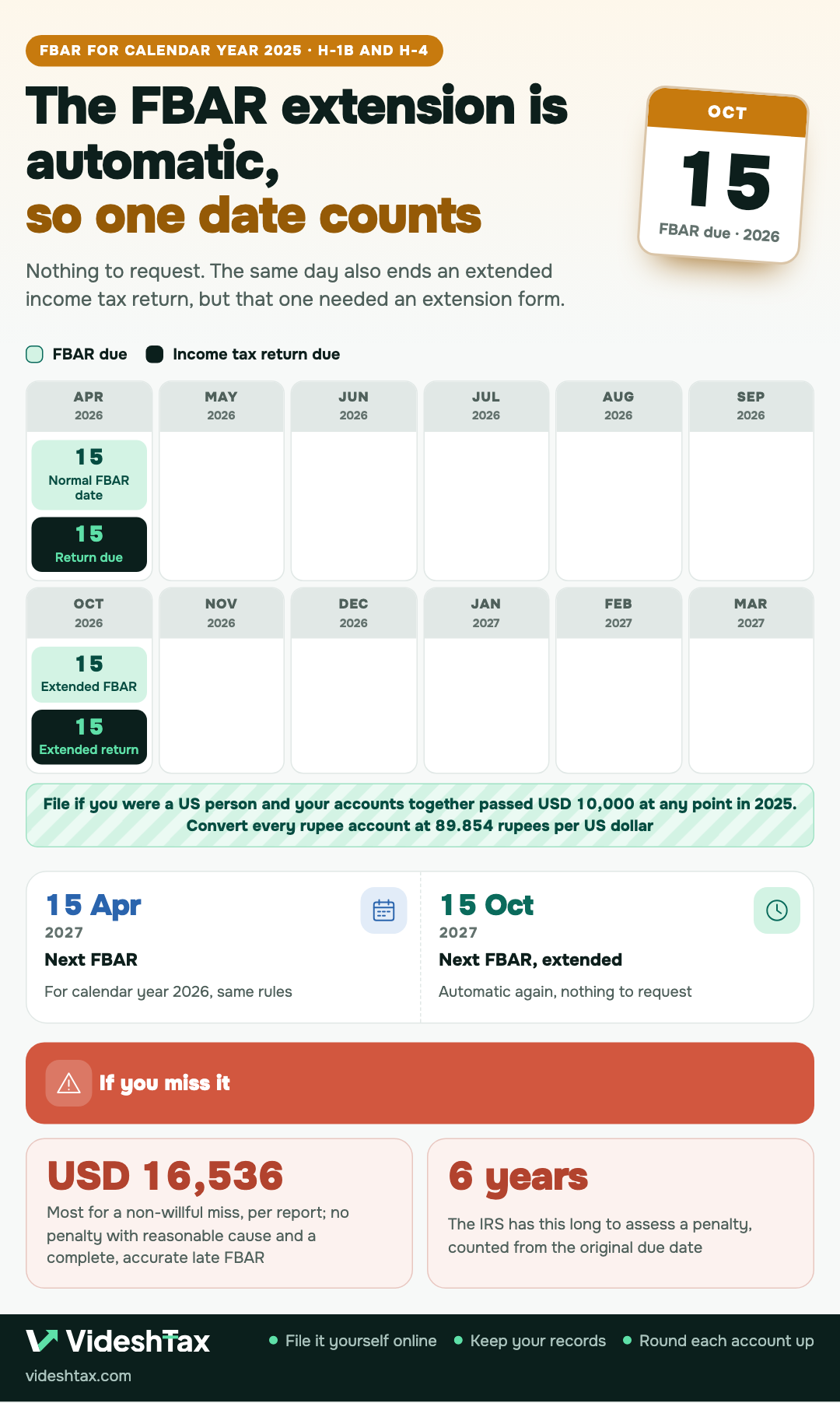
Nothing to request. The same day also ends an extended income tax return, but that one needed an extension form.
- FBAR due
- Income tax return due
- APR202615Normal FBAR date15Return due
- MAY2026
- JUN2026
- JUL2026
- AUG2026
- SEP2026
- OCT202615Extended FBAR15Extended return
- NOV2026
- DEC2026
- JAN2027
- FEB2027
- MAR2027
File if you were a US person and your accounts together passed USD 10,000 at any point in 2025. Convert every rupee account at 89.854 rupees per US dollar
For calendar year 2026, same rules
Automatic again, nothing to request
Most for a non-willful miss, per report; no penalty with reasonable cause and a complete, accurate late FBAR
The IRS has this long to assess a penalty, counted from the original due date
The deadline is Thursday, October 15, 2026. Monday, October 12, is a federal holiday (Columbus Day), so from Sunday, October 11, you have three US working days to ask an employer, a tax adviser or a help desk anything. Indian banks are generally open on Monday. Start gathering statements now and aim to file by Tuesday or Wednesday.
What’s due on the 15th, and for which year
The Report of Foreign Bank and Financial Accounts (FBAR) is FinCEN Form 114, filed online with FinCEN, the Treasury’s financial-crimes unit, not with the IRS and not with your tax return. It reports the calendar year, January to December, not India’s April-to-March tax year. The one due now covers January 1 to December 31, 2025.
Its normal due date was April 15, 2026. FinCEN gives everyone who misses that date an automatic extension to October 15, 2026, and its own notice says specific requests aren’t required. There’s no extension form and nothing to tick. The 15th falls on a Thursday this year, so no weekend rule moves it.
Three points about timing that matter this week:
- It has to arrive, not be sent. The IRS’s comparison of the two foreign-account reports describes the FBAR as due when “received” by FinCEN. Online filing arrives the moment you submit, as long as the submission goes through.
- There’s no published cut-off time. FinCEN doesn’t say what hour, or which time zone, ends the day. Don’t plan on the last evening.
- No disaster extension yet. On October 11, 2026, FinCEN’s FBAR page listed no disaster-relief extension for 2025 FBARs. In past years FinCEN has published such notices only days before October 15, so check its FBAR page again before Thursday. An IRS disaster postponement for your county’s income tax doesn’t move the FBAR by itself; FinCEN has to say so separately.
A colleague may say they have until 2027: FinCEN extended the date only for certain finance staff with signature authority over their employer’s accounts, never for your own or a parent’s. For what counts as a foreign account and the separate Form 8938 thresholds, see our full guide to FBAR and FATCA reporting.
Are you a US person for the FBAR on an H-1B?
Only “United States persons” file. If you aren’t a citizen or green card holder, that means a resident alien under the tax code’s residency rules. The IRS’s manual is blunt: people here on a work visa who don’t meet the substantial presence test are not US residents for the FBAR.
The substantial presence test. You meet it for 2025 if you were in the US on at least 31 days in 2025, and your days in 2025, plus a third of your days in 2024 and a sixth of your days in 2023, add up to 183 days or more. If you were here on an H-1B for all of 2025, you meet it on 2025’s days alone. The same goes for an H-4 spouse who was here all year: H-1B and H-4 days count in full.
Student days don’t count. Days on an F-1 visa are “exempt” days, left out of the test, as long as you kept to your visa’s terms. Once you’ve been exempt for any part of more than 5 years (any part of a calendar year counts as a whole one), your student days count, unless you can show you don’t intend to live in the US permanently and have kept to your visa’s terms. The exemption lasts only while you hold student status. The day your H-1B status starts, your days begin to count. Time on OPT or STEM OPT is part of F-1 status, so those days are exempt too, as long as you kept to the OPT rules. If you’re not sure you stayed in status, for example after a long gap without work, check it with a CPA.
The year you arrive or switch. If you first met the test in 2025, your US residency for tax started on your first day of non-exempt presence in 2025, not on January 1. FinCEN’s text deals with part-year residence only where someone makes an election (below). For an ordinary part-year resident it is silent on whether the FBAR covers all of 2025 or only the months after your residency start date. This isn’t settled. The cautious course is to report the year’s maximum balances, or at least the balances from your arrival, and to ask a CPA if the answer changes whether you file. Our guide to the H-1B dual-residency year explains how that first year works on the income tax side.
The first-year choice. If you arrived late in 2025 and don’t meet the test for 2025, you can still choose to be treated as a resident from part-way through 2025. You need to have been here for at least 31 days in a row in 2025, present for at least three-quarters of the days from the start of that run to December 31 (up to five days away count as present), and to meet the substantial presence test for 2026. You make the choice on your 2025 return, which can’t be filed until you’ve met the 2026 test, so most people who use it extended that return to October 15, 2026. The IRS’s manual lists this election as one of the ways to become a US person for the FBAR, and FinCEN has said that people who make it should file FBARs for the accounts held during the period the election covers.
That leaves one question no official text answers: what if you plan to make the choice on your return but the FBAR deadline comes first? It isn’t settled. Filing the FBAR by the 15th costs you nothing if you then make the choice; filing it later means it’s late, with a reason to give.
The treaty doesn’t change it. The India–US treaty has a tie-breaker for people both countries treat as resident. The IRS’s manual says treaty provisions don’t affect residency for the FBAR: if you meet a US residency test, you’re a US person for the FBAR even if the treaty lets you file your tax return as a non-resident. Likewise, a spouse who isn’t a resident but joins a joint return by election doesn’t become a US person for the FBAR because of it.
India’s residency rules are separate. To see how India treats you this tax year, use our residency status checker (linked at the top of this page); it doesn’t decide your US status.
Your Indian accounts, account by account
Once you’re a US person and your accounts together passed USD 10,000 at any point in 2025, every foreign account goes on the form, not only the ones that took you over. The form has three places for them: Part II for accounts you own alone, Part III for accounts you own jointly, and Part IV for accounts you can operate but don’t own.
| Account | On the FBAR? | Where and at what value |
|---|---|---|
| NRE savings or fixed deposit | Yes | Part II if yours alone; full maximum value, though the interest is tax-free in India |
| NRO savings or fixed deposit | Yes | Part II, or Part III if joint |
| FCNR deposit (held in dollars or another currency) | Yes | Part II; convert from the deposit’s currency, not from rupees |
| Joint NRO with a parent in India | Yes, in full | Part III, the whole balance, with the parent as the other owner |
| Parent’s account you can operate under a power of attorney | Usually yes | Part IV, the whole balance, with the parent as owner |
| Parent’s account where you’re only the nominee | Probably not | A nominee has no say over the account while the holder is alive |
| Demat account, mutual fund folio, insurance with cash value | Yes | Reported as accounts |
| PPF, EPF, NPS | Not settled | See below |
NRE accounts. An NRE account holds money you earned abroad, and India doesn’t tax its interest. None of that matters to the FBAR: there’s no exemption for accounts India doesn’t tax. The US also taxes resident aliens on worldwide income, so the interest goes on your US return.
NRO accounts. An NRO account holds your Indian income: rent, dividends, pension, or money left from before you moved. India taxes its interest, usually through tax the bank deducts, and the account goes on your FBAR on the same footing as the NRE. The Indian side of that interest is in our guide to TDS on NRO interest.
FCNR deposits. These are held in a foreign currency. A dollar FCNR needs no conversion; one in pounds or euros uses the Treasury’s year-end rate for that currency.
Joint accounts with parents. Many H-1B holders are second holder on a parent’s NRO or savings account, on “either or survivor” or “former or survivor” terms. Under FinCEN’s rules, each US person in whose name an account is held has a financial interest in it, and the IRS’s manual says joint accounts are reported at their entire value on each owner’s FBAR, never pro-rated. The FBAR rules never mention the mandate type; being a named holder is what counts. On “former or survivor” accounts, which only the first holder operates, no official text addresses the mandate directly, so it isn’t settled; reporting the account is the cautious course.
Signature authority and powers of attorney. You have signature authority over an account if you can control what happens to the money by instructing the bank directly, alone or with someone else. Authority only to buy and sell investments, without being able to take money out, doesn’t count. If a power of attorney lets you instruct your mother’s bank to pay out or close her account, that’s signature authority, and the account goes in Part IV. If it’s narrower, or the bank hasn’t registered it, no FBAR text says either way; ask a CPA. Being a parent’s son or daughter, by itself, puts nothing on your FBAR: the family attribution rules from income tax don’t apply.
PPF, EPF and NPS. No FinCEN or IRS text names any of them. The FBAR’s exception for retirement plans covers only US plans and IRAs, so it doesn’t help. A PPF sits at a bank or post office, which fits the definition of an account well; EPF and NPS are run by statutory bodies, where the fit is less clear. This isn’t settled. Including them costs a few lines; leaving out an account that should have been there risks a penalty.
If your spouse is on an H-4. An H-4 spouse is tested on her own days, and H-4 isn’t an exempt status, so a spouse who was here all of 2025 is a US person for the FBAR in her own right. Her accounts are tested on their own against the threshold, and an account she holds jointly with you counts in full on hers as well as yours. One spouse can file for both only if every account the other has to report is held jointly with the filing spouse; the filer reports the joint accounts on a timely FBAR, and both complete and sign FinCEN Form 114a, which you keep for 5 years rather than send. If she has even one account in her own name, you each file a separate FBAR. Your income tax filing status, joint or separate, makes no difference.
Working out the numbers
For each account:
- Find the maximum value in 2025, in the account’s own currency. FinCEN asks for a reasonable approximation of the greatest value during the year, and says periodic statements may be relied on. The IRS’s manual uses the largest amount on any quarterly or more frequent statement. For a fixed deposit, that’s usually the principal plus any interest credited to it.
- Convert at the Treasury rate for December 31, 2025. That’s 89.854 rupees per US dollar, for every rupee account, whatever day the balance peaked.
- Round up to the next whole dollar. FinCEN’s instructions say any fraction of a dollar goes up, not to the nearest. Round each account, then add.
- Enter zero for a negative value, such as an overdrawn account.
At that rate the threshold of USD 10,000 works out to ₹8,98,540 across all your accounts together. Money moved from one foreign account to another during the year counts once for that test: if you broke an NRE savings balance into a fixed deposit, the same rupees aren’t added twice.
If you truly can’t tell an account’s maximum and have fewer than 25 accounts, the form has an “amount unknown” box. Ask the bank first.
Worked example: three households, one Thursday
Each example uses the Treasury rate of 89.854 rupees per dollar, rounds each account up, then adds.
Siddharth, H-1B software engineer in Texas, in the US since 2021. He’s a US person for 2025 without question. His highest balances in 2025:
| Account | His connection | Part | Maximum (₹) | US$ (rounded up) |
|---|---|---|---|---|
| NRE fixed deposit | Sole owner | II | 32,00,000 | 35,614 |
| NRO savings | Sole owner | II | 4,10,000 | 4,563 |
| NRO savings with his father, in India | Joint owner | III | 6,75,000 | 7,513 |
| His mother’s savings, under a registered power of attorney that lets him instruct the bank | Signature authority only | IV | 9,20,000 | 10,239 |
| Total | 52,05,000 | 57,929 |
His NRE deposit alone is over the threshold, so all four accounts go on the FBAR. The joint account is reported in full even though his father funded it, and his mother’s account goes in Part IV with her as the owner, provided the power of attorney really lets him control the money. Converting the rupee total in one go gives a slightly lower figure; rounding each account up first is what the form asks for.
Ishita, H-4 spouse in Georgia, in the US since 2023. She’s tested on her own days, and she was here all of 2025, so she’s a US person. She has an NRO savings account of her own (maximum ₹4,60,000, which is $5,120) and an NRE account held jointly with her husband Kunal (maximum ₹5,00,000, which is $5,565). Together that’s $10,685, over the threshold, and only because the joint account counts in full on her FBAR too. Kunal can’t file for both of them, because her NRO account isn’t joint with him. So both file: hers lists both accounts, his lists the joint NRE in full alongside his own accounts. If her only account had been the joint NRE, she’d have been under the threshold with nothing to file, and the joint account would still appear in full on Kunal’s FBAR.
Aravind, F-1 student turned H-1B, in Illinois. He came on an F-1 visa in August 2022 and worked on OPT until his H-1B change of status took effect on November 14, 2025. His student years so far are 2022 to 2025, four calendar years. From November 14 to December 31 he had 48 non-exempt days, which passes the 31 days minimum but is nowhere near the weighted total, so he doesn’t meet the substantial presence test for 2025. Without the first-year choice, he has no 2025 FBAR at all.
He can make the choice: 48 days in a row, present on all of them, and he has already met the 2026 test by staying here through 2026 so far. If he makes it on his extended 2025 return, his residency starts on November 14, 2025, and his FBAR covers accounts held from then to December 31. His highest balances in that period: NRO ₹18,50,000 ($20,589) and NRE ₹2,40,000 ($2,671), a total of $23,260. FinCEN’s text limits the FBAR to accounts held during the election period, but doesn’t say whether each account’s maximum is measured over that period or the whole year, so if his balances were higher earlier in 2025, the cautious course is to report the higher figure. Either way he’s over the threshold, so he files by October 15, 2026, the same day his return is due. Without the choice, his first FBAR is for 2026, as a resident from January 1, 2026, due April 15, 2027 with the automatic extension to October 15, 2027, using the Treasury rate for December 31, 2026, which isn’t out yet.
The four-day checklist
If you’re doing it yourself, this is the order that fits three working days. Our step-by-step walkthrough of the online form covers the screens one by one.
| Done | What | Who | When |
|---|---|---|---|
| List every Indian account you own, co-own or can operate, with the bank’s name and branch address and the account number | You, from net banking and old cheque books | Sunday | |
| Download 2025 statements, January to December, for each account; for fixed deposits, the deposit advice and any renewal | Net banking; your parents for joint accounts | Sunday | |
| Find each account’s highest 2025 balance, divide by the year-end Treasury rate, round up, add | You, in a spreadsheet | Monday | |
| Ask the bank for anything missing; Indian banks open while the US is on its holiday | Bank’s NRI desk, by email or phone | Monday | |
| Decide whether one spouse can file for both; if so, both sign the authorization record and keep it | You and your spouse | Monday | |
| File on BSA E-Filing using the no-registration option for individuals; save the confirmation screen and its tracking ID | You, on FinCEN’s site | Tuesday | |
| Watch for the acknowledgement email with your BSA identifier; FinCEN’s filing guide says it arrives within two business days | Your inbox | By Thursday | |
| Save the filed report, the statements and your workings for at least 5 years | You | After filing |
- Gather before you open the formFor each account: the name it’s held in, the number, the bank’s name and address, the type of account and the maximum value. Those five items are exactly what the record-keeping rule asks you to keep. You’ll also need your own name, address and date of birth, your SSN or ITIN (or, if you have neither, as some H-4 spouses don’t, your passport number and the country that issued it), and the name and address of any joint owner or of the owner of an account you only operate.
- File it yourself, with no account to createIndividuals use the no-registration option on FinCEN’s BSA E-Filing System. Only professionals and institutions filing for others, such as CPAs, Enrolled Agents and attorneys, have to register. The FBAR is never attached to your tax return.
Aim for Tuesday - Keep proof that it arrivedThe confirmation screen shows a tracking ID straight away. The later email carries the BSA identifier, a 14-digit number. Keep both: you’ll need the identifier if you ever amend.
- If you got something wrong after filingFile a complete new FBAR, tick the “amended” box and enter the BSA identifier of the original. Fix a mistake as soon as you find it.
Same day, different rules: the FBAR and your extended return
If you filed Form 4868 by April 15, 2026, your 2025 federal return is also due October 15, 2026. Same day, two separate obligations:
| FBAR | Federal return | |
|---|---|---|
| Filed with | FinCEN, on BSA E-Filing | The IRS |
| October extension | Automatic, nothing to request | Only if you filed the extension form by the April date |
| Foreign accounts | Listed account by account | Yes/no questions, plus Form 8938 if over its thresholds |
The foreign-account questions on your return. Part III of the interest-and-dividends schedule of your federal return asks two things on line 7a. First, did you at any time in 2025 have a financial interest in, or signature authority over, a foreign account? The IRS’s instructions say to answer “Yes” even if you aren’t required to file the FBAR, so one small NRO account means “Yes”. Second, are you required to file the FBAR? Answer it from this page’s tests. Line 7b asks you to name the countries: India.
The FATCA statement. Form 8938 is attached to your return and due with it, including extensions, so for an extended 2025 return it’s also due on the 15th. Filing it doesn’t replace the FBAR. Its thresholds are much higher, and for a part-year resident it covers only the part of the year you were a resident. Our full FBAR and FATCA guide, linked above, has the thresholds table.
If you didn’t extend your return, it’s already late, but the FBAR isn’t yet. Don’t let one slip because of the other.
If you miss October 15
A late FBAR is a violation, but late beats never. The IRS says that if it hasn’t contacted you and you’re not under investigation, file late FBARs as soon as possible to keep penalties to a minimum.
- File it anyway. Use the same online form. After October 15 it asks why it’s late: pick a reason from the list, or “Other” with a short written explanation of what happened.
- The non-willful maximum is per report. Up to USD 16,536 for the year’s FBAR, not per account, since the Supreme Court’s 2023 ruling in Bittner. The willful maximum is the greater of USD 165,353 or 50% of the balance, per account.
- Reasonable cause means no penalty. The law imposes no non-willful penalty if the violation was due to reasonable cause and the account is properly reported. The IRS’s manual adds that a penalty isn’t asserted where the failure wasn’t willful, was due to reasonable cause, and the account is properly reported on the late FBAR. Examiners can also send a warning letter instead of a penalty, and civil FBAR penalties have no minimum.
- The no-penalty route is gone. The IRS removed its delinquent FBAR submission procedures in mid-2026. They no longer appear on its list of options, so a late FBAR now relies on reasonable cause and the examiner’s discretion.
- If you also left Indian income off your return, such as NRE interest, a late FBAR isn’t the whole fix. The Streamlined procedures cover both; for people living in the US they carry a 5% penalty on the highest year-end value of the accounts involved.
For a 2025 FBAR that misses the extended date, the violation is dated April 15, 2026, the original due date. The IRS then has 6 years from that date to assess a penalty, which is why keeping your records for 5 years matters.
Common mistakes
- Reporting half of a joint account with a parent or spouse. Each US owner reports the whole maximum value.
- One spouse filing for both when the other has an account in their own name. The joint-filing route only works when every account is joint with the filer.
- Skipping the FBAR because the India–US treaty’s tie-breaker makes you feel Indian-resident. The treaty doesn’t change FBAR residency.
- Answering “No” to the foreign-account question on your return because you’re under the FBAR threshold. The first question is about having any foreign account at all.
When to get a CPA or Enrolled Agent
Get one this week if you’re thinking of making the first-year choice for 2025; if 2025 was your arrival or switch year and your total is close to the threshold depending on which months count; if your answer turns on OPT days; if you hold a power of attorney or are only a nominee on a parent’s account and the balance would take you over; if you have 25 or more accounts; or if you’ve missed earlier years and also left out NRE or NRO interest from your returns. With three working days left, ask for a fixed-scope FBAR filing rather than a full review, and remember they need your signed authorization record to file for you.
Next steps
Questions people ask
Do I need to ask for the October extension?
No. FinCEN gives every filer who misses the April date an automatic extension to October 15 each year, and says specific requests aren't needed. There's no form to file and nothing to tick. The only date that matters for the 2025 FBAR now is October 15, 2026. The extension for your income tax return is different: that one needed Form 4868 filed by the April due date.
Doesn't the India–US treaty make me an Indian resident, so I can skip the FBAR?
No. The IRS's manual says treaty provisions don't affect residency for the FBAR: if you meet one of the US residency tests, such as the substantial presence test, you're a US person for the FBAR even if the treaty's tie-breaker lets you file your tax return as a non-resident. Most H-1B holders never use the tie-breaker anyway, but this is where the idea usually comes from.
I only arrived on an H-1B in late 2025. Do I need to file this week?
Usually not. If you didn't meet the substantial presence test for 2025 and weren't a resident before, you weren't a US person for the FBAR in 2025, so there's no 2025 FBAR. The exception is if you make the first-year choice to be treated as a resident for part of 2025 on your extended 2025 return. Then an FBAR is due for the accounts you held from your residency start date, by October 15, 2026.
Can I report only half of the joint account I hold with my father?
No. Every US person named on a joint account reports its whole maximum value, not their share, even if your father put in every rupee. It goes in the joint-accounts part of the form, with his details as the other owner. Halving joint balances is one of the commonest FBAR errors.
My wife is on an H-4. Can I file one FBAR for both of us?
Only if every account she has to report is held jointly with you. You then report the joint accounts on your FBAR and both of you sign FinCEN Form 114a, which you keep rather than send. If she has even one account in her own name, such as an NRO savings account, you each file separately and each of you reports the joint accounts in full. Your income tax filing status makes no difference.
Which exchange rate do I use for my rupee balances?
The US Treasury's reporting rate for the last day of the calendar year, for every account. For 2025 that's 89.854 rupees per US dollar. Take each account's highest rupee balance in 2025, divide by that rate, and round up to the next whole dollar. Don't use your bank's rate or the rate on the day the balance peaked.
What happens if I miss the deadline by a few days?
File as soon as you can and pick the reason it's late from the form's list. A late FBAR is a violation, but if the IRS hasn't contacted you, filing promptly keeps any penalty to a minimum. For a non-willful miss the maximum is USD 16,536 per report, and no penalty applies where there was reasonable cause and the late FBAR is complete and accurate. An examiner can also send a warning letter instead.
Sources
- FinCEN: FBAR Due Date Clarification (PD 02-02-2018): April 15 due date, automatic extension to October 15, no request neededfincen.gov
- FinCEN: Report of Foreign Bank and Financial Accounts (FBAR), including disaster-relief noticesfincen.gov
- FinCEN: BSA Electronic Filing Requirements for the FBAR (line item instructions): maximum value, rounding, Treasury year-end rate, Parts II to IV, spousesfincen.gov
- FinCEN: How do I file the FBAR? (no-registration option for individuals)fincen.gov
- FinCEN: Filing by a spousefincen.gov
- FinCEN: Filing late (reason for late filing)fincen.gov
- FinCEN: Record of Authorization to Electronically File FBARsfincen.gov
- FinCEN Notice FIN-2025-NTC3 (8 December 2025): signature-authority extension for certain financial professionalsfincen.gov
- 31 CFR §1010.350: who must report, financial interest, signature authorityecfr.gov
- 31 CFR §1010.420: records to be kept for five yearsecfr.gov
- Internal Revenue Manual 4.26.16: Report of Foreign Bank and Financial Accounts (residency, joint accounts, late filing, penalties)irs.gov
- IRS: Report of Foreign Bank and Financial Accounts (FBAR)irs.gov
- IRS: comparison of Form 8938 and FBAR requirementsirs.gov
- IRS: Instructions for Schedule B (Form 1040), 2025, Part III foreign accountsirs.gov
- IRS: Instructions for Form 8938irs.gov
- IRS Publication 519 (2025), US Tax Guide for Aliens: substantial presence test, exempt students, first-year choiceirs.gov
- 26 U.S.C. §7701(b): definition of resident alienuscode.house.gov
- 31 U.S.C. §5321: FBAR civil penalties and the six-year assessment perioduscode.house.gov
- Federal Register 76 FR 10234 (24 February 2011): FinCEN final rule on FBAR, United States person and residency electionsgovinfo.gov
- US Treasury Fiscal Data: Treasury Reporting Rates of Exchange (India-Rupee, 31 December 2025)fiscaldata.treasury.gov
- IRS: options available for US taxpayers with undisclosed foreign financial assetsirs.gov