

Your bank must deduct TDS at 30% plus cess on every rupee of NRO interest while you're non-resident, with no threshold. That's usually far more than you owe: the interest is really taxed at slab rates, and under the new regime income up to ₹4,00,000 is tax-free. File a return by 31 July 2027 to get the difference back, with interest.
Is this you? This guide covers interest on NRO savings accounts and fixed deposits while you're non-resident. Interest on NRE and FCNR accounts is tax-free in India, so no TDS applies. Renting out a flat too? The tenant's deduction works differently: see tax on rent from Indian property. Moving back this year? Read the section on changing status below first.
This assumes you're a non-resident for the whole tax year. Moving back this year? Check your residency status first, because the answer can change.
This guide is part of our guide to NRI bank accounts and their tax, which compares NRE, NRO and FCNR accounts. Here we follow one year of interest on an NRO account, from the bank’s deduction to the refund in your account.
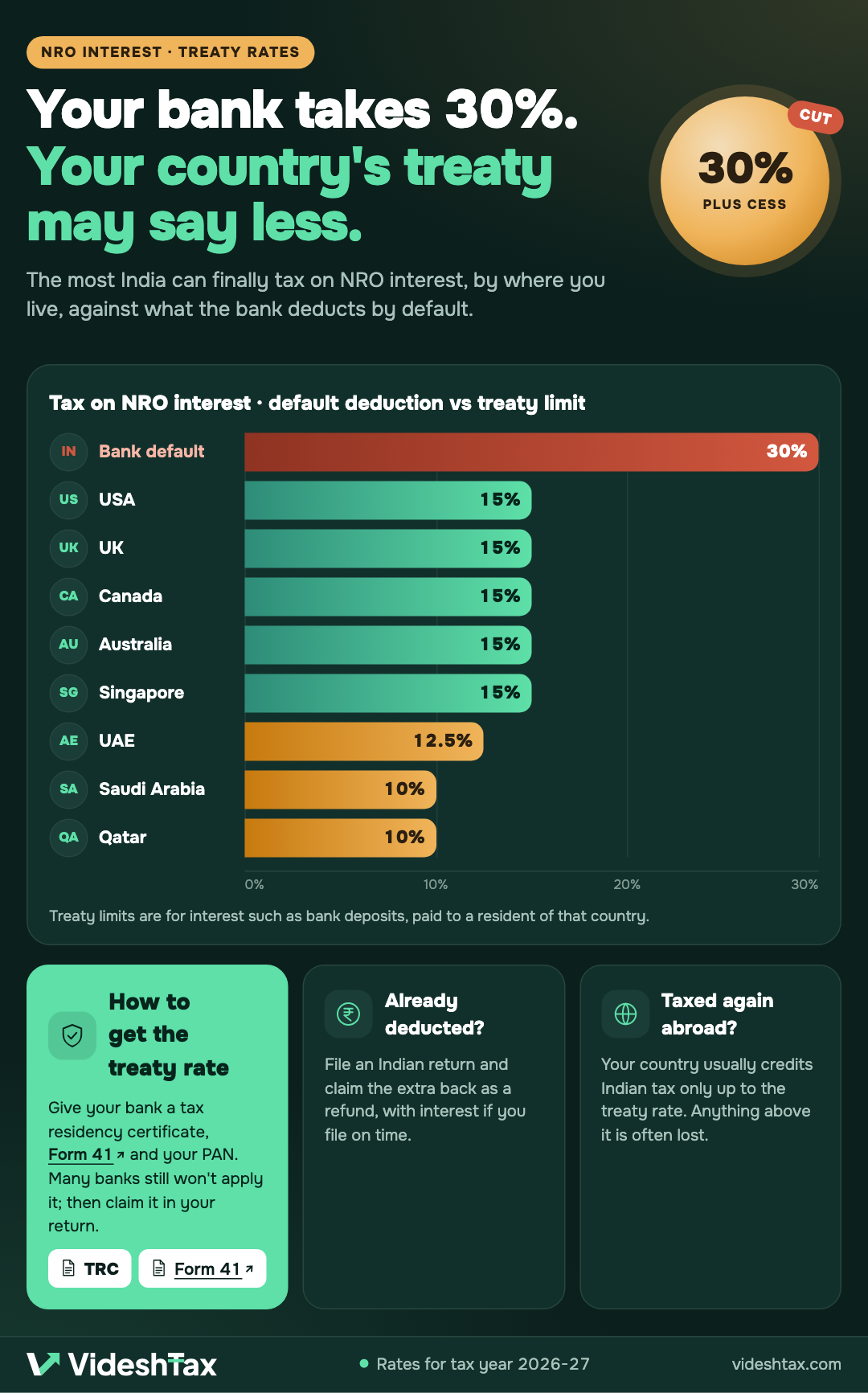
The most India can finally tax on NRO interest, by where you live, against what the bank deducts by default.
Treaty limits are for interest such as bank deposits, paid to a resident of that country.
Give your bank a tax residency certificate, Form 41 and your PAN. Many banks still won't apply it; then claim it in your return.
File an Indian return and claim the extra back as a refund, with interest if you file on time.
Your country usually credits Indian tax only up to the treaty rate. Anything above it is often lost.
What the bank deducts, and what you really owe
Two different numbers are at work. The bank deducts tax at source (TDS) at a flat rate on all your NRO interest, because it can’t see the rest of your finances. Your real tax is worked out later, in your return, on your total Indian income at slab rates. For most people living abroad the second number is much smaller than the first.
| Account or situation | Taxed in India? | What the bank deducts | Law |
|---|---|---|---|
| NRO savings or fixed deposit, PAN given | Yes, at slab rates with your other Indian income | 30% + 4% cess = 31.2%, on every rupee | 2025 Act s. 393(2) Table Sl. 17was s. 195 |
| Very large NRO interest | Yes | Surcharge on top, once the interest paid in the year passes the first surcharge band | 2025 Act s. 393(2) Table Sl. 17was s. 195 |
| No valid PAN with the bank | Yes | The higher of the normal rate or 20%, and the credit isn’t linked to you | 2025 Act s. 397(2)was s. 206AA |
| Treaty rate claimed with a tax residency certificate | Yes, but capped at the treaty rate | The treaty rate, if the bank accepts your papers | 2025 Act s. 159was s. 90 |
| NRE account | No, while you’re non-resident under FEMA | Nothing | 2025 Act Schedule IV Sl. 1was s. 10(4)(ii) |
| FCNR deposit | No, while you’re non-resident or RNOR | Nothing | 2025 Act Schedule IV Sl. 14was s. 10(15)(iv)(fa) |
Why the rate is so high
The rate comes from the Finance Act’s table for non-resident Indians. NRO interest normally falls in the catch-all line, “the whole of the other income”, not the lower line for “investment income”. Investment income only means income from certain assets (shares, listed debentures and deposits of Indian public companies, central government securities) bought with foreign exchange, and NRO money usually came from India. Whether a deposit with a private-sector bank, funded from abroad, counts is a grey area; banks deduct at the higher rate either way, and any difference is settled in your return.
Why there’s no threshold for you
Residents only suffer TDS on bank interest above a yearly threshold, and can file a no-tax declaration to stop it entirely. Neither rule is in the non-resident table, so the bank deducts from the first rupee of interest, however little you earn. The declaration route is for residents only under the 2025 Act. 2025 Act s. 393(2) Table Sl. 17was s. 195
What you really owe
Your NRO interest is added to your other Indian income, such as rent after its deductions, and taxed at slab rates. The new regime is the default for non-residents too, and income up to ₹4,00,000 is taxed at nil. The rebate that cancels tax on somewhat higher incomes is for residents only, so you don’t get it.
If NRO interest is your only Indian income and it’s below the exemption, you owe nothing and the whole deduction is refundable. If you have other Indian income, the interest is taxed at your top slab rate, which is still usually well below the bank’s rate. Only interest pushing your Indian income high into the top slab gets close to what the bank deducted. Long-term capital gains, short-term gains on listed shares and equity funds, and dividends don’t count here. They’re taxed at their own rates, and a non-resident can’t set unused slab room against them, so they never push the interest into a higher slab; they only count toward the surcharge band. Other short-term gains, such as on a flat held for two years or less, or on debt funds, are taxed at slab rates like the interest, so they do.
Step by step
- Give the bank your PAN and current statusMake sure your NRO accounts carry your PAN and that the bank records you as non-resident. Without a PAN, the deduction won’t show against your name and you can’t claim it back.
- Decide whether to cut the deductionIf your real tax will be far below the TDS every year, apply for a lower or nil deduction certificate on TRACES, naming each bank, with Form 128 (was Form 13), or give the bank treaty papers. Both are covered below. 2025 Act s. 395(1)was s. 197
Early in the tax year - Collect the TDS certificatesThe bank issues Form 131 (was Form 16A) each quarter, and gives an interest certificate for the year on request. 2025 Act s. 395(4)was s. 203
- Check the creditsDownload Form 168 (was Form 26AS) from the e-filing portal and match every deduction to the bank’s certificates.
- File your returnReport all NRO interest (we suggest including interest accrued on deposits that haven’t matured), and claim the TDS. Our guide to filing an Indian return from abroad covers the forms and e-verifying from overseas.
31 July 2027 - Receive the refundIt’s paid to a pre-validated Indian bank account, usually your NRO account, with interest if you filed on time.
Worked example
Meera lives in Dubai. She has fixed deposits and a savings account in her NRO account in Kochi, which earn ₹3,20,000 of interest this tax year. She also lets a small flat, leaving ₹1,50,000 of taxable rent after its deductions. She has no other Indian income and uses the new regime.
| Step | Amount |
|---|---|
| NRO interest credited this tax year | ₹3,20,000 |
| Bank deducts TDS at 30% + 4% cess = 31.2%, on every rupee | ₹99,840 |
| Other Indian taxable income | ₹1,50,000 |
| Total Indian income | ₹4,70,000 |
| Tax on the total at new-regime slab rates, with cess | ₹3,640 |
| Less tax on the other income alone | −₹0 |
| Tax the NRO interest adds | ₹3,640 |
The bank has done nothing wrong: it had to deduct on every rupee. Meera’s rent is taxed on its own terms, with its own deduction by her tenant; see renting out property as an NRI for that side. The gap between what the bank held back and what her interest really costs comes back only when she files.
Try your own numbers
Your NRO interest
Pre-filled with Meera's NRO deposits. Change any figure; results update as you type. Amounts are for the whole tax year.
Not your salary abroad. Include rent after its deductions, Indian salary, other Indian interest that isn't in NRE or FCNR accounts, and short-term gains taxed at slab rates (for example on property held two years or less, or debt funds). Leave out long-term gains, short-term gains on listed shares and equity funds, and dividends: for a non-resident they're taxed at their own rates and don't use up your slabs. The full estimator has a separate field for them.
The bank holds back ₹99,840 but the interest only adds ₹3,640 to your tax. You get the difference back when you file your return.
Paying less, and getting the excess back
File a return, even if you don’t have to
You must file if your total Indian income is above the basic exemption. 2025 Act s. 263(1)was s. 139(1) Separate rules make some people file whatever their income, for example when the tax deducted in a year reaches ₹25,000. Our guide on whether NRIs need to file goes through every case.
Even when you don’t have to file, a return is the only way to get excess TDS back. The special exemption from filing for non-resident Indians covers only investment income and long-term gains from foreign-exchange assets, with tax deducted, so it rarely covers ordinary NRO interest. 2025 Act s. 216was s. 115G
Interest on your refund
The department adds simple interest of 0.5% for each month or part month. If you file by the due date, it runs from 1 April after the tax year to the date the refund is paid; file late and it only runs from the date you file. 2025 Act s. 437was s. 244A So a late return costs you interest on your own money as well as time.
A lower or nil deduction certificate
If your NRO interest is steady and your real tax is low every year, you can ask the tax department to tell the bank to deduct less. Apply on TRACES with Form 128 (was Form 13), showing your estimated income for the year. The process is the same one property sellers use, set out in our guide to getting a lower-deduction certificate. Name every bank that pays you interest in the application: the certificate is issued for each bank you name, for a set amount and period, and the bank sees it on TRACES. It only covers interest paid after it’s issued, so apply early and again each year. 2025 Act s. 395(1)was s. 197
A treaty rate
India’s tax treaties cap what India may take from interest paid to a resident of the other country. Under the UK treaty the cap is 15% of the gross interest; under the UAE treaty it’s 12.5%. Both are below the bank’s rate. The Act lets a bank deduct at the treaty rate instead, if you give it a tax residency certificate from your country, Form 41 (was Form 10F), and your PAN. 2025 Act s. 159was s. 90
This is a grey area in practice. Many banks don’t apply treaty rates to NRO interest at all, some only to fixed deposits, and they differ on whether cess goes on top; some tribunals have held it shouldn’t. If your bank won’t apply the treaty rate, you can still claim it in your return and get the excess back. It mainly helps when your Indian income is high enough that slab rates would cost more than the treaty rate. See every country’s rate side by side in the DTAA rate lookup.
Changing status mid-year
The bank goes by how your account is designated, not by the day count that decides your tax status. When you move abroad, tell the bank so your savings account becomes an NRO account; until then it deducts at the resident rate and you may owe the balance. When you move back, have your NRO accounts redesignated as resident accounts, after which the resident rules apply. Work out your status for the year with our guide to counting your days in India, because the year you move is the one most people get wrong.
Joint accounts and deposits that pay at maturity
A joint NRO account’s interest is reported against the first holder’s PAN, at the non-resident rate if the first holder is non-resident. The interest is taxable for whoever’s money it really is, so ask the bank how it records the credit if that’s someone else.
For a cumulative fixed deposit, the bank deducts TDS as interest is credited or provided for, usually every year, even though you receive nothing until maturity. Report the interest in the same years so it matches the TDS. You can instead report it when it’s paid if you always use the cash basis for interest; the TDS credit then moves to that year. Reporting it each year is simpler and avoids mismatch notices. Public sector banks (and government and public financial institution payers) are the exception: the Act lets them deduct only when they actually pay.
Forms, documents and deadlines
| Done | What | Who | When |
|---|---|---|---|
| Your PAN on every NRO account, and non-resident status recorded | You to bank | Before interest is credited | |
| Form 128 (was Form 13) application (optional) | You, on TRACES | Early in the tax year | |
| Tax residency certificate and Form 41 (was Form 10F) (optional) | You to bank | Before interest is credited | |
| Form 131 (was Form 16A) and the yearly interest certificate | Bank to you | Each quarter | |
| Form 168 (was Form 26AS) matched against the certificates | You | Before filing | |
| Indian bank account pre-validated on the e-filing portal | You | Before filing | |
| Return reporting the interest and claiming the TDS | You | 31 July 2027 |
If you live in the UK, the Gulf or elsewhere
India taxes NRO interest first, because it arises in India. Most countries of residence tax it again and give credit for the Indian tax, but only up to what the double taxation agreement lets India keep. Tax the bank held back above that level usually isn’t credited anywhere, so reclaim it from India. Our guide to how tax treaties work for NRIs explains the credit in more detail.
UK residents report Indian interest as foreign savings income. HMRC gives foreign tax credit relief only up to the treaty rate of 15%, so anything the bank deducted above that has to come back from India through your return.
The UAE has no personal income tax on your Indian interest, so the Indian tax is the only tax. Your aim is simply to pay India no more than you owe: file for the refund, or cut the deduction with a certificate or the treaty rate of 12.5%. The same logic applies in other Gulf states without personal income tax.
US citizens and residents report the interest on their US return and claim the Indian tax as a foreign tax credit, limited to the tax India could finally keep. NRO accounts also count towards the foreign account reports, such as the FBAR. On an H-1B or H-4? Our H-1B guide to the FBAR deadline shows how to value NRO accounts, including joint ones with parents.
Canadian residents report worldwide interest to the CRA and claim a foreign tax credit for the Indian tax. Keep your Indian return and TDS certificates as proof of what India finally kept.
Australian residents include the interest in their return and claim a foreign income tax offset for the Indian tax actually payable, not the excess the bank deducted.
Singapore generally doesn’t tax foreign-sourced interest that individuals receive, so the Indian tax is usually the only tax. Getting the Indian refund is the whole job.
Common mistakes
- Not filing because “the bank already deducted tax”. That leaves the refund, often most of the TDS, with the tax department.
- Leaving out interest accrued on fixed deposits that haven’t matured. The TDS on it shows in your annual statement, and the mismatch can bring a notice.
- Forgetting to tell the bank you’ve moved abroad, or back. The wrong rate is deducted until the account is redesignated.
- Claiming credit abroad for the full TDS before the Indian refund. The credit should match the tax India finally keeps.
When to get a CA
Get one if your NRO interest and other Indian income together are high enough for surcharge or the top slab, since the treaty-versus-slab comparison then matters; if you want a lower-deduction certificate or treaty rate and your bank pushes back; if the TDS doesn’t show against your PAN; if you changed residency status during the year; or if you’ve had a notice about unreported interest.
Next steps
Questions people ask
Why does my bank deduct TDS on NRO interest when my resident friends pay nothing?
Residents get a threshold below which no TDS is deducted, and can give the bank a declaration that their income is below the taxable limit. Neither applies to a non-resident. The non-resident rule has no threshold and no declaration, so the bank deducts at the full rate from the first rupee. The tax you finally owe is the same kind of slab-rate tax a resident pays; only the deduction is different.
Can I give my bank a declaration so it doesn't deduct TDS?
No. The no-tax declaration that stops TDS on a resident's interest is only for residents under the 2025 Act. Your options are a lower or nil deduction certificate from the tax department, which the bank must follow, or a treaty rate backed by your tax residency certificate. Otherwise the deduction stands and you claim the excess back in your return.
How long does the NRO TDS refund take?
Once you file and e-verify, most straightforward refunds are processed within a few months. The department adds interest at 0.5% a month from 1 April after the tax year, if you filed on time. Delays usually come from a bank account that isn't pre-validated on the e-filing portal, or a credit that doesn't show against your PAN.
Do I pay tax on NRO interest if I also pay tax on it where I live?
India taxes it first, because the interest arises in India. Your country of residence may tax it again and give you credit for the Indian tax, usually only up to the treaty rate. That's why reclaiming the excess from India matters: the part above what India can finally keep is rarely credited abroad.
My NRO account is joint with my mother, who lives in India. Whose PAN gets the TDS?
The bank deducts against the first holder's PAN, at the non-resident rate if you're the first holder. The interest is taxable in the hands of whoever's money it is. If the money is really your mother's, ask the bank whether it will show the credit against her PAN instead; practice varies, and without that she can't claim the TDS.
Is interest on my NRO fixed deposit taxed every year or only when it matures?
Usually every year, and that's the simplest way to report it. Banks deduct TDS as interest is credited or provided for, which for a cumulative deposit is at least once a year, even though you receive nothing until maturity. Report the interest in the same years the bank deducts on it, so the TDS and the income match.
Sources
- Income-tax Act, 2025: s. 2(90) (rates in force), s. 202 (new regime), ss. 212–216 (non-resident Indians), s. 263 (returns), s. 393(2) Table Sl. 17 and Note 3, s. 395 and s. 397(2) (TDS, certificates, PAN), s. 437 (interest on refunds), Schedule IV Sl. 1 and 14 (NRE and FCNR interest)egazette.gov.in
- Finance Act, 2026: First Schedule Part II, TDS rates for non-resident Indians and surcharge on TDSegazette.gov.in
- Income Tax Department: Form 168 (was Form 26AS), annual tax statementincometaxindia.gov.in
- Income Tax Department: Form 128, application for a lower or nil TDS certificateincometaxindia.gov.in
- Income Tax Department: Form Mapping Guide, Income-tax Act 1961 to 2025 formsincometax.gov.in
- India–UK Double Taxation Convention, Article 12 (interest), HMRC's published textassets.publishing.service.gov.uk
- Income Tax Department: India–UAE comprehensive agreementincometaxindia.gov.in
- RBI FAQs: accounts in India by non-residents (NRE and NRO)rbi.org.in