

Rent from Indian property is taxed in India at slab rates, after municipal taxes, a flat 30% standard deduction and home-loan interest. Your tenant must still deduct TDS at 30% plus cess on the full rent, usually far more than you owe. File a return each year to get the difference back.
Is this you? This guide covers rent from property you own directly in India, let to a tenant. Selling the property instead? See tax when you sell as an NRI. Renting out a home you inherited? The rent rules here still apply; for the sale later, see tax on inherited property.
This assumes you're a non-resident for the whole tax year. Moving back this year? Check your residency status first, because the answer can change.
This guide is part of our guide to property tax for NRIs, which also covers buying, selling and inheriting. Here we follow one year of rent, from the tenant’s first payment to the refund in your account.
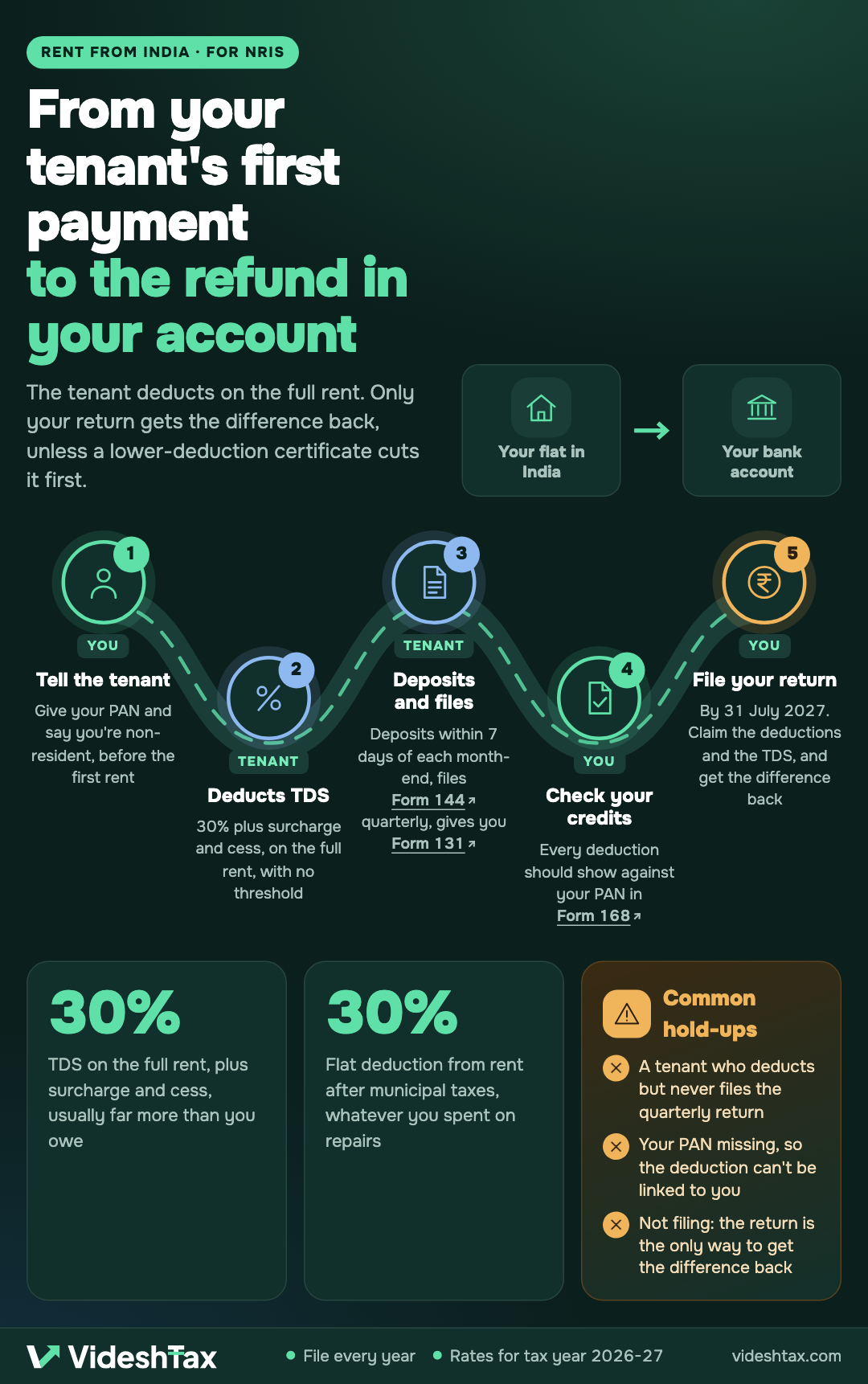
The tenant deducts on the full rent. Only your return gets the difference back, unless a lower-deduction certificate cuts it first.
- 1YouTell the tenant
Give your PAN and say you're non-resident, before the first rent
- 2TenantDeducts TDS
30% plus surcharge and cess, on the full rent, with no threshold
- 3TenantDeposits and files
Deposits within 7 days of each month-end, files Form 144 quarterly, gives you Form 131
- 4YouCheck your credits
Every deduction should show against your PAN in Form 168
- 5YouFile your return
By 31 July 2027. Claim the deductions and the TDS, and get the difference back
TDS on the full rent, plus surcharge and cess, usually far more than you owe
Flat deduction from rent after municipal taxes, whatever you spent on repairs
- A tenant who deducts but never files the quarterly return
- Your PAN missing, so the deduction can't be linked to you
- Not filing: the return is the only way to get the difference back
How rent is taxed
India taxes rent from Indian property wherever you live. It’s taxed as “income from house property”, and the tax is worked out on what’s left after three deductions, not on the rent itself.
| Step | What you do | Law |
|---|---|---|
| Rent for the year | Rent received or due for the months it was let. If the property could reasonably fetch more, that higher figure is used, unless the gap is only because it stood empty. | 2025 Act s. 21was s. 23 |
| Less municipal taxes | Property tax you actually paid to the local body in the tax year, whenever it fell due | 2025 Act s. 21was s. 23 |
| Less standard deduction | 30% of what’s left, whatever you actually spent on repairs | 2025 Act s. 22was s. 24 |
| Less home-loan interest | All the interest on a loan used to buy, build or repair a let-out property | 2025 Act s. 22(1)(b), cap in 22(2)was s. 24(b) |
| Taxable rent | Added to your other Indian income and taxed at slab rates |
The standard deduction replaces everything you spend on repairs, painting, maintenance and agents’ fees. You can’t claim those separately, even with receipts. Society maintenance charges aren’t deductible either, unless they are really a municipal tax.
The tax rate
Your taxable rent is added to your other Indian income, such as interest on an NRO account, and taxed at the normal slab rates. The new regime is the default, and you can choose the old regime instead, but only in a return filed by the due date. Both give non-residents the basic exemption, but the rebate that wipes out tax on lower incomes for residents isn’t available to you.
Empty months and empty flats
If the flat is let for part of the year and empty for the rest, you’re taxed on the rent you received or were owed. You don’t pay tax on rent you never got. A flat that isn’t let at all is different: up to 2 homes you keep for your own use count as nil, but beyond that an empty home is taxed on the rent it could reasonably fetch. 2025 Act s. 21was s. 23
Why your tenant deducts so much
Any tenant paying rent to a non-resident must deduct tax at source (TDS) before paying you. The rate is 30% plus surcharge and cess, on the full rent, with no threshold. 2025 Act s. 393(2) Table Sl. 17was s. 195 The lighter rule that lets individual tenants deduct a small percentage once a year applies only to resident landlords.
Your tenant can’t see your deductions, so they deduct on the whole rent. They need a TAN for this (the relief from 1 October 2026 covers property purchases, not rent), deposit the tax within 7 days of the end of each month, file Form 144 (was Form 27Q) each quarter and issue you Form 131 (was Form 16A). 2025 Act s. 397(1)was s. 203A
Step by step
- Tell the tenant you’re non-residentGive them your PAN and residency status in writing before the first payment, and ask them to get a TAN if they don’t have one. Without your PAN the deduction can’t be linked to you, and you won’t get credit for it when you file.
- Choose the accountHave the rent paid into your NRO account in India.
- Apply for a lower-deduction certificate, if it’s worth itIf your real tax is much lower than the TDS, apply on TRACES with Form 128 (was Form 13). The tenant then deducts at the rate on the certificate. 2025 Act s. 395(1)was s. 197
Early in the tax year - Keep the paperworkRent agreement, municipal tax receipts and your lender’s interest certificate. Collect the tenant’s TDS certificate each quarter.
- Check the creditsBefore you file, make sure every deduction shows against your PAN in Form 168 (was Form 26AS).
- File your returnReport the rent, claim the deductions and the TDS, and get back the difference.
31 July 2027
Worked example
Priya lives in London. She lets her flat in Pune for ₹35,000 a month all year. She pays ₹12,000 in property tax and ₹1,50,000 in interest on the home loan she took to buy it. She has no other Indian income and uses the new regime.
| Income from the flat this tax year | Amount |
|---|---|
| Rent received (₹35,000 × 12 months) | ₹4,20,000 |
| Less municipal tax paid | −₹12,000 |
| Annual value | ₹4,08,000 |
| Less standard deduction (30%) | −₹1,22,400 |
| Less home-loan interest | −₹1,50,000 |
| Taxable rental income | ₹1,35,600 |
The tenant doesn't see any of those deductions. They deduct 31.2% (the rate plus any surcharge and cess) on the whole ₹4,20,000 of rent.
The tenant has done nothing wrong: they had to deduct on the whole rent. The gap between what they held back and what Priya owes only comes back when she files a return.
Paying less, and getting the excess back
Claim every deduction
The 30% standard deduction is automatic, but municipal tax only counts in the year you actually pay it, so keep the receipts. Home-loan interest on a let-out property has no cap. Interest for the years before the flat was finished is claimed in 5 equal yearly instalments from the year it’s completed. 2025 Act s. 22(1)(b), cap in 22(2)was s. 24(b) Principal repayments don’t count against rent. For the loan side in more detail, see our guide to home-loan deductions for NRIs.
If the interest is more than the rent, you have a loss. Under the old regime, up to ₹2,00,000 of it can be set off against your other Indian income each year, and the rest carried forward for up to 8 years against future rent. 2025 Act s. 109(1)(b)was s. 71(3A) Under the new regime a house-property loss can’t be set off against other income, and it can’t be carried forward either: the law treats it as used up. That can make the old regime better for a landlord with a large loan.
Get the tenant to deduct less
If you know your real tax will be well below the TDS, apply for a lower-deduction certificate. It works for rent just as it does for a sale, and it’s valid for the tax year it’s issued for, so apply again each year. Our guide to the lower TDS certificate application covers what to attach. Give the tenant a copy as soon as it’s issued; they can’t apply it to rent already paid.
File and claim the refund
The refund only comes through a return. File by 31 July 2027, e-verify it, and make sure your Indian bank account is pre-validated on the e-filing portal, because that’s where the refund goes. Most delays come from a tenant who deducted but never filed their quarterly return, so the credit doesn’t show against your PAN. Chase them before you file.
Where the rent goes, and getting it abroad
The RBI treats rent as current income. It can be credited to your NRO account and sent abroad once the tax is paid, with Form 145 (was Form 15CA) and, where the bank asks for it, Form 146 (was Form 15CB). Current income doesn’t count towards the USD 1 million a year you can move from other NRO balances.
Forms, documents and deadlines
| Done | What | Who | When |
|---|---|---|---|
| Your PAN and a note that you’re non-resident | You to tenant | Before the first rent | |
| Form 128 (was Form 13) application (optional) | You, on TRACES | Early in the tax year | |
| TDS deposited each month | Tenant | Within 7 days of each month-end | |
| Form 144 (was Form 27Q) quarterly return | Tenant | Each quarter | |
| Form 131 (was Form 16A) | Tenant to you | After each quarterly return | |
| Municipal tax receipts and lender’s interest certificate | You | Before filing | |
| Return reporting the rent and claiming the TDS | You | 31 July 2027 |
If you live in the US, UK or elsewhere
India’s tax treaties let India tax rent from property in India first. Most countries of residence tax the same rent again and give you credit for the Indian tax, under the double taxation agreement and their own law. The credit is for the Indian tax you finally owe, not the larger amount the tenant deducted, so file in India first.
US citizens and residents report the rent on their US return, with US depreciation and expenses rather than the Indian standard deduction. The Indian tax is claimed as a foreign tax credit, which usually means a separate form for passive income.
Claiming Indian tax as a US credit US section
UK residents report the rent as overseas property income and claim credit for the Indian tax under the India–UK treaty. UK rules on allowable expenses differ from India’s flat deduction, so work out both separately.
India–UK tax treaty guide
Canadian residents report worldwide rental income to the CRA and claim a foreign tax credit for the Indian tax. Keep your Indian return and TDS certificates as proof.
India–Canada tax treaty guide
The UAE has no personal income tax, so Indian tax is the only tax on the rent. Your main job is getting the Indian refund, or a certificate so less is deducted.
India tax for NRIs in the UAE
Australian residents include the rent in their return and claim a foreign income tax offset for the Indian tax. Australian deductions for the property follow Australian rules, not India’s flat rate.
India–Australia tax treaty guide
Singapore generally doesn’t tax foreign-sourced income that individuals receive there, so the Indian tax is usually the only tax. Check with an adviser if the rent is part of a business.
India–Singapore tax treaty guide
There’s no lower treaty rate for rent: the treaty lets India tax it under its own rules. Your country of residence gives the credit, and may ask for your Indian return and the tenant’s TDS certificates as proof.
Common mistakes
- Agreeing with the tenant to skip TDS “to keep it simple”. The tenant becomes liable, and you still owe the tax.
- Claiming repairs, agents’ fees or society charges on top of the standard deduction. The flat deduction replaces them.
- Not filing because “tax was already deducted”. That leaves the refund, often most of the TDS, unclaimed.
- Claiming the foreign tax credit abroad on the full TDS, before the Indian refund. The credit should match the Indian tax you finally owe.
When to get a CA
Get one if the loan interest is more than the rent, since the choice between regimes then matters; if you own several properties or one jointly; if you want a lower-deduction certificate; or if you’ve had a notice about unreported rent or a TDS mismatch. If you’re thinking of selling instead, a CA can also compare keeping the flat with selling and using the reinvestment exemptions on a sale.
If you later decide to sell, the gain is worked out from what you paid, not from the rent: see capital gains on property.
Next steps
Questions people ask
My tenant says they don't need to deduct TDS. Are they right?
Not if you're non-resident. Any tenant paying rent to an NRI must deduct tax at the non-resident rate, whatever the amount and whether they are an individual or a company. The lighter rule for individual tenants applies only to resident landlords. If the tenant doesn't deduct, they are liable for the tax and interest, and you still owe the tax yourself. Tell them early, before the first rent is paid.
Does my tenant need a TAN?
Yes. Unlike a buyer of property, who from 1 October 2026 can pay through a PAN-based form, a tenant paying rent to an NRI still needs a TAN. They deposit the tax each month, file Form 144 every quarter and give you Form 131. Applying for a TAN online is quick and costs very little, so it isn't a reason to skip the deduction.
Can the rent go straight into my NRE account?
The usual home for rent is your NRO account. The RBI treats current income such as rent as a permitted credit to NRE too, but banks often ask for proof that tax has been paid first. Ask your bank how it handles rent before you give the tenant account details. From NRO, rent (net of tax) can be sent abroad with Form 145 and, where needed, a CA's Form 146.
My flat was empty for part of the year. Do I pay tax on rent I didn't get?
No, not for a flat you normally let out. If it was let for part of the year and empty for the rest, you are taxed on the rent you actually received or were owed. A flat nobody lives in all year is different: up to 2 homes you keep for yourself are taxed at nil, but beyond that an empty home is taxed on the rent it could fetch.
Do I have to file a return if TDS has already been deducted?
You must file if your Indian income is above the basic exemption limit, and it is almost always worth filing anyway. The tenant deducts on the full rent, without your standard deduction, municipal tax or loan interest, so the deduction is usually far more than your real tax. The return is the only way to get that back.
I own the flat jointly with my spouse. How is the rent taxed?
Each co-owner is taxed on their own share of the rent, and each gets their own deductions and slab rates. The tenant should split the rent and deduct TDS separately against each owner's PAN. If only one of you is non-resident, only that share attracts TDS at the non-resident rate.
Sources
- Income-tax Act, 2025: ss. 20–24 (house property), 109–110 (losses), 202 (new regime), 393(2) and 395 (TDS and certificates)egazette.gov.in
- Finance Act, 2026: TDS rates, surcharge and cess; amendments to ss. 22 and 397egazette.gov.in
- RBI FAQs: accounts in India by non-residents (NRE and NRO)rbi.org.in
- Income Tax Department: Form 128, application for a lower or nil TDS certificateincometaxindia.gov.in
- Income Tax Department: Form 168 (was Form 26AS), annual tax statementincometaxindia.gov.in
Update log
- First published.