

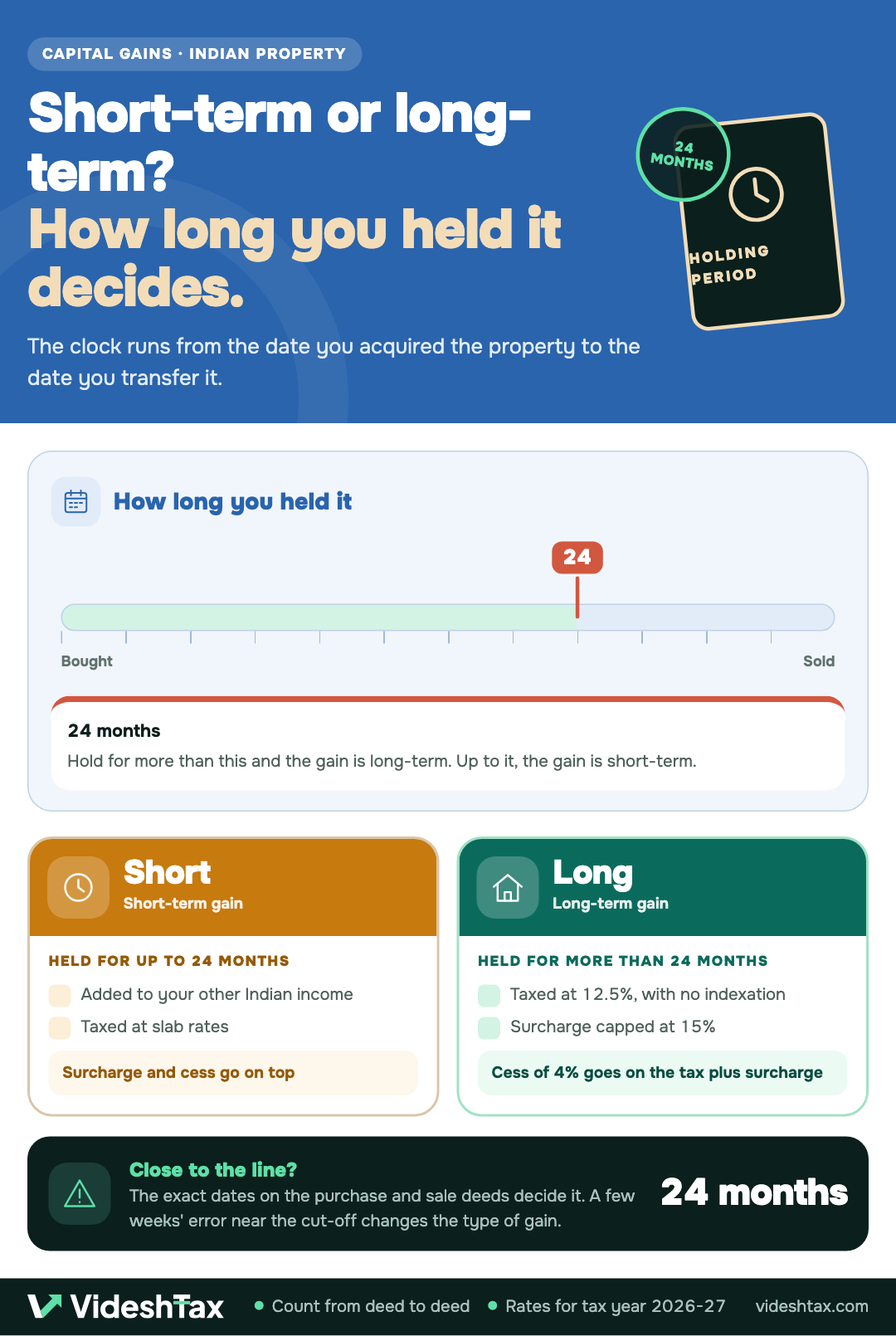
Your gain is the sale price minus what you paid, what you spent improving the property, and the costs of selling it. Held for more than 24 months, it's a long-term gain taxed at 12.5%, with no adjustment for inflation. Held for less, it's added to your other Indian income and taxed at slab rates. Surcharge and cess go on top of both.
Is this you? This explainer covers residential and commercial property you own directly. Selling agricultural land or a property you inherited? The cost and holding-period rules differ: see selling agricultural land as an NRI and tax on inherited property.
This assumes you're a non-resident for the whole tax year. Moving back this year? Check your residency status first, because the answer can change.
This explainer is part of our guide to property tax for NRIs. It covers one question: how much of your sale price is taxable gain, and at what rate.
The clock runs from the date you acquired the property to the date you transfer it.
Hold for more than this and the gain is long-term. Up to it, the gain is short-term.
- Added to your other Indian income
- Taxed at slab rates
Surcharge and cess go on top
- Taxed at 12.5%, with no indexation
- Surcharge capped at 15%
Cess of 4% goes on the tax plus surcharge
The exact dates on the purchase and sale deeds decide it. A few weeks' error near the cut-off changes the type of gain.
The rule in plain English
India taxes the gain on Indian property wherever you live. Two things decide the tax: how long you held the property, and how much of the price is really profit.
Short-term or long-term
The clock runs from the date you acquired the property to the date you transfer it. 2025 Act s. 2(101)was s. 2(42A)
| Held for | Type of gain | How it’s taxed for an NRI |
|---|---|---|
| Up to 24 months | Short-term | Added to your other Indian income and taxed at slab rates |
| More than 24 months | Long-term | 12.5%, with no indexation 2025 Act s. 197was s. 112 |
A long-term capital gain is usually the cheaper of the two. A short-term gain is added to your other Indian income and taxed at the slab rates, so what it costs depends on how much else you earn in India.
Working out the gain
Start with the sale price and take away three things. 2025 Act s. 72was s. 48
- Your cost: the price you paid, plus stamp duty, registration and brokerage when you bought.
- Improvements: capital spending that added to the property, such as an extra room or a new floor. Routine repairs and upkeep don’t count. 2025 Act s. 90was s. 55
- Selling costs: brokerage, legal fees and other spending wholly for the sale.
If you owned the property before 1 April 2001, you can use its fair market value on that date as your cost instead, capped at the stamp duty value then. And if you sell below the stamp duty value, that value can be treated as your sale price, unless it’s no more than 110% of the price you agreed. 2025 Act s. 78was s. 50C
The rate, surcharge and cess
On a long-term gain the rate is 12.5%. Surcharge is added once your total Indian income passes a threshold, capped at 15% on a long-term gain (a short-term gain is slab income and can attract more), and a 4% cess goes on the tax plus surcharge.
One relief residents get is closed to you. A resident whose other income is below the basic exemption limit can use the unused part against the gain; an NRI can’t.
No indexation for NRIs
Residents selling land or a building bought before 23 July 2024 can compare 20% on an inflation-adjusted gain with 12.5% on the plain gain, and pay the lower. That choice is written for residents only. As a non-resident, you pay the flat rate on your actual cost, however long ago you bought.
Three examples
Each example assumes no other Indian income and the new regime, and each cost already includes the buying and selling costs.
Yes: a clear long-term gain
Priya lives in London. She bought a flat in Hyderabad ten years before selling it. Her cost counts the purchase price, stamp duty and registration, a new kitchen she paid for, and the brokerage on the sale.
| Their actual tax | Amount |
|---|---|
| Long-term gain (₹92,00,000 − ₹52,00,000) | ₹40,00,000 |
| Tax at 12.5% | ₹5,00,000 |
| Surcharge | ₹0 |
| Cess | ₹20,000 |
| Tax actually owed | ₹5,20,000 |
Without a certificate, the buyer deducts the same rate plus its own surcharge band and cess on the whole ₹92 lakh.
No: a short-term gain
Vikram lives in Singapore. He bought a flat in Pune and sold it before the long-term holding period was up, so the gain is short-term.
| Their actual tax | Amount |
|---|---|
| Short-term gain (₹88,00,000 − ₹80,00,000) | ₹8,00,000 |
| Tax at new-regime slab rates (no rebate for a non-resident) | ₹20,000 |
| Surcharge | ₹0 |
| Cess | ₹800 |
| Tax actually owed | ₹20,800 |
Without a certificate, the buyer deducts at the top slab rate, 30%, plus its own surcharge band and cess on the whole ₹88 lakh.
Edge case: sold on the cut-off
Meera lives in Toronto. She registered the sale exactly 24 months after she bought. The gain is long-term only if you hold for more than that, so hers is still short-term.
| Their actual tax | Amount |
|---|---|
| Short-term gain (₹70,00,000 − ₹60,00,000) | ₹10,00,000 |
| Tax at new-regime slab rates (no rebate for a non-resident) | ₹40,000 |
| Surcharge | ₹0 |
| Cess | ₹1,600 |
| Tax actually owed | ₹41,600 |
Without a certificate, the buyer deducts at the top slab rate, 30%, plus its own surcharge band and cess on the whole ₹70 lakh.
Had Meera registered the sale a few weeks later, the same gain would have been long-term. When you’re close to the line, the exact dates on the purchase and sale deeds decide it.
Try your own sale price, cost and dates.
Capital gains on your sale
Pre-filled with Priya's flat in Hyderabad, sold in Aug 2026. Change any figure; results update as you type.
How it interacts with TDS, exemptions and losses
TDS. The buyer deducts tax before paying you, but on the whole price rather than your gain, so the amount held back is usually far more than the tax. To stop that, apply for a lower-deduction certificate before you sign.
Exemptions. A long-term gain can be cut or removed by buying another home in India or putting money into capital-gain bonds. 2025 Act s. 82was s. 54 2025 Act s. 85was s. 54EC Our guide to saving tax on a property sale sets out the windows and caps.
Losses. A short-term capital loss can be set against any capital gain in the same year; a long-term loss only against long-term gains. 2025 Act s. 108was s. 70 Neither can be set against rent, salary or interest. What’s left can be carried forward for 8 years, but only if you file your return on time. 2025 Act s. 111was s. 74
Rent. Rent you earned while you owned the property is taxed separately each year, not as part of the gain. See tax on rent from your Indian flat.
For the sale from start to finish, including moving the money abroad, read the NRI property-selling guide.
Common mistakes
- Applying indexation to the cost. It’s only open to residents.
- Counting repairs, society charges or loan interest already claimed as improvements.
- Getting the holding period wrong by a few weeks near the cut-off.
When to get a chartered accountant
Get one if the property was bought under construction, inherited, or owned before 1 April 2001, or if the sale price is below the stamp duty value. Those are the cases where the cost or the dates are open to argument.
Next steps
Questions people ask
Can I use indexation on a property I bought years ago?
No. A resident individual or HUF selling land or a building bought before 23 July 2024 can compare 20% on an inflation-adjusted gain with 12.5% on the plain gain, and pay the lower. The Act limits that choice to residents. As an NRI you pay 12.5% on your actual cost.
When does the holding period start and end?
It usually runs from the date you acquired the property to the date you transfer it, which for most sales is the registered sale deed. For a flat bought under construction, the start date can be the allotment rather than possession; that point is often disputed, so get a CA to look at your papers if the dates are close to the cut-off.
Can I deduct home-loan interest from the gain?
Not if you've already claimed it against rent or as a deduction in your returns. The Act bars counting the same interest twice. Interest you never claimed anywhere is a harder question, and a CA should look at it before you add it to your cost.
Is the gain taxed in the country where I live too?
Often, yes. The US and Canada tax their residents on worldwide gains and give credit for the Indian tax you paid. The UK does too, unless you're a recent arrival claiming its foreign income and gains relief. Australia does for permanent residents and citizens, but not for most temporary visa holders. The UAE has no personal income tax. Your country's rules decide how the credit works.
Sources
- Income-tax Act, 2025: s. 2(101) (short-term capital asset), s. 72 (computation), s. 78 (stamp duty value), s. 90 (cost), ss. 108–111 (losses), s. 197 (long-term rate)egazette.gov.in
- Finance Act, 2026: surcharge and cess (First Schedule)egazette.gov.in
- Income Tax Department: set off and carry forward of lossesincometax.gov.in
Update log
- First published.