
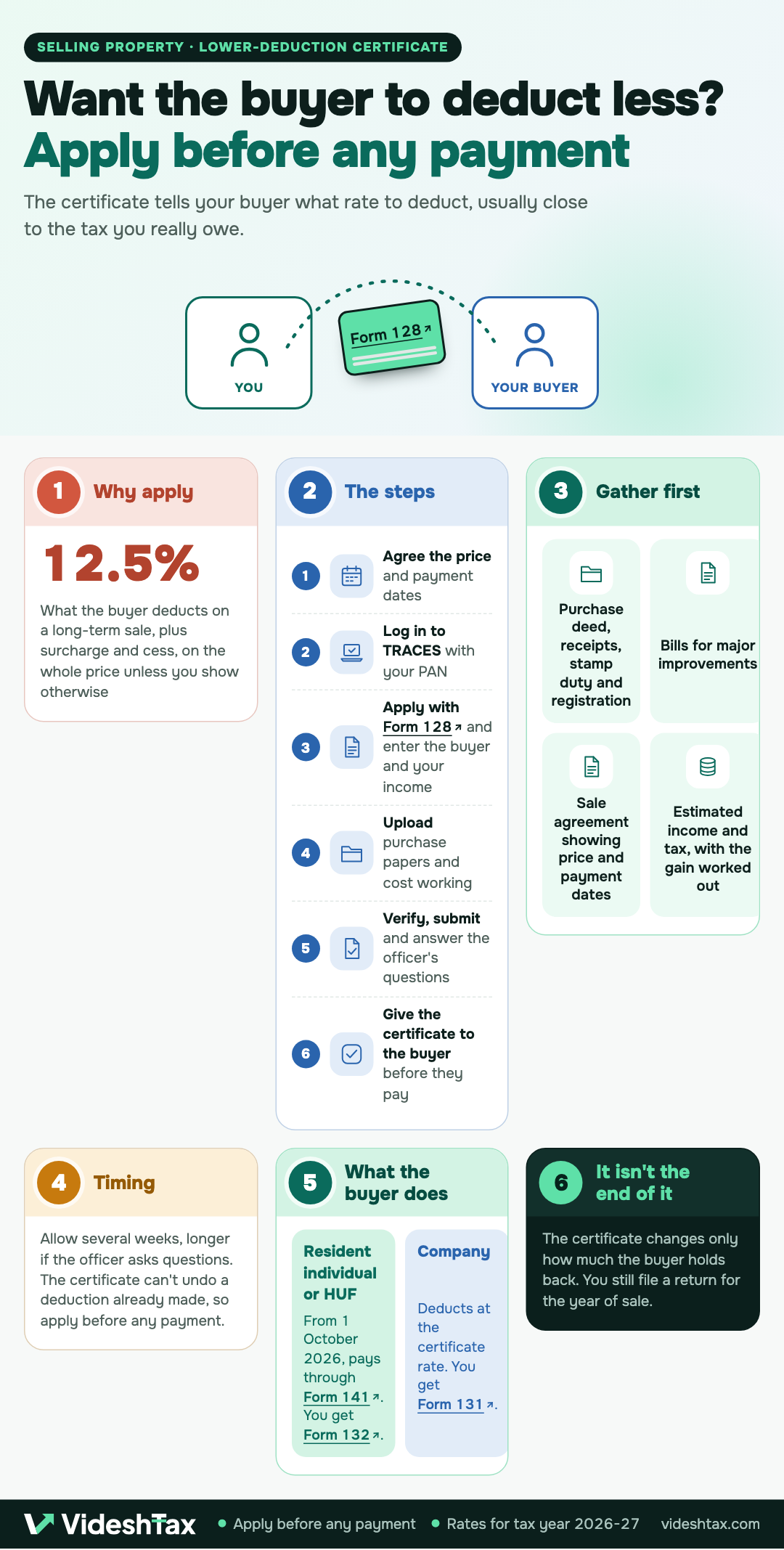
You need one whenever the buyer would otherwise hold back more than your real tax: almost always. A buyer paying an NRI deducts 12.5% plus surcharge and cess on a long-term sale, worked out on the whole price unless you show otherwise. Apply on TRACES using Form 128 (was Form 13), with your cost working, once you've agreed a price, before any payment. The buyer then deducts at the certificate's rate.
Is this you? This guide covers the seller's application for property you own directly. Still weighing up the sale as a whole? Start with selling property in India as an NRI. Selling while resident? The buyer uses the flat resident-seller rule instead, and you rarely need this certificate.
This assumes you're a non-resident for the whole tax year. Moving back this year? Check your residency status first, because the answer can change.
This guide is part of our guide to property tax for NRIs. It covers one job: getting the tax office to tell your buyer to deduct less, before the money changes hands.
The certificate tells your buyer what rate to deduct, usually close to the tax you really owe.
What the buyer deducts on a long-term sale, plus surcharge and cess, on the whole price unless you show otherwise
Agree the price and payment dates
Log in to TRACES with your PAN
Apply with Form 128 and enter the buyer and your income
Upload purchase papers and cost working
Verify, submit and answer the officer's questions
Give the certificate to the buyer before they pay
Allow several weeks, longer if the officer asks questions. The certificate can't undo a deduction already made, so apply before any payment.
The certificate changes only how much the buyer holds back. You still file a return for the year of sale.
Do you need it?
When you sell as a non-resident, the buyer must deduct tax deducted at source before paying you and pay it to the government. 2025 Act s. 393(2) Table Sl. 17was s. 195 The rate is the capital-gains rate plus surcharge and cess. The buyer can’t see what you paid for the property, and they’re liable for any shortfall, so in practice they deduct on the whole sale price, as if all of it were profit.
A lower-deduction certificate fixes that. You apply to the tax officer with your cost working, and the certificate tells the buyer what rate to deduct, usually close to the tax you really owe. 2025 Act s. 395(1)was s. 197 Apply if any of these is true:
- You’ve held the property for years and the gain is much smaller than the price. This is most sellers.
- You’re selling at a loss or close to cost. Without a certificate, the buyer still deducts on the full price.
- You’re reinvesting the gain in another home or in capital-gain bonds, so little or no tax will be due.
- You need the money soon, for a purchase abroad or to repay a loan, and can’t wait for a refund.
You may not need one if the gain really is most of the price, for example land bought decades ago for very little. Even then, a CA can check whether the certificate rate would differ enough to be worth the wait.
What it saves: an example
Rahul lives in Dubai. He sells the flat he bought in Bengaluru, and his cost includes the stamp duty and registration he paid when he bought it. He has no other Indian income that tax year.
| Their actual tax | Amount |
|---|---|
| Long-term gain (₹95,00,000 − ₹70,00,000) | ₹25,00,000 |
| Tax at 12.5% | ₹3,12,500 |
| Surcharge | ₹0 |
| Cess | ₹12,500 |
| Tax actually owed | ₹3,25,000 |
Without a certificate, the buyer deducts the same rate plus its own surcharge band and cess on the whole ₹95 lakh.
Put in your own sale price and cost to see how much a certificate would free up.
TDS on your sale
Pre-filled with Rahul's flat in Bengaluru's sale. Change any figure; results update as you type.
What you need before you start
The application is only as good as your cost working. If you haven’t done that yet, work out your capital gain first: the holding period, your cost and your expenses all feed into the rate you ask for.
| Done | What | Who | When |
|---|---|---|---|
| Your PAN, and a taxpayer login on TRACES | You | Before you apply | |
| Purchase deed, payment receipts, stamp duty and registration receipts | You | Before you apply | |
| Bills for major improvements (extensions, a new floor, a full refit) | You | Before you apply | |
| Draft or signed sale agreement showing the price and payment dates | You and the buyer | Before you apply | |
| Buyer’s name and PAN, and TAN if the buyer is a company or firm | Buyer to you | Before you apply | |
| Estimated income and tax for the tax year, with the gain worked out | You or a CA | Before you apply | |
| Your returns for each earlier tax year the form asks about, or a computation of your income for any year you didn’t file | You | Before you apply | |
| Proof of a planned reinvestment, if you’re claiming an exemption | You | Before you apply |
If the lower rate depends on buying another home or bonds, the officer will want to see the plan. Our guide to reinvesting the gain to pay less tax sets out what each exemption needs.
Steps
The application is made online, on the TRACES portal, and verified electronically. Menu names change from time to time, so treat the labels below as a guide.
- Agree the price and the payment datesSettle the price, the buyer and the payment dates. You need these for the application, and the certificate must be in the buyer’s hands before they pay. If a token or advance will be paid when you sign, the buyer must deduct on it too, so get the certificate first or keep that payment small.
Before any payment - Log in to TRACES as a taxpayerUse your PAN. If you’ve never registered, register first, and allow time for this.
- Open the lower-deduction applicationChoose Form 128 (was Form 13) from the forms you can file, and pick the category that fits an individual selling property.
- Enter the buyer and the paymentAdd the buyer’s details, the sale price and when each payment is due. Two buyers means one entry, and one certificate, for each.
- Enter your income and the tax on itGive your estimated Indian income for the tax year, including the gain, and the tax you expect to owe.
- Upload your documentsAttach the purchase papers, the draft agreement and your cost working.
- Verify and submitVerify electronically and note the acknowledgement number the portal gives you.
- Answer any questionsThe officer may ask for more papers through the portal or by email. Reply quickly; an unanswered query can hold up or close the application.
- Download the certificate and send it to the buyerOnce it’s issued, download it from TRACES and give a copy to the buyer before they make the payment it covers.
Before payment
After you submit: timelines and what can go wrong
Allow several weeks, and more if the officer comes back with questions, and build that into your sale date. Track the application on TRACES rather than waiting for an email.
The certificate is issued in the name of the buyer, the person who deducts the tax, and copied to you. It states the rate, the amount it covers and the period of the tax year it runs for. The officer can cancel it before it expires.
What the buyer does with it
How the buyer uses the certificate depends on who they are. From 1 October 2026, a resident individual or HUF buying from you no longer needs a TAN. 2025 Act s. 397(1)was s. 203A
| Buyer | How they deduct and report | What you get |
|---|---|---|
| Resident individual or HUF, paying on or after 1 October 2026 | Pays the TDS with their own PAN through Form 141 (was Form 26QB), quoting your certificate number in the property schedule | Form 132 |
| Company, firm or other buyer, or any buyer paying earlier | Deducts under their TAN at the certificate rate and quotes the certificate in the quarterly Form 144 | Form 131 |
Each buyer reports separately, so two buyers means two filings and two certificates for you. Check your Form 168 a few weeks after each payment: the deduction should show against your PAN at the certificate rate.
The same application works for rent. If a tenant deducts at the flat non-resident rate but your real tax is lower, see how rent from Indian property is taxed before applying for that too.
Common mistakes
- Letting the buyer pay a token or advance before the certificate is issued. The certificate can’t cover a deduction already made.
- Getting one certificate for a flat with two buyers. Each buyer needs their own.
- A buyer who deducts at the full rate anyway because the certificate reached them late or named someone else.
- Treating the certificate as the end of it. You still file a return for the year of sale.
When to get a chartered accountant
Get one to prepare the cost working and file the application if the property was inherited, bought in instalments, jointly owned, or bought before 1 April 2001. Get one too if you’re claiming a reinvestment exemption, or if you haven’t filed Indian returns for earlier years, since the officer looks at your past record: the form asks you to declare your past returns, so a gap needs a computation and an explanation.
Next steps
Questions people ask
How long does a lower-deduction certificate take?
Allow several weeks from the day you apply, and longer if the tax officer asks questions. Most delays come from missing purchase papers, unfiled returns for earlier years, or a cost working the officer can't follow. Apply as soon as you have a buyer and an agreed price, and keep checking your TRACES account for queries so the application isn't closed for lack of a reply.
Can the buyer apply instead of me?
Yes. A buyer can ask the tax officer to decide what part of the payment is taxable in your hands, and deduct only on that. In practice most buyers won't: it's your tax, your papers and your cost, so the seller's application is faster and the one tax officers expect. If the buyer does get their own determination, they quote it when they report the deduction.
Can I use one certificate for two buyers or two sales?
No. The certificate is issued in the name of the person deducting the tax, for the amount and the period of the tax year written on it. Two buyers of one flat means two certificates, one for each buyer's share. A second property sold later needs a fresh application, and so does a sale that slips into the next tax year.
What if the buyer has already paid me?
The certificate can't undo a deduction that has already happened. If the price is being paid in instalments, apply at once so the remaining instalments are covered. For anything already deducted, you get the excess back by filing your return for that tax year and claiming the TDS credit.
Do joint owners each need a certificate?
Yes. Each co-owner is a separate seller with their own PAN and their own share of the gain, and the buyer deducts against each of you separately. Every NRI co-owner applies for their own share. A resident co-owner is dealt with under the resident-seller rule and doesn't need one.
Does the certificate reduce the tax I owe?
No. It changes only how much the buyer holds back. Your actual tax is still worked out in your return, from the real gain, any exemptions you claim and your other Indian income. You still file that return, and if the certificate's rate turns out too low you pay the difference when you file.
Sources
- Income-tax Act, 2025: s. 395 (lower-deduction certificates), s. 393(2) (TDS on payments to non-residents), s. 397 (TAN)egazette.gov.in
- Finance Act, 2026: TDS rates on payments to non-residents (First Schedule, Part II)egazette.gov.in
- CBDT Notification 121/2026: Form 141 Schedule E and Form 132 for property bought from an NRIincometax.gov.in
- Income Tax Department: Form 128, application for a lower or nil TDS certificate (FAQs)incometaxindia.gov.in
- Income Tax Department: Form 128 textincometaxindia.gov.in
- Income Tax Department: Form 141, challan-cum-statement of TDSincometax.gov.in
Update log
- First published.