

Yes, and being non-resident doesn't stop you. Put the long-term gain into one residential house in India, bought up to 1 year before or 2 years after the sale or built within 3 years, or into capital-gain bonds within 6 months, and that part isn't taxed. Unspent money must go into a capital gains deposit account by the return due date.
Is this you? This guide is about a long-term gain on a residential house or flat, and on land or buildings for the bonds route. Selling a short-term holding? Neither exemption applies: see how the gain is worked out. Selling agricultural land? See selling agricultural land as an NRI.
This assumes you're a non-resident for the whole tax year. Moving back this year? Check your residency status first, because the answer can change.
This guide is part of our guide to property tax for NRIs. It picks up where selling property in India as an NRI leaves off: you have a gain, and you want to know how much of it you can keep out of tax.
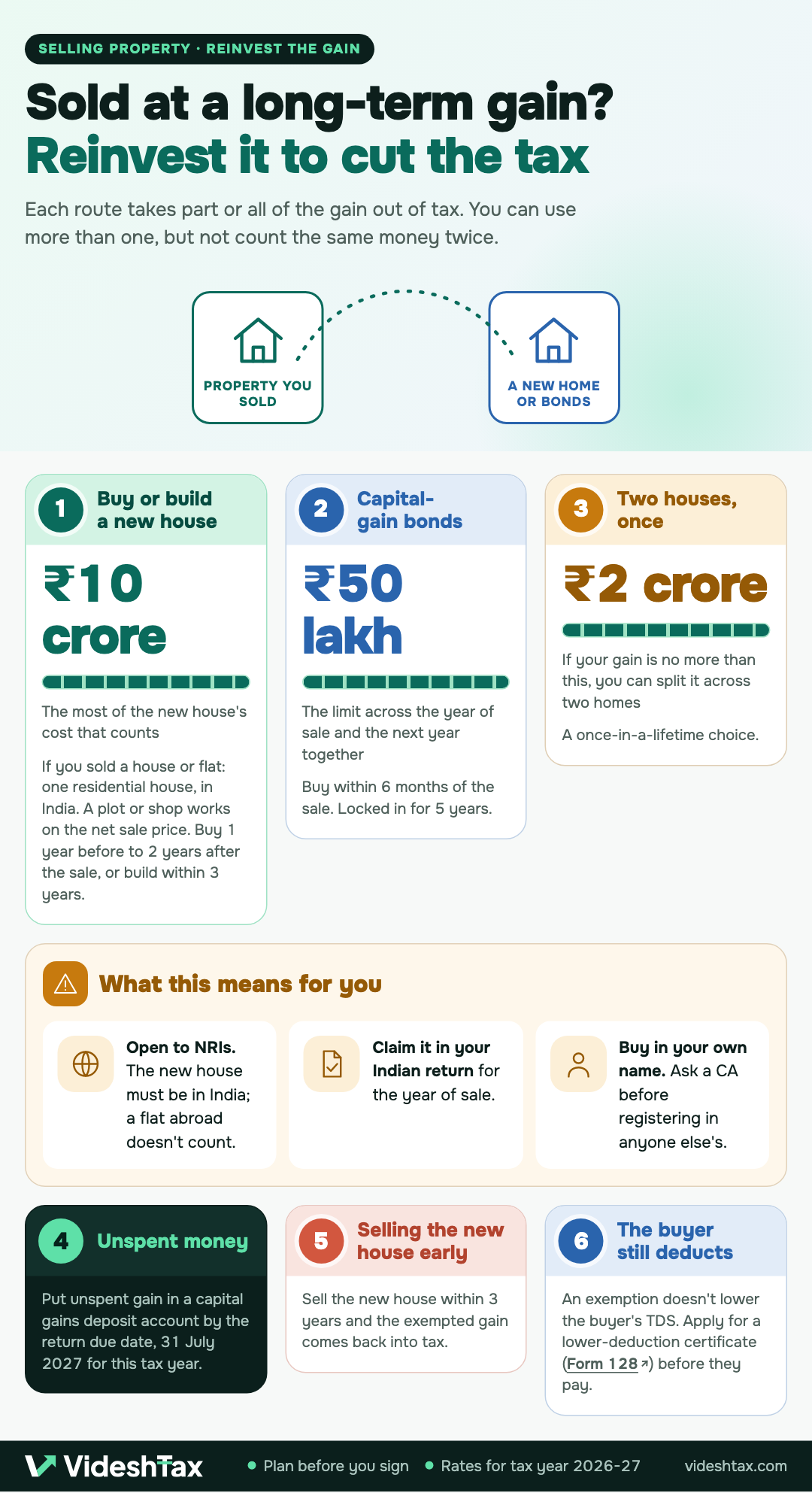
Each route takes part or all of the gain out of tax. You can use more than one, but not count the same money twice.
The most of the new house's cost that counts
If you sold a house or flat: one residential house, in India. A plot or shop works on the net sale price. Buy 1 year before to 2 years after the sale, or build within 3 years.
The limit across the year of sale and the next year together
Buy within 6 months of the sale. Locked in for 5 years.
If your gain is no more than this, you can split it across two homes
A once-in-a-lifetime choice.
Open to NRIs. The new house must be in India; a flat abroad doesn't count.
Claim it in your Indian return for the year of sale.
Buy in your own name. Ask a CA before registering in anyone else's.
Put unspent gain in a capital gains deposit account by the return due date, 31 July 2027 for this tax year.
Sell the new house within 3 years and the exempted gain comes back into tax.
An exemption doesn't lower the buyer's TDS. Apply for a lower-deduction certificate (Form 128) before they pay.
What you’ll owe, and what each exemption takes off
Without an exemption, a long-term capital gain on property is taxed at 12.5% plus surcharge and cess. Each exemption below takes part or all of the gain out of that charge. You can use more than one on the same sale, but you can’t count the same money twice.
| Route | What you sell | What you do with the gain | Deadline | Limit |
|---|---|---|---|---|
| New house 2025 Act s. 82was s. 54 | A residential house or flat held long-term | Buy or build one residential house in India | Buy 1 year before to 2 years after; build within 3 years | New house’s cost counted up to ₹10,00,00,000 |
| Capital-gain bonds 2025 Act s. 85was s. 54EC | Any land or building held long-term | Buy specified bonds (NHAI, REC or others the government notifies) | Within 6 months of the sale | ₹50,00,000 across the year of sale and the next year |
| Deposit account | As for the new house | Park unspent gain until you buy or build | By the return due date, 31 July 2027 for this tax year | Must then be used within the new-house windows |
The new house
The exemption is the smaller of your gain and what the new house costs. If the house costs more than the gain, the whole gain is exempt; if it costs less, the difference is taxed. Only one residential house counts, and it must be in India. From tax year 2026-27 the rule sits in a new section of the 2025 Act, but most people and many CAs still call it “section 54”.
The new house’s cost is counted only up to ₹10 crore. Buy a more expensive home and the excess simply doesn’t count.
The windows run from the date of transfer, which is usually the date the sale deed is registered. Buying normally means a registered purchase. A flat booked with a builder, or allotted by a development authority or housing society, is usually treated as construction instead, so it must be completed within 3 years of the sale. This isn’t settled: officers and courts don’t always agree.
Two houses instead of one
If your gain is no more than ₹2 crore (₹2,00,00,000), you can choose to split it across two homes in India instead of one. This is a once-in-a-lifetime choice: use it on this sale and you can never use it again, even on a much larger gain later.
Capital-gain bonds
The bonds route suits you if you don’t want another property. It works on any long-term land or building, not only a house. The limit of ₹50 lakh applies across the year of sale and the next tax year together, so you can’t double it by splitting the purchase across the year-end. 2025 Act s. 85was s. 54EC
The bonds are locked in for 5 years. Selling them early, or even taking a loan against them, brings the exempted gain back into tax in that year. The interest is taxable every year, and the amount you invest gets no other deduction.
If you sell the new house early
The exemption comes with a string attached. Sell the new house within 3 years of buying or building it, and its cost for tax purposes is reduced by the gain you exempted (or taken as nil). The exempted gain therefore comes back into tax on that second sale, and because you’ve held the new house only briefly, it is usually taxed as a short-term gain at slab rates. 2025 Act s. 82was s. 54
The same idea applies to the bonds: cash them in, or borrow against them, inside the lock-in and the exempted gain is taxed as a long-term gain in that year. If you might need the money back within a few years, the exemption may not be worth taking.
Selling a plot or a shop instead
If what you sold wasn’t a residential house (a plot, a shop, an office), the new-house route still exists but works on the net sale price, not the gain. You get full exemption only if you reinvest the whole net price, and you mustn’t own more than one other house on the date of sale. 2025 Act s. 86was s. 54F The bonds route works the same way for a plot as for a flat.
Step by step
- Confirm the gain is long-termYou must have held the property for more than 24 months. Our guide to working out your capital gain shows how to count the period and your cost.
- Decide how much goes whereSplit the gain between a new house, bonds and tax before you sign the sale agreement. The plan decides what you ask for in the next step.
- Apply for a lower-deduction certificateApply on TRACES with Form 128 (was Form 13), showing the planned reinvestment. Unless you do, the buyer will usually deduct TDS on the full price. Any advance the buyer pays before the certificate is issued is deducted at the full rate. 2025 Act s. 395(1)was s. 197
Once you have a buyer, before they pay - Buy the bondsApply through the issuer or an authorised bank, paying from your NRO account.
Within 6 months of the sale - Buy or build the new houseRegister the purchase in your own name, or sign a construction contract and keep every payment receipt.
- Deposit anything unspentMoney meant for the new house that isn’t spent by the return due date goes into a capital gains deposit account at an authorised bank branch.
31 July 2027 - Claim it in your returnReport the sale, the exemptions and the deposit, and claim back any extra TDS.
Worked example
Ravi lives in Dubai. He sells his Bengaluru flat for ₹1,60,00,000. He paid ₹75,00,000 for it, so his gain is ₹85,00,000. He buys a smaller flat in Mysuru for ₹60,00,000 and puts ₹20,00,000 into capital-gain bonds, so ₹80,00,000 of the gain is exempt. We ignore stamp duty and brokerage to keep it simple.
| Their actual tax | Amount |
|---|---|
| Long-term gain left after reinvesting (₹1,60,00,000 − ₹75,00,000 − ₹80,00,000) | ₹5,00,000 |
| Tax at 12.5% | ₹62,500 |
| Surcharge | ₹0 |
| Cess | ₹2,500 |
| Tax actually owed | ₹65,000 |
Without a certificate, the buyer deducts the same rate plus its own surcharge band and cess on the whole ₹1.6 crore.
Ravi’s real tax is on the small slice he didn’t reinvest. The buyer, though, has no way to know about the flat or the bonds. Without a certificate they will usually deduct on the full sale price, and Ravi waits for a refund of almost all of it.
You can run your own figures, including a reinvestment amount, in the TDS on property sale calculator.
Getting the buyer’s TDS down, and the rest back
An exemption lowers your tax, but it doesn’t lower what the buyer deducts. When the seller is non-resident, the buyer will usually deduct tax at source (TDS) at the full long-term rate on the whole price, because they can’t check your cost or your plans. 2025 Act s. 393(2) Table Sl. 17was s. 195 Your exemption only counts when you file your return, which can be a year or more after the sale.
The fix is a lower-deduction certificate. The Assessing Officer looks at your cost and your reinvestment plan and sets a lower rate the buyer must use. Bring evidence: the agreement for the new flat, a bank quote for the bonds, or the deposit account. Officers are more willing to allow a reinvestment that has already happened than one you only plan.
Our guide to getting a lower TDS certificate walks through the application, what to attach and how long it takes.
If you’re too late for a certificate, you still get the money back. File your return for the tax year of the sale, claim the exemptions, and the excess TDS is refunded to your Indian bank account once the return is processed. Check that the buyer’s deduction shows in your Form 168 (was Form 26AS) before you file.
Forms, documents and deadlines
| Done | What | Who | When |
|---|---|---|---|
| Purchase deed and cost records for the property you sold | You | Before the certificate application | |
| Form 128 (was Form 13) application, with the reinvestment plan | You, on TRACES | Once you have a buyer, before they pay | |
| Bond allotment letter or certificate | Issuer to you | Within 6 months | |
| Registered deed for the new house, or construction contract and receipts | You | Within the purchase or construction window | |
| Deposit account passbook or receipt for any unspent gain | Authorised bank | 31 July 2027 | |
| Return claiming the exemptions and the TDS | You | 31 July 2027 |
The deposit account, in brief
The deposit account (formally the Capital Gains Accounts Scheme) holds money you’ve earmarked for the new house but not yet spent. You must make the deposit before you file, and no later than the return due date. Proof of the deposit goes with your return, and you then withdraw from it only to pay for the house. 2025 Act s. 82was s. 54
If the money isn’t used by the end of the construction window, 3 years from the sale, the unused part is taxed as a long-term gain in the tax year that window ends. You can then withdraw it. Not every bank branch runs these accounts, so find an authorised branch early and ask whether it opens them for non-residents.
If you live in the US, UK or elsewhere
The Indian exemptions are Indian rules. Your country of residence taxes the sale under its own law, and most don’t recognise a reinvestment in India. The awkward result is that the less Indian tax you pay, the less foreign tax credit you have to set against your tax at home.
The US taxes the gain under its own rules, and the Indian exemptions don’t carry across. Buying a new home in India doesn’t defer US tax. Swapping an Indian rental for another foreign rental can, under a properly structured like-kind exchange. Claiming the new-house or bonds exemption can leave you with little Indian tax to credit against a US bill, so work out both sides before you decide.
US tax on selling Indian property US section
UK residents report the gain to HMRC, which doesn’t recognise an Indian reinvestment either. Credit is given for the Indian tax you actually pay, so compare the Indian saving with the UK tax it may add.
India–UK tax treaty guide
Canada taxes residents on worldwide gains, with a foreign tax credit for the Indian tax actually paid. An Indian exemption reduces that credit, so the saving may be smaller than it looks.
India–Canada tax treaty guide
With no personal income tax in the UAE, every rupee saved in India is a real saving. This is where the exemptions are most clearly worth it.
India tax for NRIs in the UAE
Australia includes the gain in your return, with a foreign income tax offset for the Indian tax paid. As in the US, a smaller Indian bill means a smaller offset.
India–Australia tax treaty guide
Singapore doesn’t generally tax capital gains, so, as in the UAE, an Indian exemption is usually a clean saving. Check with an adviser if you trade property as a business.
India–Singapore tax treaty guide
Common mistakes
- Buying the new home outside India. Only a house in India qualifies, wherever you live.
- Missing the bonds window because the sale money was stuck in TDS. The months run from the sale date, not from when your refund arrives.
- Parking the money in an ordinary fixed deposit instead of the deposit account by the return due date. The exemption on the unspent part is lost.
- Selling the new house or the bonds too soon. Sell the house within 3 years of buying it and the exempted gain comes back into tax; the bonds are locked in for 5 years.
When to get a CA
Get one before you sign the sale agreement if you plan to reinvest, because the lower-deduction certificate and the split between house and bonds are decided together. You also need one if the new house is under construction, jointly owned or in a family member’s name, if you sold a plot rather than a house, or if you live in a country that taxes the gain too.
Letting the flat out instead of selling it? Rent is taxed quite differently: see our guide to tax on rent from your Indian flat.
Questions people ask
Can an NRI claim the new-house exemption?
Yes. The exemption is open to any individual or HUF, resident or not. What matters is that the house you sell is a long-term residential property and the new house is in India. A flat in Dubai or London doesn't count, even though you live there. You claim it in your Indian return for the year of sale, so you need to file even if the buyer's TDS already covers the tax.
Can I use both the new house and the bonds on the same sale?
Yes. They are separate exemptions and you can combine them on one gain, as long as you don't count the same rupee twice. A common pattern is to buy a smaller flat and put part of the rest into bonds within 6 months. Whatever gain is left after both is taxed at the normal long-term rate.
Does the new house have to be in my name alone?
It should be in your name, as the person who sold. Buying in a spouse's or child's sole name is a common reason claims are refused, although some courts have allowed it. Buying jointly with your spouse is safer, but the exemption is limited to what you paid. Ask a CA before you register the new flat if it will be in anyone else's name.
Can I invest in capital-gain bonds from abroad?
Usually, yes, but the money has to come from India. Issuers generally accept NRI applications paid from an NRO account on a non-repatriation basis, which means the principal comes back to NRO when the bonds mature. Check the current issue's terms, because not every issuer takes NRI money for every series. The interest is taxable in India each year.
What if I bought the new flat before selling the old one?
That still counts if you bought it no more than 1 year before the sale. Keep the registered deed. A booking or allotment is usually treated as construction, not purchase, so what matters then is that the flat is completed within the construction window. Officers and courts don't always agree on this, so ask a CA if your flat isn't registered or finished yet. If you're building, the construction window only runs after the sale, so a house finished before the sale has to qualify as a purchase instead.
Can I use the two-house option now and again later?
No. The option to put the gain into two homes instead of one is available once in your lifetime, and only when the gain is no more than ₹2 crore. Once you use it, every later sale is limited to one new house, so save it for the sale where it helps most.
Sources
- Income-tax Act, 2025: ss. 82 (new house, was s.54), 85 (bonds, was s.54EC), 86 (was s.54F) and 395 (lower-deduction certificate)egazette.gov.in
- Finance Act, 2026: rates, surcharge and cess for tax year 2026-27egazette.gov.in
- CBDT Notification 161/2025: Capital Gains Accounts (Second Amendment) Scheme, 2025incometaxindia.gov.in
- Income Tax Department: Form 128, application for a lower or nil TDS certificateincometaxindia.gov.in
Update log
- First published.