

For tax year 2026-27, you must file if your Indian income, counted before reinvestment exemptions and deductions, is above ₹4 lakh, if tax of ₹25,000 or more was deducted from you, or if you have a capital loss to carry forward. If your only income is dividends or foreign-currency investment income taxed in full at source, you needn't. If tax was over-deducted, file anyway: a return is the only way to get it back.
Is this you? This guide is for individuals. Moving back to India this year? Check how your residency status is decided first. Selling a flat? The tax on the sale is in selling property in India as an NRI.
This assumes you're a non-resident for the whole tax year. Moving back this year? Check your residency status first, because the answer can change.
This guide is part of our guides to filing your return from abroad, which cover the forms, the portal and the deadlines. Here we answer the question that comes first: does the law require a return from you this year, and if it doesn’t, should you file one anyway?
Most people who ask are non-resident Indians with some Indian income: interest on an NRO deposit, rent from a flat, dividends, or a sale. Being non-resident changes less than people hope. The same tests apply to you as to anyone in India, with one exemption that only non-residents get.
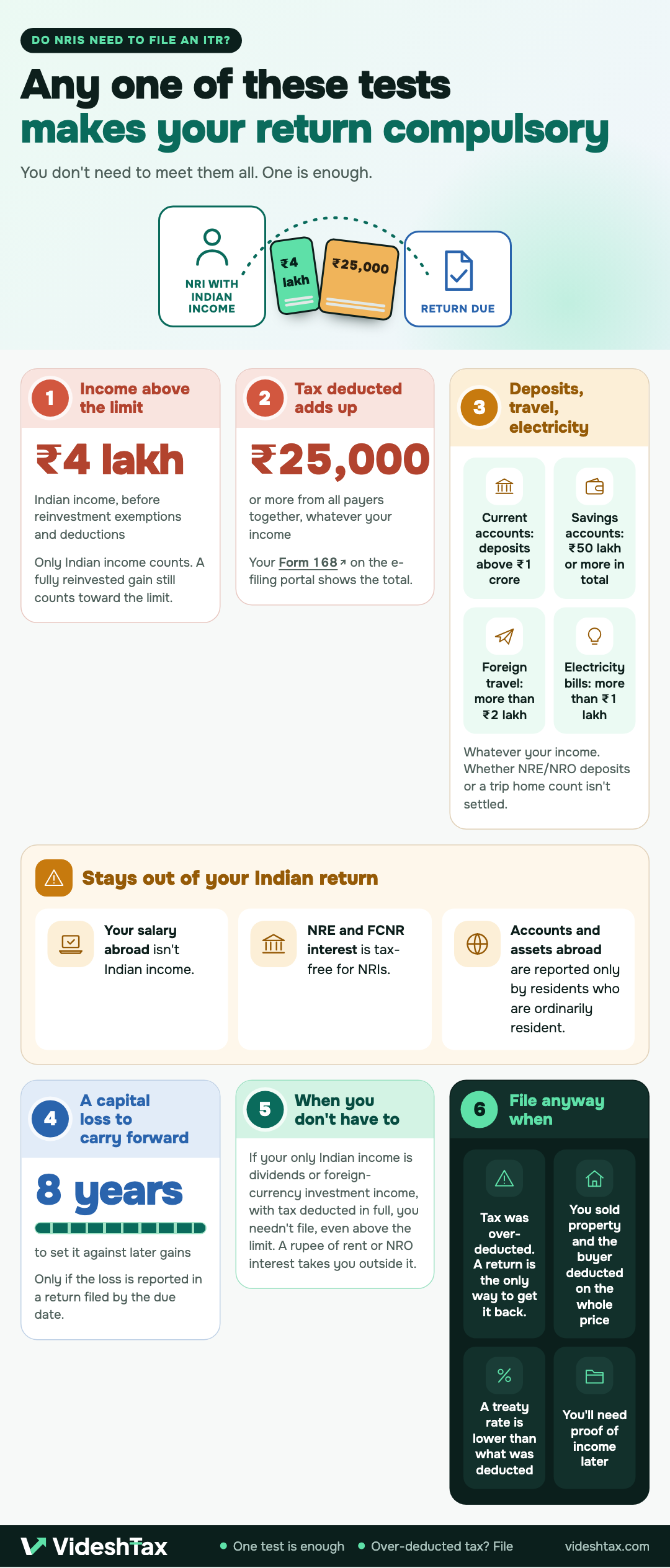
You don't need to meet them all. One is enough.
Indian income, before reinvestment exemptions and deductions
Only Indian income counts. A fully reinvested gain still counts toward the limit.
or more from all payers together, whatever your income
Your Form 168 on the e-filing portal shows the total.
Whatever your income. Whether NRE/NRO deposits or a trip home count isn't settled.
Your salary abroad isn't Indian income.
NRE and FCNR interest is tax-free for NRIs.
Accounts and assets abroad are reported only by residents who are ordinarily resident.
to set it against later gains
Only if the loss is reported in a return filed by the due date.
If your only Indian income is dividends or foreign-currency investment income, with tax deducted in full, you needn't file, even above the limit. A rupee of rent or NRO interest takes you outside it.
The tests, in one table
A return is compulsory if any one of these applies to you. Meeting one is enough; you don’t need all of them.
| Your situation this tax year | Do you have to file? | The law |
|---|---|---|
| Indian income, before reinvestment exemptions and deductions, above ₹4 lakh | Must | 2025 Act s. 263(1)was s. 139(1) |
| Tax deducted or collected from you adds up to ₹25,000 or more | Must, whatever your income | 2025 Act s. 263(1)was s. 139(1) and rule 163 |
| Large deposits, foreign travel or electricity bills (see below) | Must, whatever your income | 2025 Act s. 263(1)was s. 139(1) and rule 163 |
| A capital loss you want to carry forward | Must, by the due date | 2025 Act s. 263(1)(a)(viii)was s. 139(3) |
| Only dividends or foreign-currency investment income, with tax deducted in full | No, even above the limit | 2025 Act s. 216was s. 115G 2025 Act s. 207(8)was s. 115A(5) |
| More tax deducted than you owe | No, but you should: it’s the only way to get a refund | 2025 Act s. 433was s. 239 |
| Assets or accounts abroad | No for NRIs and RNORs; must for residents who are ordinarily resident | 2025 Act s. 263(1)was s. 139(1) |
The tax year (2026-27) runs from 1 April to 31 March. Under the old Act it was the financial year, with the return filed in the following “assessment year”.
When you must file
Your income is above the limit
The main test compares your income with the basic exemption limit, the most that isn’t chargeable to tax at all: ₹4 lakh under the new regime, which applies unless you choose otherwise. As a non-resident you get no rebate, so for you that’s also the most you can earn tax-free. As a non-resident, only your Indian income counts: interest on NRO deposits, rent, dividends, gains on Indian shares, funds and property, and any Indian salary. Your salary abroad doesn’t, and nor does interest on deposits in an NRE account or an FCNR account, which is tax-free for NRIs. 2025 Act s. 263(1)was s. 139(1)
The trap is when you measure it. The test uses your income before the exemptions for reinvesting a gain in a new home or in capital-gain bonds, and before deductions such as insurance or pension contributions. So if you sell a flat, reinvest the whole gain and owe no tax, you still have to file if the gain itself was above the limit. The return is also where you claim the exemption, so skipping it would cost you the exemption too. Our guide to reinvesting the gain to pay less tax covers the conditions. 2025 Act s. 82was s. 54 2025 Act s. 85was s. 54EC
Enough tax was deducted to trigger a return
This one catches many NRIs who are sure they are under the limit. Banks deduct tax deducted at source on NRO interest at 30% plus surcharge and 4% cess, so it doesn’t take much interest before the tax held back crosses the line. Once the total deducted from you in the year, by every payer together, reaches ₹25,000, a return is compulsory even if your income is under the limit. Your Form 168 (was Form 26AS) on the e-filing portal shows the total. 2025 Act s. 263(1)was s. 139(1)
This condition, and the three below, come from rule 163 of the Income-tax Rules, 2026, which replaced the old rule 12AB. They apply to any individual, resident or not, except that a resident aged 60 or over uses ₹50,000 for the tax-deducted figure.
Large deposits, travel or electricity
You must also file if, during the tax year, you:
- deposit more than ₹1 crore in one or more current accounts;
- deposit ₹50 lakh or more in total in savings accounts;
- spend more than ₹2 lakh on foreign travel, for yourself or anyone else;
- pay more than ₹1 lakh in electricity bills.
Two of these are unclear for NRIs, so treat them as grey areas. Whether money paid into NRE or NRO savings accounts counts towards the savings figure isn’t settled; the rule says savings accounts without any exception. And whether a trip from India back to the country you live in is “travel to a foreign country” hasn’t been tested. There are also conditions for business turnover and professional fees, which rarely apply to someone working abroad.
You have a capital loss to carry forward
If you sold shares, funds or property at a loss, you can set that loss against gains in later years, for up to 8 years. But only if the loss was reported in a return filed by the due date. A late return can still get your refund, but the loss is gone. This applies even if you have no other income at all. 2025 Act s. 263(1)(a)(viii)was s. 139(3) 2025 Act s. 121was s. 80
When you don’t have to
Your only income is investment income taxed in full
This is the exemption only non-residents get, and it comes in two versions:
- Dividends and some interest. If your only Indian income is dividends, interest on money the government or an Indian company borrowed in foreign currency, or income from certain funds bought in foreign currency, and the payer deducted tax at the full rate, you needn’t file. 2025 Act s. 207(8)was s. 115A(5)
- Investment income from assets you bought with foreign currency. If you’re an Indian citizen or of Indian origin, and your only income is income or long-term gains from shares in an Indian company, public-company debentures or deposits, or central government securities you paid for in foreign currency, with tax deducted, you needn’t file either. 2025 Act s. 216was s. 115G
Both depend on all your Indian income being of that kind. A single rupee of rent or NRO interest takes you outside them, and then the normal tests apply. NRO interest doesn’t qualify: bank interest isn’t on the list for the first version, and deposits in an NRO account are rupee deposits, not foreign-currency assets.
This exemption also lifts the tax-deducted and spending conditions: the Act says no return is needed without carving those out. The department hasn’t confirmed it in writing, though, so treat that part as a grey area.
You’re under every threshold
If your Indian income is at or below ₹4 lakh, less than ₹25,000 was deducted, none of the spending conditions applies and you have no loss to keep, the law doesn’t require a return. You may still want to file, for the reasons below.
Your foreign income and assets stay out of it
As a non-resident you never report your salary abroad, your foreign bank accounts or your home overseas in an Indian return. The rule that makes holding assets abroad a reason to file, and the schedule where they’re listed, apply only to residents who are ordinarily resident. RNORs are outside it too. 2025 Act s. 263(1)was s. 139(1)
When you should file anyway
“Not required” isn’t the same as “better off not filing”. File anyway if:
- Tax was over-deducted. A refund can only be claimed through a return. Banks, tenants and buyers deduct at flat non-resident rates without knowing your other income or your exemption limit, so many NRIs are owed money. Our guide to claiming back TDS on NRO interest covers the most common case. 2025 Act s. 433was s. 239
- You sold property. The buyer deducts tax on your whole sale price unless you had a lower-deduction certificate. That is usually far more than the tax on your gain, and the return is where the difference comes back.
- A treaty rate is lower than what was deducted. If the payer deducted at the Indian rate, you claim the treaty rate in your return, with your tax residency certificate and Form 41 (was Form 10F). 2025 Act s. 159was s. 90
- You’ll need proof of income later. An Indian return is the cleanest record of what you earned and paid in India: banks ask for it when you move sale proceeds abroad, and your tax office at home may ask for it when you claim credit for Indian tax.
Check your own year
The law requires a return from you for this tax year, by the due date.
- MustYour Indian income of ₹4,50,000, counted before any reinvestment exemption or deduction, is above ₹4,00,000, the new regime's basic exemption limit. 2025 Act s. 263(1) · was s. 139(1)
- MustTax of ₹1,40,400 was deducted or collected from you this year. That reaches ₹25,000 and requires a return even if your income is below the limit. 2025 Act s. 263(1) · was s. 139(1)
- ShouldMore tax was deducted than you owe. A refund can only be claimed by filing a return, so without one the excess stays with the government. 2025 Act s. 433 · was s. 239
How we decide
- Must file if your income, before reinvestment exemptions and deductions, is above ₹4 lakh (₹2.5 lakh for a non-resident on the old regime); if tax of ₹25,000 or more (₹50,000 for a resident aged 60 or over) was deducted or collected from you; if you meet a deposit, travel or electricity condition; or if you have a capital loss to carry forward.
- Resident and ordinarily resident with anything abroad: must file, whatever your income. NRIs and RNORs are outside this rule.
- A non-resident whose only income is dividends, or income from assets bought with foreign currency, taxed in full at source: no return needed.
- Otherwise, should file if more tax was deducted than you owe, including after a sale or where a treaty rate is lower.
Three NRIs, three answers
Same rules, three different results. Each has no other Indian income.
Her income of ₹4,50,000 is above ₹4 lakh, and the ₹1,40,400 deducted is above ₹25,000. Either test on its own makes the return compulsory. NRO interest isn’t the kind of investment income that could exempt her. The good news is in the return itself: under the new-regime slabs her actual tax is ₹2,600 including cess, so she gets ₹1,37,800 back.
His ₹60,000 of income is under ₹4 lakh and the ₹18,720 deducted is under ₹25,000, so no test is met. But he owes no tax at all on ₹60,000, so the whole ₹18,720 is his. With no income tax in the UAE, there’s nothing to set it against at home either. Filing is the only way to get it back.
Her income is above ₹4 lakh and the tax deducted is above ₹25,000, but the investment-income exemption lifts both: all her income is dividends, taxed in full at source. The tax deducted is the tax she owes, so there’s no refund to chase. She reports the dividends on her US return and claims credit there for the Indian tax, using the payers’ TDS certificates. If she also sells shares at a gain, or earns a rupee of NRO interest, she should check again.
If you don’t file when you have to
Not filing a compulsory return costs more than the return would have taken to prepare:
- A late fee of ₹5,000, or ₹1,000 if your total income is ₹5 lakh or less. 2025 Act s. 428was s. 234F
- Interest at 1% a month on any tax still unpaid after TDS, from the due date until you file. If TDS already covers your tax, there’s nothing for this to run on. 2025 Act s. 423was s. 234A
- Your refund waits, and a capital loss is lost for good once the due date passes.
- A notice. The department sees the TDS against your PAN and the payments reported by banks. A notice for a missing return usually leads to filing anyway, on its timetable instead of yours.
You can still file late: a belated return is accepted until 31 December 2027, and after that an updated return can be filed for up to 48 months after the end of the following financial year, with extra tax. An updated return can’t claim a refund, though. After the belated deadline, the only route to a refund is a request to the department to accept a late claim, which it grants at its discretion. Don’t count on it. 2025 Act s. 263(4)was s. 139(4)
One thing you no longer need to worry about: the old rule that made payers deduct TDS at double the rate from people who hadn’t filed returns was removed by the Finance Act, 2025, and the 2025 Act has no equivalent. It never applied to non-residents without a business base in India anyway. What does still apply is a higher rate if you don’t give the payer your PAN.
The year you move back
Your filing duty follows your residency status, which is decided afresh every tax year. In the year you return you may be an RNOR taxpayer: resident, but with most foreign income still outside Indian tax. The tests above apply to you in the same way, with one difference: if you’re 60 or over, the tax-deducted figure is ₹50,000 instead of ₹25,000. The rule on assets abroad still doesn’t apply. Once you’re resident and ordinarily resident, your worldwide income counts towards the limit, and holding any foreign account, shares or property makes a return compulsory, with every one of them listed.
That makes the status question the one to settle first, especially if you spent a long stretch in India this year: the residency checker linked under the short answer at the top of this page takes you through the day tests.
Forms and deadlines
| What | When |
|---|---|
| Return for tax year 2026-27, no business income or audit | 31 July 2027 |
| Last day to file a return that carries a capital loss forward | 31 July 2027 |
| Belated return (late fee applies) | 31 December 2027 |
| Check the tax deducted against your PAN | Before you file, on Form 168 (was Form 26AS) |
| Treaty-rate paperwork to the payer | Before the income is paid: TRC and Form 41 (was Form 10F) |
The return form for tax year 2026-27 is ITR-2 for most NRIs with interest, rent or gains; the department notifies the forms each spring.
If you live in the US, Canada or the UAE
Your Indian filing duty doesn’t depend on where you live. What changes is what the Indian return does for you at home.
You report your Indian income on your US return every year, whether or not you file in India, and claim a foreign tax credit for the Indian tax you actually owe. Over-deducted TDS isn’t creditable in the US, so an Indian refund claim is often the only way to recover it. The treaty decides which country taxes first: see how treaty relief works for NRIs.
Canadian residents report worldwide income to the CRA and claim a foreign tax credit for Indian tax. As in the US, the credit is for tax properly owed in India, not for extra TDS, so file in India to get the excess back.
With no personal income tax in the UAE, Indian tax is the only tax on your Indian income, and any over-deduction is a straight loss unless you claim it back. That makes filing in India worth doing for almost every UAE resident with NRO interest or rent.
Common mistakes
- Testing income after the reinvestment exemption. A gain you’ve fully reinvested still counts towards the limit, so you may have to file with no tax to pay.
- Assuming “TDS was deducted, so I’m done”. That’s true only for dividend-only or foreign-currency investment income. With NRO interest or rent, the TDS figure itself can make the return compulsory.
- Filing a loss return after the due date. You get a refund, but the capital loss can’t be carried forward.
- Listing foreign assets as an NRI. The schedule is for residents who are ordinarily resident; filling it in as a non-resident only invites questions.
When to get a chartered accountant
Get one if you’re in the year you move back and unsure of your status, if you’re relying on the investment-income exemption with any other income in the picture, or if you sold property and want the reinvestment exemptions. Also when you’ve received a notice for a return you didn’t file, or you want to claim a treaty rate the payer didn’t apply.
Next steps
Questions people ask
I have no income in India at all. Do I need to file?
No. A non-resident is taxed in India only on Indian income, so with none there is nothing to report and no test to meet. Interest on NRE and FCNR deposits is tax-free for NRIs, so an account that only earns that interest doesn't count either. The one catch is the spending and deposit conditions: a large amount paid into Indian accounts in the year can still make a return compulsory, even if it earned nothing taxable.
Do I have to report my foreign salary or bank accounts in an Indian return?
Not as an NRI. Your salary abroad isn't Indian income, and the schedule of foreign assets and income is only for residents who are ordinarily resident. RNORs don't fill it in either. If you moved back and have become ordinarily resident, the position reverses: every account, share or property abroad has to be listed, and holding any of them makes a return compulsory.
Which exemption limit applies to me, the old regime's or the new one's?
The test uses the most you can earn tax-free, and for most NRIs that is the new regime's ₹4 lakh, because the new regime is the default. Under the old regime a non-resident of any age gets only ₹2.5 lakh; the higher limits for older taxpayers are for residents. If your income falls between the two and you want the old regime, you have to file to choose it anyway.
Do I need to file to get the tax-treaty rate?
Not if the payer applies it. Give them your tax residency certificate and Form 41 (was Form 10F) before they pay, and many will deduct at the treaty rate. If they deducted at the full Indian rate instead, the only way to get the difference back is to claim the treaty rate in your return, with the same documents.
I missed the due date. Can I still file?
Yes. A belated return can be filed until 31 December 2027, with a late fee of ₹5,000 (₹1,000 if your total income is ₹5 lakh or less), plus interest on any tax still unpaid. You still get your refund, but a capital loss in a late return can't be carried forward.
My income is below the limit but tax was deducted. Is filing optional?
Only if less than ₹25,000 was deducted in total. At that level or above, the return is compulsory even when your income is under the limit. Below it, filing is optional, but it's the only way to get the tax back, so it's usually worth it.
Sources
- Income-tax Act, 2025: ss. 207, 212–216 (non-residents), 263 (return of income), 121 (losses), 423 (interest), 433 (refunds)egazette.gov.in
- Finance Act, 2026: s. 3(2) (maximum amount not chargeable), s. 66 (due dates, s. 263), s. 96 (late fee, s. 428)egazette.gov.in
- Income-tax Rules, 2026 (G.S.R. 198(E), 20 March 2026): rule 163, conditions for filing a returnincometaxindia.gov.in
- Income Tax Department: Form 168 (was Form 26AS), annual tax statementincometaxindia.gov.in