
File the FBAR yourself on FinCEN's BSA E-Filing site, using the online (HTML) form; individuals don't register. First collect each Indian account's highest 2025 balance, divide it by the Treasury's year-end rate of 89.854 rupees per dollar and round up. Fill in one block per account, finalize and submit in one sitting, and keep the confirmation.
Is this you? You're a US citizen, green card holder or US tax resident, such as an H-1B worker, whose Indian accounts together went over the FBAR threshold at some point in 2025, and you're filing the FBAR yourself. Not sure you need to? Check which Indian accounts count first.
This assumes you're a US person for the year: a citizen, a green card holder, or resident under the substantial presence test. Moving back this year? Check your residency status first, because the answer can change.
This guide is part of our guide to US and India tax for Indians living in America. It covers one job: filing FinCEN Form 114 online for your Indian accounts, from collecting the balances to the email that confirms FinCEN has it. It assumes you’re a US person for the whole of 2025 and that you’ve already decided you need to file.
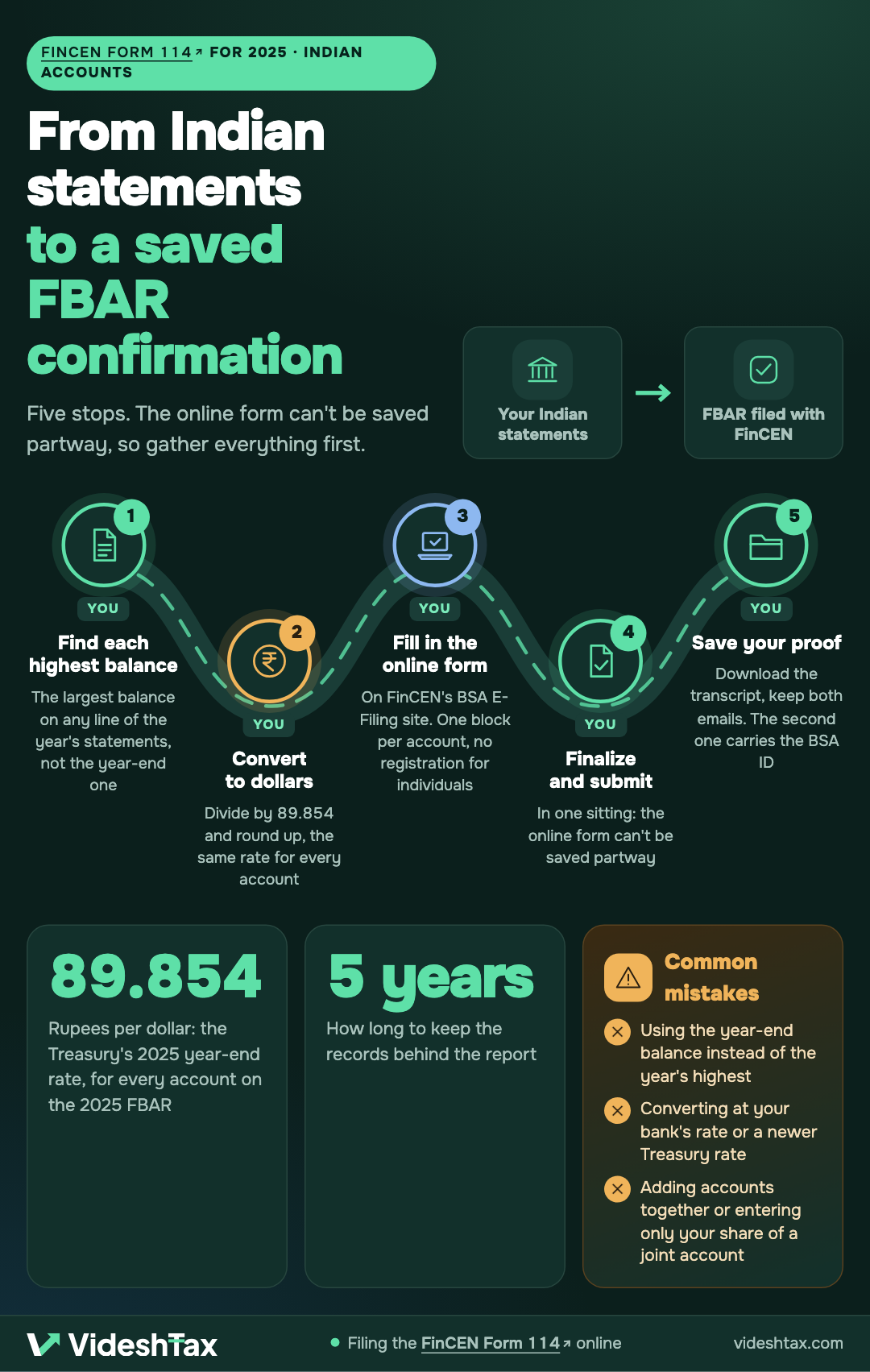
Five stops. The online form can't be saved partway, so gather everything first.
- 1YouFind each highest balance
The largest balance on any line of the year's statements, not the year-end one
- 2YouConvert to dollars
Divide by 89.854 and round up, the same rate for every account
- 3YouFill in the online form
On FinCEN's BSA E-Filing site. One block per account, no registration for individuals
- 4YouFinalize and submit
In one sitting: the online form can't be saved partway
- 5YouSave your proof
Download the transcript, keep both emails. The second one carries the BSA ID
Rupees per dollar: the Treasury's 2025 year-end rate, for every account on the 2025 FBAR
How long to keep the records behind the report
- Using the year-end balance instead of the year's highest
- Converting at your bank's rate or a newer Treasury rate
- Adding accounts together or entering only your share of a joint account
Before you start: what you need
The Report of Foreign Bank and Financial Accounts is filed on FinCEN’s BSA E-Filing System at bsaefiling.fincen.gov. Individuals filing their own report don’t register or create an account: you choose to file the FBAR, pick the online (HTML) form, and start typing.
The catch is that FinCEN’s guide to the online form says it can’t be saved partway through. If your connection drops before you submit, everything you entered is lost and you start again. So gather all of this first, in one document you can copy from:
| Done | What | Who | When |
|---|---|---|---|
| A list of every Indian account you own, own jointly or can operate: savings, current, each fixed deposit, PPF, demat, mutual fund folios, and any others you report | You | Before anything else | |
| Each institution’s full name, as printed on its statements | Statements, passbooks | Before you open the form | |
| Each institution’s mailing address, city spelled out in full | Statements, the bank’s website | Before you open the form | |
| Each account number, and each fixed deposit’s own number | Statements, deposit advice | Before you open the form | |
| Each account’s highest 2025 balance in rupees, then converted to whole US dollars (see below) | Statements for 1 January to 31 December 2025 | Before you open the form | |
| Your Social Security number or ITIN, typed without hyphens | You | Before you open the form | |
| Your date of birth | You | Before you open the form | |
| Your US home street address (not a post office box) | You | Before you open the form | |
| For joint accounts, or accounts you only operate, the other owner’s name, address and taxpayer number if known | Your co-owner or the account owner | Before you open the form |
FinCEN’s instructions ask for “the complete mailing address of the financial institution where the account is held” without saying whether that’s the branch or the head office. Using the branch address printed on your statement, or the bank’s registered office if it shows none, is a sensible reading, not a stated rule; pick one and note it.
Getting your highest balance from Indian banks
The FBAR doesn’t ask for your 31 December balance. It asks for each account’s maximum value: FinCEN’s instructions describe it as “a reasonable approximation of the greatest value of currency or nonmonetary assets in the account during the calendar year.” You can rely on periodic statements, “provided that the statements fairly reflect the maximum account value during the calendar year.” The IRS’s manual adds that it’s the largest amount on any statement for the year, not only a closing balance. So download statements for 1 January to 31 December 2025 and find the largest balance on any line:
| Account | Where the highest balance is | Watch for |
|---|---|---|
| NRE and NRO savings or current | The net-banking statement for the full calendar year, or the passbook | A large credit that came in and went out within days still counts |
| Fixed deposits (NRE, NRO, FCNR) | The deposit advice or the bank’s deposit summary, one deposit at a time | Whether to use principal alone or principal plus interest isn’t settled (below) |
| PPF | The passbook or online PPF statement | Deposits and the interest credit both move the balance |
| Demat | The depository’s consolidated account statement or your broker’s holding statements | FinCEN doesn’t say which price to value holdings at; use the highest value a statement shows |
| Account closed during 2025 | The statements up to the day it closed | It still goes on the 2025 report, valued at its highest point while open |
Two grey areas for fixed deposits. FinCEN doesn’t say whether a deposit’s value is the principal alone or principal plus accrued interest, and many Indian banks show only the principal on a cumulative deposit until it matures. The safer approach is the highest value your bank shows, including interest where shown; keep what you used. Nor is it settled whether several deposits under one customer ID are one account or many. The instructions value each account separately, and treating each deposit with its own number as its own account follows from that, but FinCEN hasn’t addressed it.
An account held in a foreign currency other than rupees, such as an FCNR deposit in dollars, works the same way in that currency. If it’s held in US dollars, the instructions say the maximum is simply the largest dollar value in the year, with no conversion.
Converting rupees to dollars
Every amount on the FBAR is in US dollars. FinCEN’s instructions set out the order: find the highest balance in rupees first, then convert that one figure using the Treasury’s rate for the last day of the calendar year, not the rate on the day the balance peaked. For the 2025 report that’s 89.854 rupees per dollar, the Treasury Reporting Rate of Exchange for India as of 31 December 2025, published by the Bureau of the Fiscal Service on its rates of exchange table. The rate is quoted as rupees per dollar, so you divide.
- Take each account’s highest rupee balanceOne figure per account, from the statements above. Don’t add accounts together first.
- Divide by the year-end rateRupees ÷ 89.854 gives dollars. Use the same rate for every rupee account on the report.
- Round up to the next whole dollarThe instructions say amounts are “rounded up to the next whole dollar”, so any fraction, however small, goes up.
- Enter zero if the result is negativeAn overdrawn account with a minus balance all year is reported at zero, not left off.
Later quarterly rates are already out, but the 2025 report uses the 31 December 2025 rate even though you’re filing in October 2026. Your bank’s rate, the Reserve Bank’s reference rate and a yearly average are all wrong for the FBAR.
The form has an “amount unknown” box for an account’s maximum value. FinCEN limits it to filers with fewer than 25 accounts who can’t work out whether their combined maximums passed the reporting threshold. It isn’t a shortcut for a balance you could get from a statement.
Filing step by step
These steps follow FinCEN’s guide to the online form and its line-item instructions, so they use the form’s Parts and the instructions’ item names; the labels on screen may be worded a little differently.
- Open the BSA E-Filing site and choose to file the FBARAt bsaefiling.fincen.gov, choose to file the FBAR and pick the online (HTML) form rather than the PDF. No user ID, password or PIN is needed. Use a desktop or laptop: FinCEN’s PDF-route guide says the system doesn’t support mobile devices, and a full-size screen is safer for the online form too.
- Home tab: name the reportGive it a filing name, such as your surname, “FBAR” and the year; it’s how the report is tracked. Leave the late-filing reason blank if you file by October 15, 2026. After that, choose a reason from the list, or “Other” with a short written explanation.
- Filer Information tab: Part I, about youCalendar year 2025, type of filer, taxpayer number, date of birth, name and US address (below). Leave Amended unticked for a first 2025 filing.
- Account Information tab: one block per account in the right PartPart II, III or IV (below). The plus (+) sign adds another account; fields with an asterisk are required.
- Signature/Third Party Preparer Information tabFiling your own report, leave the third-party preparer box unticked.
- Submit tab: your contact details, then FinalizeEnter your email address (FinCEN uses it only for messages about your submission’s status), name and phone number, then choose Finalize. Finalizing signs the form and fills in the date. If you go back to another tab to change something, the form is no longer finalized, so finalize again when you come back.
- Pass the captcha and choose Submit FBARA confirmation page follows. Use its Download Transcript button to save a copy of your report, and save the page too.
Part I: you, the filer
- Type of filer. Individuals tick the individual box, “including those reporting only signature authority.”
- Taxpayer number. Your SSN or ITIN, with no hyphens. The foreign identification item is only for filers with no US taxpayer number, so an H-1B worker with an SSN skips it.
- Address. Living in the US, enter “the street address of the individual’s United States residence not a post office box”, not your Indian address. Living abroad, give a US mailing address, or a foreign home address if you have none.
- Formatting. Two-letter state abbreviation, ZIP code without a hyphen, city names in full. Filler such as “NONE”, “NOT APPLICABLE”, “SAME AS ABOVE” or “UNKNOWN” is banned in text fields.
Part I also asks two account-count questions. With a financial interest in 25 or more foreign accounts, you answer yes, enter the number and skip Parts II and III, but must keep each account’s details for FinCEN or the IRS on request. A matching question covers accounts you can only operate, and sends you to the owner details in Part IV. Most filers answer no to both; with a long ladder of fixed deposits, the count turns on the grey area above.
Parts II to V: one block per account
| Part | Use it for | What it asks beyond the basics |
|---|---|---|
| II: owned separately | Accounts in your name alone | Nothing more: maximum value, account type, institution name, account number, institution address |
| III: owned jointly | Accounts you hold jointly with anyone, such as a spouse or a parent | The number of other joint owners (don’t count yourself), and the main other owner’s taxpayer number, name and address. If your spouse is a joint owner, your spouse is the main one. Enter the account’s full value, not your share |
| IV: signature authority only | Accounts you can operate but don’t own, such as a parent’s account under a power of attorney | The owner’s taxpayer number, name and address, and your title or role with that owner |
| V: consolidated | Companies reporting their subsidiaries’ accounts | Not used by individuals |
Whether a joint account with your parents, or a power of attorney, belongs in Part III or Part IV is a judgement call our guide to the FBAR deadline for H-1B workers works through. Mechanically, leave blank any joint owner’s details you don’t have; an owner with no US mailing address can be given a foreign one.
The type of account is a drop-down with three choices: Bank, Securities or Other (Other needs a short description). FinCEN’s regulation defines a bank account as a savings, demand, checking or other account with a bank, and the IRS manual adds time deposits. Beyond that, FinCEN hasn’t named the Indian products, so the right-hand column below is our reading of its definitions, not FinCEN’s word:
| Account | Type to choose | How firm |
|---|---|---|
| NRE, NRO, FCNR savings or current | Bank | Settled: a deposit account with a bank |
| NRE, NRO, FCNR fixed deposit | Bank | Settled: the IRS manual counts time deposits as bank accounts |
| Demat | Securities | Grey: fits the regulation’s securities account, but FinCEN doesn’t mention depository participants |
| Mutual fund folio | Other, described as a mutual fund folio | Grey: the regulation lists mutual funds under “other financial account” |
| PPF at a bank or post office | Bank, or Other described as PPF | Grey: both are defensible; FinCEN hasn’t named PPF |
| EPF, NPS | Other, with a description, if you report them | Grey: whether they’re reportable at all isn’t settled |
Whether EPF and NPS belong on the report at all, and why the US doesn’t treat them like an IRA, is covered in our FBAR and FATCA reporting guide.
Mutual fund folios also bring separate US tax rules, set out in our guide to Indian mutual funds as PFICs.
Signing
The date fills itself in when you finalize. Leave the filer title blank when reporting your own accounts; it’s for someone signing in a role, such as a parent filing for a child. Spouses filing jointly don’t complete the third-party preparer section.
Worked example: five accounts on one FBAR
He divides each balance by 89.854 and rounds each result up separately:
| Account | Highest 2025 balance | Rupees ÷ rate | Maximum value entered | Type | Part |
|---|---|---|---|---|---|
| NRE savings | ₹18,45,320.50 | 20,536.88 | $20,537 | Bank | II |
| NRO savings, same bank | ₹6,12,780 | 6,819.73 | $6,820 | Bank | II |
| NRE fixed deposit (cumulative), highest value on the deposit statement | ₹27,31,450 | 30,398.76 | $30,399 | Bank | II |
| PPF at a bank branch | ₹9,84,000 | 10,951.10 | $10,952 | Bank (or Other: PPF) | II |
| Demat | ₹14,26,900 | 15,880.21 | $15,881 | Securities | II |
His five maximums add up to $84,589, far above USD 10,000, so all five go on the report. The total is only for his own check: the form has no box for it. His NRE savings balance of ₹18,45,320.50 (about 18.45 lakh) becomes $20,537, not $20,536, because the instructions round up.
In Part I he enters 2025, his SSN, date of birth and New Jersey street address, and answers no to both account-count questions. In Part II he adds five blocks, each with the bank’s full name, the account or deposit number, and the branch address with the country set to India and the state left blank, as the instructions require for foreign addresses. Filing before October 15, 2026, he gives no late-filing reason.
Had his NRO savings account been joint with his wife, also a US person, it would go in Part III instead, with one other joint owner, his wife as the main one, and the full $6,820, not half.
After you submit
FinCEN’s guide to the online form describes what happens next:
- Straight away: a confirmation page. Download the transcript of your FBAR from it (the Download Transcript button), and save the page itself.
- Shortly after: an email saying whether your submission was accepted or rejected. Keep it. If it was rejected, you correct the problem and submit again.
- In about two business days: a second, final email saying FinCEN has acknowledged the report and given it a unique BSA ID, a 14-digit number. FinCEN’s guide calls the filing complete at this point.
No emails? The site’s help says to use the individual Submission Status Lookup: enter the email address you used and a date range of up to 60 days, and the system emails you a list of the FBARs it holds for that address.
Don’t leave it to the last hour of October 15, 2026. FinCEN doesn’t say whether an accepted report still waiting for its BSA ID counts as filed on the day you submitted, so the acceptance email is your best evidence that you filed on time.
Keep your records for 5 years. The regulation lists what they must show: the name on each account, its number, the institution’s name and address, the type of account and its maximum value. FinCEN’s instructions count from 15 April of the year after the year reported, or from the date you filed if later, so from the day you file the 2025 report now; the IRS’s page says from the due date, so keeping things a little longer covers both. Keep the downloaded copy, the confirmation page, both emails, the statements behind each maximum, and the exchange rate you used.
Filing for your spouse, or letting a CPA file
The online system takes only one electronic signature, so a married couple can’t both sign one FBAR. FinCEN’s instructions allow one spouse to report for both, but only when all three conditions hold:
“(1) all the financial accounts that the non-filing spouse is required to report are jointly owned with the filing spouse; 2) the filing spouse reports the jointly owned accounts on a timely filed FBAR electronically signed; and (3) the filers have completed and signed [the authorization record] … Otherwise, both spouses are required to file separate FBARs, and each spouse must report the entire value of the jointly owned accounts.”
That authorisation is FinCEN Form 114a. Both spouses complete and sign its first part, the filing spouse completes the rest, and you keep it with your records. You never upload or post it to FinCEN. The filing spouse lists the joint accounts in Part III, with the other spouse as the main joint owner. If the non-filing spouse has even one account of their own, such as a sole NRO account, the shortcut fails and you each file. Your tax filing status, joint or separate, makes no difference to this.
A CPA, Enrolled Agent or attorney who files for you can’t use the individual route. FinCEN’s FAQs say they must register with the BSA E-Filing System as an institution and file from there, and you complete FinCEN Form 114a to authorise them. Without it, you must sign and submit the report yourself. Either way, the report being on time and accurate stays your responsibility, not the preparer’s.
Fixing a mistake: amending a filed FBAR
Spotted a missed account or a wrong balance after submitting? You don’t edit the old report. You file an amended one:
- Wait for the original’s BSA IDThe site’s help says you can amend only once the original is acknowledged and has its BSA ID, usually about two business days after it was accepted.
- Start a fresh formThe transcript you downloaded can’t be reused for a resubmission. Fill in the whole report again with the corrected information, including the accounts that were already right.
- Mark it as an amendmentOn the Filer Information tab, tick Amended next to the calendar year in Part I.
- Give the prior report’s BSA IDEnter the 14-digit BSA ID from the acknowledgement email in the Prior Report BSA ID box. If you can’t find it, try the Submission Status Lookup; failing that, FinCEN’s instructions say to enter 14 zeros.
- Finalize and submit as beforeThe same two emails follow, and the amended report gets its own BSA ID.
Problems and help
- Lost your work. The online form has no save, so a dropped connection means starting again. If you can’t finish in one sitting, FinCEN’s fillable PDF form can be saved before upload, though it needs Adobe Reader.
- Browser trouble. FinCEN’s published browser list dates from around 2014. Use an up-to-date desktop browser, and try another before you call.
- Technical problems. The BSA E-Filing Help Desk is on 1-866-346-9478 or by email at BSAEFilingHelp@fincen.gov, Monday to Friday, 8 a.m. to 6 p.m. Eastern, and closed on federal holidays. Monday, October 12 is a federal holiday (Columbus Day), so expect it to be closed then. FinCEN asks you not to put account numbers or taxpayer numbers in a support ticket.
- Questions about what to report. FinCEN’s Regulatory Helpline answers questions on how to complete the form, on 1-800-949-2732, or 703-905-3975 if you call from outside the US.
- The site is down near the deadline. Keep trying, and keep a dated note or screenshot of what you saw. The online form’s list of late-filing reasons includes “Unable to access BSA E-filing system”.
If you end up filing after October 15, 2026, you file the same way, with a reason from the late-filing list or “Other” and a written explanation. What lateness can cost is covered in the deadline guide linked above.
Common mistakes
- Entering the 31 December balance instead of the year’s highest. A deposit that matured and paid out in June can leave a much smaller year-end figure than the peak the FBAR wants.
- Converting at the rate on the day the balance peaked, your bank’s rate or the latest Treasury rate, instead of the single 31 December 2025 rate for every rupee account.
- Adding accounts together, or putting only your share of a joint account. Each account is its own block, at its full value.
- Putting your Indian address in Part I. If you live in the US, it’s your US home street address.
- Uploading or posting the spouse or preparer authorisation to FinCEN. You keep it; FinCEN asks for it only if it wants to see it.
When to get a CPA or Enrolled Agent
Most people with a handful of NRE, NRO and deposit accounts in their own name can file this themselves. Get a CPA or Enrolled Agent who handles Indian accounts if you have, or might have, 25 or more accounts once each fixed deposit is counted; if you operate a parent’s or employer’s account and aren’t sure whether it’s Part III or Part IV; if you hold EPF, NPS or insurance policies and can’t decide whether or how to report them; if you’re filing for a year already past its deadline; or if an amendment would add accounts or raise balances by a lot. If you hand the filing over, make sure they register as an institution and that you both sign the authorisation first.
Next steps
Questions people ask
Do I need a BSA E-Filing account to file my own FBAR?
No. FinCEN's instructions say individuals don't have to register: you open the BSA E-Filing site, choose to file the FBAR, and start the form. Registration, with a user ID and password, is only for institutions, and that includes a CPA, Enrolled Agent or attorney filing on a client's behalf. They can't use the individual route for someone else's FBAR.
Can I save the online form and finish it later?
No. FinCEN's own guide to the online form says it doesn't let you save your progress, and if your internet connection drops before you submit, everything you entered is lost. Gather every account's details and dollar figure before you open it. If you need to work on it over several sittings, the alternative is FinCEN's fillable PDF form, which you can save before uploading, but it needs Adobe Reader.
Which exchange rate do I use for my 2025 rupee balances?
The US Treasury's reporting rate for the last day of the calendar year: for 2025, that's 89.854 rupees per dollar, as of 31 December 2025. Divide each account's highest rupee balance by it, and round each result up to the next whole dollar. Don't use the rate on the day the balance peaked, your bank's rate or a newer Treasury rate: the 2025 report uses the 31 December 2025 figure for every account.
Do I send the FBAR with my US tax return?
No. The FBAR goes to FinCEN, the Treasury's financial-crimes unit, through its BSA E-Filing System. The IRS tells taxpayers not to file it with their federal return. It has its own deadline, and your tax-return extension doesn't change it. Filing on paper isn't the normal route: the IRS says you need an exemption from FinCEN to do that.
My spouse and I hold our NRE account jointly. Do we file one FBAR or two?
One can be enough, but only if every account your spouse has to report is held jointly with you. Then you report the joint accounts on your FBAR, on time and signed, and you both complete and sign FinCEN Form 114a, which you keep rather than send. If your spouse has even one account in their own name, or one they can only operate, you each file a separate FBAR, and each of you reports the joint account's full value.
How do I know my FBAR was actually filed?
The site shows a confirmation page when you submit. An email follows shortly afterwards saying whether the submission was accepted or rejected, and in about two business days a second email confirms FinCEN has acknowledged it and gives it a 14-digit BSA ID. If neither email arrives, use the individual Submission Status Lookup on the BSA E-Filing site with the email address you entered.
I made a mistake after submitting. How do I fix it?
File an amended FBAR. You fill in the whole form again with the correct information, tick the box that marks it as amended, and give the BSA ID of the report you're correcting. The transcript you downloaded can't be reused for this. You can only amend once the original has its BSA ID, usually about two business days after it was accepted. If you can't find the BSA ID, FinCEN's instructions say to enter 14 zeros.
Which account type do I pick for PPF, demat or a mutual fund folio?
The form offers only Bank, Securities and Other, and FinCEN hasn't said which fits these Indian products. Reading its definitions, a demat account looks like a securities account, and a mutual fund folio fits its "other financial account" category best. A PPF account held at a bank fits Bank, though Other with "PPF" typed in is equally defensible. Pick one, use it consistently each year, and keep a note of why.
Sources
- FinCEN: BSA Electronic Filing Requirements for the Report of Foreign Bank and Financial Accounts (FinCEN Form 114), line-item instructions, v1.4 (January 2017)fincen.gov
- BSA E-Filing System: Filing the FBAR using the 'Online' formbsaefiling.fincen.gov
- BSA E-Filing System: How to File the FBAR Electronically (PDF form route)bsaefiling.fincen.gov
- BSA E-Filing System: FBAR E-Filing FAQs (V 1.0, March 2014)bsaefiling.fincen.gov
- FinCEN: FinCEN FBAR Help (June 2020) — help desk and Regulatory Helplinebsaefiling.fincen.gov
- FinCEN Form 114a: Record of Authorization to Electronically File FBARs (May 2015)fincen.gov
- FinCEN: Reporting maximum account valuefincen.gov
- FinCEN: FBAR due date clarification (automatic extension to October 15)fincen.gov
- Treasury Fiscal Data: Treasury Reporting Rates of Exchange (India-Rupee, 31 December 2025)fiscaldata.treasury.gov
- IRS: Report of Foreign Bank and Financial Accounts (FBAR)irs.gov
- IRS newsroom: How to report foreign bank and financial accountsirs.gov
- IRS: Internal Revenue Manual 4.26.16, Report of Foreign Bank and Financial Accounts (FBAR)irs.gov
- eCFR: 31 CFR 1010.350, reports of foreign financial accounts (account types, 25 or more accounts)ecfr.gov
- eCFR: 31 CFR 1010.420, records to be kept for foreign financial accountsecfr.gov
Update log
- First draft: the online FBAR form, part by part, for Indian accounts, with a worked example at the 31 December 2025 Treasury rate.