

Almost every payment you send abroad from India needs Form 145, filed online before the transfer. Once your taxable remittances for the tax year pass ₹5 lakh, a chartered accountant must first certify the tax on Form 146. Below that, or if the payment isn't taxable in India, you file it yourself, with no certificate. A few specified payments need no form at all.
Is this you? This guide covers sending your own money abroad once the tax on it is settled. Still working out that tax? Start with selling property in India as an NRI or TDS on NRO interest. Money a resident relative sends you is their paperwork, not yours.
This assumes you're a non-resident for the whole tax year. Moving back this year? Check your residency status first, because the answer can change.
This guide is part of our guide to NRI bank accounts and their tax. It picks up once the tax on your money is settled and you’re ready to move it out of India: which remittance form you need, when a chartered accountant has to sign off first, and what your bank checks before it releases the transfer.
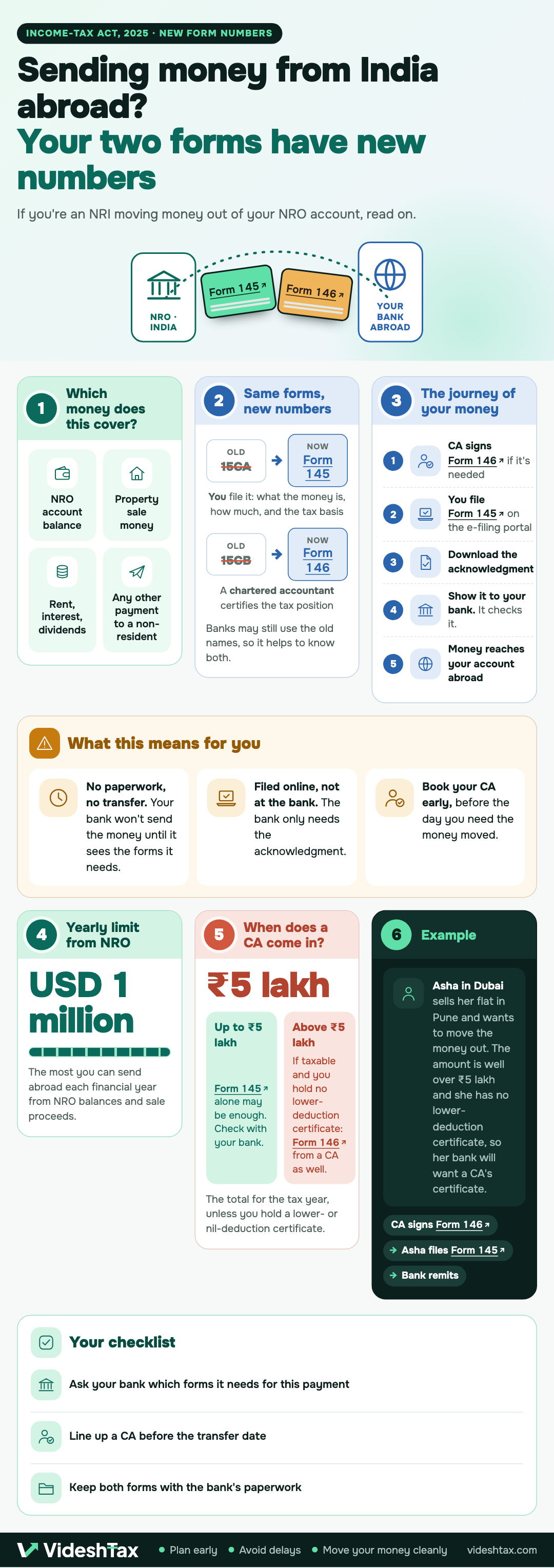
If you're an NRI moving money out of your NRO account, read on.
No paperwork, no transfer. Your bank won't send the money until it sees the forms it needs.
Filed online, not at the bank. The bank only needs the acknowledgment.
Book your CA early, before the day you need the money moved.
The most you can send abroad each financial year from NRO balances and sale proceeds.
Do you need it?
Before an Indian bank sends money abroad on your behalf — an NRO balance, the proceeds of selling property, or any other payment to you as a non-resident — it needs your declaration that the tax position has been dealt with. That declaration is Form 145 (was Form 15CA), filed online before the transfer. 2025 Act s. 397(3)(d)was s. 195(6)
Almost everything goes through it, but which part you fill in, and whether a chartered accountant has to certify it first, depends on the amount and whether the payment is taxable at all:
| Part of Form 145 | When it applies | CA certificate needed? |
|---|---|---|
| A | Taxable, and your taxable remittances for the tax year total ₹5 lakh or less (generally read as the total to the same payee) | No |
| B | Taxable, above ₹5 lakh, and you already hold a lower- or nil-deduction certificate from the Assessing Officer (applied for on Form 128 (was Form 13)), or an order on the payer’s own application to the Assessing Officer | No — the certificate or order stands in for it |
| C | Taxable, above ₹5 lakh, with no certificate or order | Yes, on Form 146 (was Form 15CB), before you file |
| D | Not chargeable to tax in India at all | No |
Rule 220(3) of the Income-tax Rules, 2026 takes some payments out of this table entirely, so no form of any kind is needed, but only for a sum that isn’t chargeable to tax in India. Two parts of it matter to individuals. One covers a remittance by an individual that needs no RBI approval: the Liberalised Remittance Scheme route, which residents mostly use. The other is a specified list of payment purposes. Most are business payments, such as import settlements and freight insurance, but the list also includes remittances by non-residents towards family maintenance and savings, and personal gifts and donations.
Whether that family-maintenance item covers an NRI sending their own already-taxed savings or sale proceeds abroad is not settled. The rule doesn’t say, and banks differ. Most still ask for the form, with a chartered accountant’s certificate, before they repatriate NRO money, so plan on that unless your bank tells you otherwise.
An example: Priya’s transfer to Toronto
Priya lives in Toronto and sells a flat she inherited in Chennai. After the buyer’s TDS and her own return for the year, she wants to send the rest of the proceeds to her Canadian bank account. The amount is well above ₹5 lakh and she has no lower-deduction certificate for this payment, so her bank will almost certainly handle it as Part C: her chartered accountant works out the tax already accounted for, certifies it on Form 146 (was Form 15CB), and only then does Priya file Form 145 (was Form 15CA) herself, quoting the certificate’s acknowledgement number. Her bank won’t start the transfer without both.
Strictly, this is a grey area. Priya is paying herself, and the sale money is capital she has already paid tax on, not new income. Some practitioners argue that makes it a non-taxable remittance (Part D), or one that fits the family-maintenance item above. The rule text doesn’t settle it, and bank practice puts most transfers like hers in Part C, so the certificate is the safe course.
What you need before you start
| Done | What | Who | When |
|---|---|---|---|
| Your PAN, and a login on the income-tax e-filing portal | You | Before you apply | |
| Proof of where the money came from: sale deed, TDS certificates, fixed deposit statement | You | Before you apply | |
| Evidence the tax on this money is settled: a filed return, TDS certificates, or a lower-deduction certificate | You | Before you apply | |
| A chartered accountant engaged, if the amount is above ₹5 lakh | You | Early — before you agree a transfer date | |
| A tax residency certificate and Form 41 (was Form 10F), if a treaty rate is relevant | You | Before the CA certifies | |
| Your NRO account details and the destination account abroad | You | Before you apply | |
| Your bank’s own remittance request on Form A2 and a FEMA purpose code | You to bank | With the transfer request |
If you haven’t settled the tax side yet, do that first. Our guide to TDS on NRO interest covers the most common source of money an NRI sends abroad.
For sale proceeds, see selling property in India as an NRI for the tax and TDS before you get to this stage.
Steps
- Work out whether tax on the money is settledYou need this before either form makes sense: a filed return, TDS already deducted, or a lower-deduction certificate on file.
- Check which Part appliesUse the table above. If you’re in Part C, brief your chartered accountant as soon as you know the amount and payee, not once you’re ready to transfer.
Before you agree a transfer date - Let the CA certify first, if Part C appliesYour accountant works out the taxable amount, the rate (including any treaty rate) and certifies Form 146 (was Form 15CB) on the e-filing portal, generating an acknowledgement number. 2025 Act s. 393(2) Table Sl. 17was s. 195
- File your own formLog in to the e-filing portal and complete Form 145 (was Form 15CA), the right Part, quoting the accountant’s acknowledgement number if you’re in Part C.
- Download the acknowledgementKeep the printed or downloaded copy; it’s what your bank asks for next.
- Give the bank both acknowledgements, and its own paperworkHand over the Form 145 (was Form 15CA) acknowledgement, the CA’s certificate if there is one, and your bank’s remittance request.
Before the transfer - Bank verifies and remitsOnce its checks pass, the bank processes the transfer through its own timeline.
After you submit: timelines and what can go wrong
Filing the forms themselves is usually quick once the CA’s certificate is ready; the certificate is the part that takes longest, because it depends on your accountant having your full cost and income picture. Build in a few days for that, longer if a treaty rate or an inherited asset makes the working more involved. Banks vary in how long they then take to process the transfer itself, from same-day to several working days.
Most delays and rejections come down to a handful of recurring problems:
Common mistakes
- Planning to file your own form before the CA has certified. You can’t complete Part C without the acknowledgement number from your accountant’s Form 146, so the accountant always goes first.
- A name or PAN mismatch between the two forms, your bank account and your certificate — banks check these against each other before they’ll act.
- Treating a transfer to your own NRE account as needing nothing, because “it’s still my money in India.” Moving NRO balances counts within the same yearly FEMA ceiling as sending them abroad (current income such as rent and interest sits outside it), and most banks ask for the same forms.
- Applying for a treaty rate without a current tax residency certificate on file, which the bank and the CA both need before the lower rate can be used.
- Leaving the certificate and filing until the day you want the money moved. Both take real time to arrange properly.
When to get a chartered accountant
Get one whenever your taxable remittances for the tax year will pass ₹5 lakh, since the certificate is mandatory at that point. Get one too if a treaty rate might apply, if the money includes an inherited or jointly owned asset, if you’re not sure whether a payment is taxable at all, or if your bank has already queried an earlier filing.
Next steps
Questions people ask
Do I need these forms for every rupee I send out of India?
No, but the exceptions are narrow, and they only cover a sum that isn't chargeable to tax in India. A remittance by an individual that needs no RBI approval (the Liberalised Remittance Scheme route, mostly used by residents) needs no form, and neither does a payment on a specified list of purposes, which includes remittances by non-residents towards family maintenance and savings. Everything else goes through Form 145, even a small, clearly tax-free transfer, which goes in Part D. Whether an NRI's own savings fit the family-maintenance item isn't settled, and most banks still ask for the form.
Is the ₹5 lakh threshold measured per transfer or for the whole year?
For the whole tax year, not per transfer. The rule looks at the remittance or the aggregate of such remittances during the tax year, which is generally read as the total to the same payee. Two transfers that each sit under ₹5 lakh can look small on their own, but once their total passes it, the transfer that takes you over needs a chartered accountant's certificate, the same as one large transfer would.
Does my chartered accountant file before or after I do?
Before. Your accountant certifies Form 146 first and gets an acknowledgement number from the e-filing portal. You quote that number when you file Form 145 yourself. You can't complete its Part C without that number, so the accountant always goes first.
Does moving money from NRO to NRE need these forms too?
Usually, in practice. The RBI counts a transfer of NRO balances to your own NRE account within the same yearly FEMA ceiling as sending them abroad, and most banks ask for Form 145 and a chartered accountant's certificate before they move it. Whether the tax forms are strictly needed for a transfer between your own accounts isn't settled, and bank practice varies. Current income such as rent, interest and dividends sits outside that ceiling. Our guide to moving money from NRO to NRE covers the transfer step by step.
What if my chartered accountant gets the tax position wrong?
The certificate is the accountant's professional opinion, not a determination by the tax department, so it doesn't protect you if the tax was actually higher. If the transaction turns out to be taxed differently, you still owe the difference, with interest, and you report it in your own return for that tax year. Choose an accountant who deals with NRI remittances regularly, especially where a treaty rate is involved.
My bank asked for more than the acknowledgement — what else is normal?
Most banks also want their own remittance request on Form A2, a purpose code for FEMA reporting, and proof of the underlying transaction — a sale deed, a fixed deposit certificate, or your TDS certificates. Some ask for a tax residency certificate too, if a treaty rate was used in the certificate. Ask your bank's NRI desk for its checklist before you apply, so you're not caught short at the last step.
Sources
- Income-tax Act, 2025: s. 397(3)(d) (furnishing information on payments to a non-resident or foreign company), s. 393(2) Table Sl. 17 (TDS on payments to non-residents), s. 395(1) and s. 395(2) (lower/nil deduction certificate; the payer's own application to the Assessing Officer), s. 159 (treaty relief)egazette.gov.in
- CBDT Notification No. 22/2026, G.S.R. 198(E), 20 March 2026: the Income-tax Rules, 2026, Rule 220 (information for payments to a non-resident or foreign company) and its specified list of exempt paymentsincometax.gov.in
- Income Tax Dept, Form Mapping Guide ITA 1961 to ITA 2025incometax.gov.in
- Income Tax Department: Form No. 145 (earlier Form 15CA), FAQsincometaxindia.gov.in
- Income Tax Department: Form No. 146 (earlier Form 15CB)incometaxindia.gov.in
- RBI FAQs: Remittance of Assets (Foreign Exchange Management (Remittance of Assets) Regulations, 2016)rbi.org.in
- RBI FAQ: Accounts in India by non-residents (as on 16 January 2025)rbi.org.in
Update log
- First published.