

If you're sending money from the US to India, whether the remittance tax applies depends entirely on how you pay, not who you are or where the money goes. Pay in cash, a money order, a cashier's check or a traveler's check, and 1% of the amount is due. Fund the same transfer from a US bank account, debit card or credit card instead, and none of it applies.
Is this you? For anyone in the US sending money to family in India, or to their own NRE or NRO account. It taxes the outgoing transfer itself — separate from FBAR, FATCA and the gift-reporting rules for money moving the other way.
This guide is part of our guide to US and India tax for Indians living in America. It covers the new US tax on remittance transfers — commonly called the remittance tax — and whether it applies when you send money from the US to India, to your parents, or to your own NRE or NRO account.
Not who you are, and not who gets the money.
- 1YouChoose how you pay
That decides it, not your citizenship, visa or who receives the money.
- 2TaxedCash, money order, cashier's check, traveler's check
1% of the amount that reaches India.
- 3Not taxedUS bank account, debit card or credit card
A wire, or an app pulling from your US bank account, is not taxed either.
- 4ProviderThe provider collects it
It reports to the IRS on Form 720. You file nothing yourself.
- 5IndiaThe money arrives
India doesn't tax the act of receiving a remittance.
Of the whole amount of a cash-funded transfer above the small-transfer limit
A transfer of this or less isn't a remittance transfer
- Cash to your own NRE account is taxed the same as cash to a relative
- A US citizen or green card holder gets no exemption
- There's no year-end credit for the tax once it's collected
- If a transfer is canceled and refunded, you may claim the tax back from the IRS
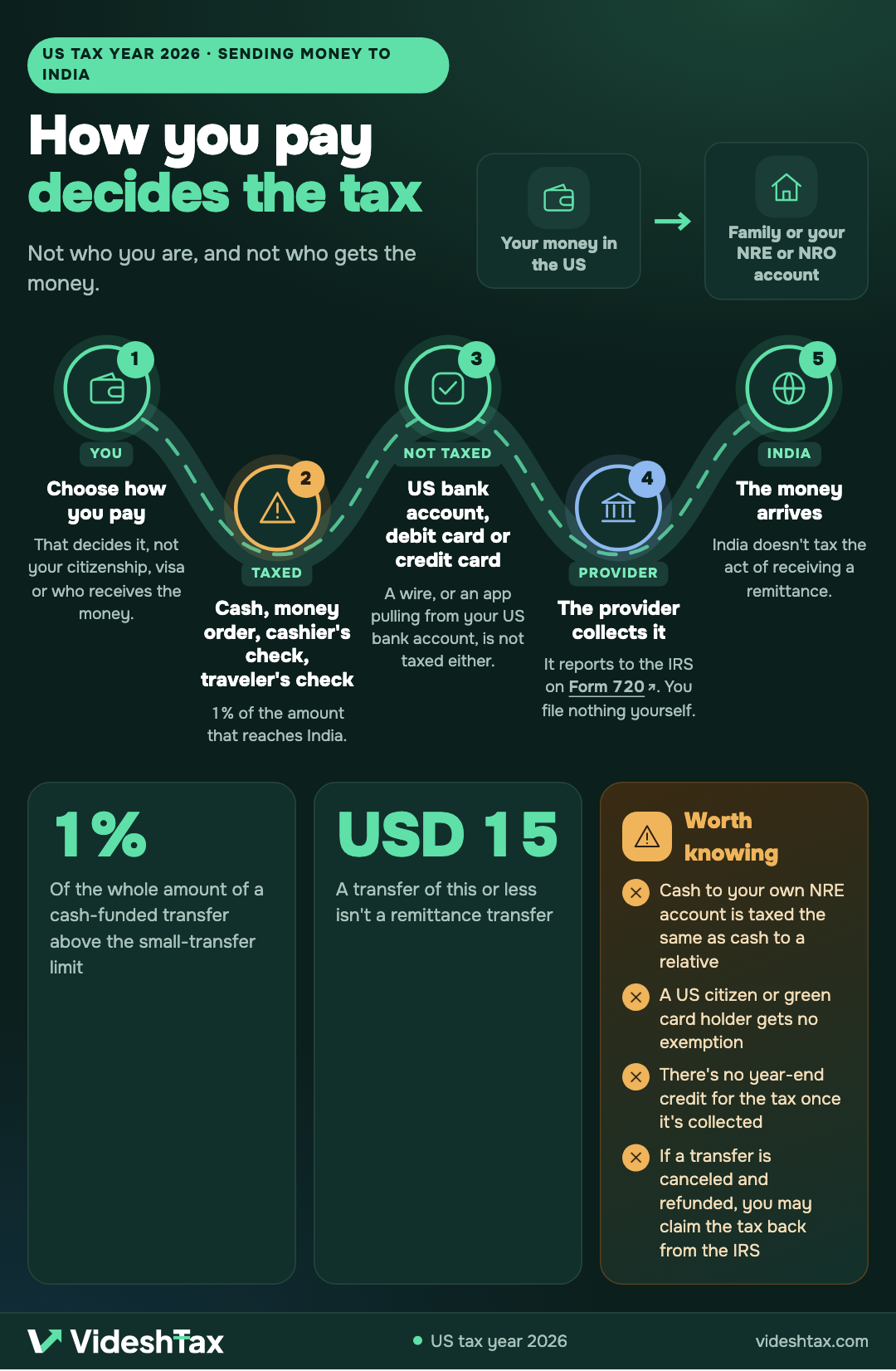
The short version: how you pay decides it
What decides whether this tax applies isn’t your citizenship, your visa, or whether you’re sending to your own account or to a relative’s. It’s the instrument you hand over to pay for the transfer. Cash, a money order, a cashier’s check or a traveler’s check: taxed. A wire from your US bank account, an app pulling money from that account, or a debit or credit card: not taxed — whatever bank or app processes it, and wherever the money ends up in India.
What the tax is
This is the federal excise tax on remittance transfers, 26 U.S.C. §4475, added by the 2025 tax law known as the One, Big, Beautiful Bill Act. The essentials:
- Rate: 1% of the amount that will reach the recipient in India, counting any bonus the provider adds. The provider’s fees and the tax itself aren’t counted in it.
- Who’s liable: the sender, by law.
- Who collects it: the remittance transfer provider — the bank, app or counter you use — which remits it to the IRS every quarter on Form 720. You don’t file anything yourself.
- From when: transfers made since January 1, 2026.
- Almost no minimum: a transfer of USD 15 or less isn’t a “remittance transfer” under the law, so it isn’t taxed. Above that, a cash-funded transfer is taxed on the whole amount, from the first dollar.
- No citizenship or immigration test: a US citizen, a green card holder and a visa holder sending the same amount in cash pay the identical rate. Nothing in the enacted law ties this to status.
- No credit for it: once collected, it isn’t a prepayment of anything else, and there’s no year-end credit for a transfer that goes through as planned. If a transfer is canceled or expires and the provider returns your money, you may be able to claim the tax back from the IRS.
The IRS has also spared providers deposit penalties while they get their systems right, as long as they deposit on time and pay any shortfall with their quarterly return. It first covered the first three quarters of 2026, and has since been extended until the final regulations take effect. That’s relief for the provider’s paperwork, not for what you owe.
Some of this rests on proposed regulations (REG-114499-25, April 2026), which the IRS says taxpayers may rely on until final rules are published, as long as they follow them consistently. None have been finalized as of this writing.
Which ways of sending money to India it hits
The tax follows the payment method, not the app or bank you use — many providers offer both a taxed and an untaxed way to fund the same transfer.
| How you pay | Taxed? | Why |
|---|---|---|
| Bank wire from a US account | No | Funded from an account at a bank, credit union or broker-dealer — excluded by law |
| App (Wise, Remitly, Xoom and similar) funded by pulling from your US bank account | No | Same exclusion — the app is only the provider; the funding source decides it |
| App funded with a debit card | No | Cards aren’t on the taxable list at all, whoever issued them |
| App or counter funded with a credit card | No | Same as a debit card |
| Personal check made out to the provider | No | Drawn on your bank account, so the account exclusion applies |
| Cash at a money-transfer counter | Yes | Cash is squarely the instrument the tax targets |
| Money order | Yes | Named in the statute alongside cash |
| Cashier’s check | Yes | Named in the statute alongside cash |
| Traveler’s check | Yes | Added by the proposed regulations as “similar” to a money order |
| Sending to your own NRE account instead of a relative’s | Depends only on how you pay | The tax never looks at who receives the money or which account it lands in |
| Sending to parents or other relatives | Depends only on how you pay | Same as above — the recipient is irrelevant to this tax |
A provider that cashes a check for you and then sends that cash still counts as paying in cash, even if you never touch the money: the proposed rules treat it as a cash-funded transfer.
Worked example: Sunita sends the same amount two ways
Paying cash at a counter. The counter takes her $2,000 in cash — a taxable instrument. The tax is 1% of the $2,000 her parents will receive: $20. Sunita pays $2,020 plus the counter’s own fee, if any. The counter collects the $20 for the money-transfer company, which reports it to the IRS on Form 720. Sunita files nothing.
Paying through an app linked to her checking account. She sends the same $2,000, but funds it by letting the app pull the money by ACH from her US bank account. That’s an excluded funding source, so no remittance tax applies at all — she pays $2,000, plus only the app’s own transfer fee, if any.
On the India side: receiving the money
India doesn’t tax the act of receiving a remittance at all. If the money is a gift from a relative, as the Act defines one (parents, children, siblings, a spouse, and some in-laws, uncles and aunts, but not cousins), it isn’t taxable income in India, however large it is. The Income-tax Act, 2025 charges money received without consideration in a tax year above ₹50,000, but excludes anything from a relative 2025 Act s. 92(2)(m), 92(3)was s. 56(2)(x). Sunita is her parents’ lineal descendant, so her gift is covered.
And if the money isn’t a gift at all — just Sunita’s own dollars moving into her own account — there’s nothing to tax on the Indian side either way: it was never anyone’s income in India.
Her parents, who live in India, simply receive it in their ordinary savings account. They can’t hold an NRE account, which is only for people living outside India. If Sunita sends to her own NRE account instead, that’s exactly what the account is for: money from abroad can be credited to it freely.
For how NRE, NRO and FCNR accounts differ in what each one can receive, see the guide to NRI bank accounts.
What it isn’t
Form 3520 is for a US person receiving a gift from abroad, for example from a parent in India who isn’t a US person — the reverse direction from this page. It only comes in once gifts from a foreign individual or related givers in a year pass USD 100,000, and even then it’s a report, not a tax on the gift itself. Sending money to India doesn’t touch it.
Neither is this the FBAR. That’s about the foreign accounts you hold — your own NRE, NRO or FCNR balances — once they pass USD 10,000 combined, not about the act of sending money into or out of them. See our FBAR and FATCA reporting for Indian accounts guide for that separate filing.
Common mistakes
- Assuming a wire or an app transfer is safe from the tax because “apps are different” — it’s the funding instrument that matters, not the app or bank’s name.
- Paying by cash to avoid an app’s fee, without weighing the remittance tax against what that fee would have been.
- Thinking a US citizen or green card holder gets any exemption or credit — the enacted law has none tied to citizenship or status.
- Confusing this tax with Form 3520 or the FBAR, which run in the opposite direction or cover something different entirely.
When to get a CPA
Get one if you send money to India regularly in cash and want to work out whether switching to a bank-funded transfer is worth it; if a provider charged you the tax and you’re not sure it applied correctly; if a transfer was canceled and you want to claim back the tax on it; or if you’re weighing this tax against the separate US gift-tax rules for a large one-off gift you’re making. A CPA or Enrolled Agent can also tell you whether the proposed regulations, which aren’t final yet, change anything for your situation.
Next steps
Questions people ask
Do I have to file or pay anything myself?
No filing, just the tax at the counter. The law makes you, the sender, liable for the tax, but your remittance transfer provider (the bank, app or money-transfer company you use, even if you pay at a shop acting for it) collects it when you pay and reports it to the IRS every quarter on Form 720. You never file a form for this yourself. If a provider fails to collect it, the law makes the provider pay it.
I'm sending cash to my own NRE account, not to a relative. Does that change anything?
No. Nothing in the law looks at who receives the money or what kind of account it lands in — only at how you funded the transfer. Cash is cash whether it's going to your own NRE account or to a relative's account; an app pulling the money from your US bank account is untaxed either way, for the same reason.
Does a US citizen or green card holder get any exemption?
No, not under the law as enacted. A US citizen, a green card holder and a nonimmigrant visa holder sending the same amount in cash all pay the identical 1%. The statute has no citizenship, nationality or immigration-status test in it at all — what decides the tax is where you are and how you pay, not who you are.
What if my transfer gets canceled after I've already paid?
If a remittance transfer is canceled or expires and the provider returns your money, you may be able to claim back the tax on it by filing a refund claim with the IRS. The provider can't refund the tax itself. There's no year-end credit or reconciliation for a transfer that goes through as planned.
Are the current rules final, and can providers and I rely on them?
The IRS has only published proposed regulations (REG-114499-25, April 2026) so far; none had been finalized as of this writing. The IRS says senders and providers may rely on the proposed regulations in the meantime, as long as they follow them consistently and in full — so a provider charging the tax the way these proposed rules describe is on solid ground even before they're made final.
Is there a minimum amount below which the tax doesn't apply?
Only a very small one. A transfer of USD 15 or less falls outside the law's definition of a remittance transfer, so it isn't taxed. Above that there's no threshold: a cash-funded transfer is taxed on its full amount, whether it's a modest sum to a friend or a large one to a parent.
Sources
- 26 U.S.C. §4475: excise tax on remittance transfers (rate, liability, collection, effective date, exceptions)uscode.house.gov
- IRS Notice 2025-55, 2025-43 I.R.B. 625 (20 Oct 2025): background on section 4475, and penalty relief for remittance transfer providersirs.gov
- IRS Notice 2026-52: extension of relief from penalty for failure to deposit remittance excise tax (until final regulations under section 4475 apply)irs.gov
- REG-114499-25, "Excise Tax on Remittance Transfers" (Federal Register, 13 Apr 2026): proposed regulations, including traveler's checks, the anti-avoidance rule, and reliance before finalizationfederalregister.gov
- IRS, Instructions for Form 720 (Rev. June 2026), Part I, IRS No. 155: the remittance transfer tax as a provider filingirs.gov
- 12 CFR 1005.30(e)(2)(i): transfers of $15 or less are not remittance transfers (CFPB Regulation E)consumerfinance.gov
- RBI FAQ: Accounts in India by Non-residents (16 Jan 2025): who can open an NRE accountrbi.org.in
- Income-tax Act, 2025, s. 92(2)(m), s. 92(3)(a) and s. 92(5)(g), as gazetted: money without consideration, the exclusion for a relative, and who counts as oneegazette.gov.in
Update log
- First version.